

 Series Introduction
In the first article of this series, we explored how Goal Trees and Systems Thinking can help semiconductor companies improve alignment and decision-making in New Product Introduction (NPI). Now, we turn our attention to managing knowledge work — a crucial aspect of NPI — using the TameFlow Kanban method. Knowledge work in NPI, such as design, firmware development, and validation, involves navigating unpredictable and complex tasks, making it difficult to track progress and manage bottlenecks effectively. In this article, we will show how TameFlow Kanban, integrated with the Theory of Constraints (TOC), can drive significant improvements in managing knowledge work.
This article is part of a series that applies TOC to different facets of NPI, including:
Strategic Alignment and Decision-Making using Goal (previous article)
Managing Knowledge Work with TameFlow Kanban (this article)
Project Management using Critical Chain Project Management (CCPM)

Disclaimer
The views, opinions, and insights expressed in this article series are my own and do not reflect the official policies or strategies of my employer, Marvell Technology Italia, srl. This content is provided for educational purposes based on personal experience and research. Any references to companies, products, or individuals are not endorsements.

Introduction: The Challenge of Managing Knowledge Work in NPI
Knowledge work is different from traditional manufacturing tasks. While production tasks are tangible and often repetitive, knowledge work involves unpredictable cycles of creative problem-solving and expertise. In the semiconductor industry, knowledge work is particularly challenging due to the rapid pace of innovation, complex dependencies, and the specialized skills required to execute tasks such as design, firmware development, and validation.
The Core Issues in Knowledge Work:
Intangibility of Work: Progress is harder to measure, and it is often unclear when tasks are close to completion.
High Wait Time: In knowledge work, the majority of time spent on a task is waiting—not active work.
Resource Constraints: Specialized knowledge and expertise are often bottlenecks that limit the throughput of work.
In semiconductor NPI, inefficiencies in managing knowledge work can lead to significant delays, missed market opportunities, and cost overruns. Addressing these challenges requires a robust approach to managing flow and prioritizing constraints.

Brief overview of Tameflow
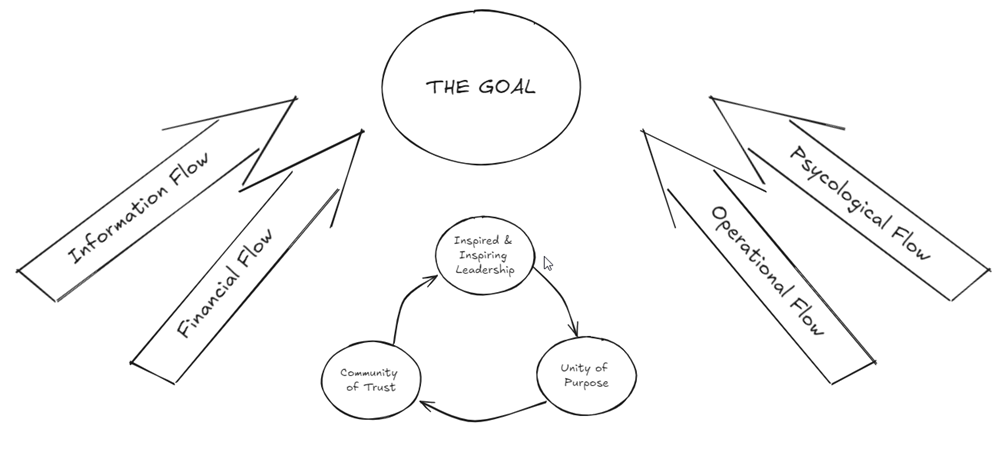
It must be noticed that Tameflow is a holistic approach to manage knowledge work, it focus on 3 main pillars:
1 Inspired Leadership
Leadership in TameFlow is not about motivating others, but about sharing deep insights that emerge from understanding the system’s constraints, problems, and solutions. Like Alex Rogo in The Goal, leaders are inspired by mental models and then share these insights with the team, aligning everyone’s enlightened self-interest toward system success.
2. Unity of Purpose
Unity of Purpose in TameFlow is more than goal alignment; it is rooted in the understanding that personal and organizational goals are interconnected. This fosters a deep sense of commitment, leading to unanimous decision-making, where each individual sees their self-interest in the success of the system.
3. Community of Trust
Trust underpins high-performance organizations. In TameFlow, trust is built through transparency and consistent results. When team members know their efforts are valued and aligned, collaboration and information sharing thrive.
The 3 pillars above creates the conditions for the organizational psychological flow and learning.
Tameflow specifically cares about improving 4 fundamental flows that support company perfomances:
1. Operational Flow: How Well Are We Delivering?
Operational flow in TameFlow refers to the conventional workflow—how work moves through the system. In semiconductor NPI, this means ensuring that every task, from design to validation, progresses smoothly and efficiently. TameFlow's unique approach to Kanban, with its emphasis on managing constraints and using tokens for work entry, optimizes this flow by ensuring that only fully-kitted, ready-to-execute tasks enter the system constraint.
2. Financial Flow: How Much Wealth Are We Creating?
While traditional approaches to NPI often emphasize cost reduction, TameFlow shifts the focus to financial throughput—the rate at which tasks generate value for the organization. This means that decisions are made not on cost alone but on how quickly and efficiently resources can be turned into profitable outcomes.
3. Informational Flow: How Well Are We Communicating?
The informational flow is the lifeblood of any organization. In semiconductor NPI, where tasks are complex and interdependent, clear communication is crucial. TameFlow enhances this flow by establishing effective communication patterns and ensuring that all necessary information is available when and where it is needed.
4. Psychological Flow: How Happy Are Our People?
Achieving a state of psychological flow—where individuals are fully engaged and satisfied with their work—is essential for high performance. TameFlow creates this environment by reducing unnecessary stress and distractions. For example, by ensuring that tasks are fully-kitted and ready to execute before entering the constraint, TameFlow reduces the cognitive load on team members, allowing them to focus on high-value work.
For the rest of the article we will focus specifically on the operational Flow, how tasks moves through the systems for a more general understanding of Tameflow is highly recommended to look in the Tameflow website or following the information of the bibliography.
Introducing TameFlow Kanban: A Systems Approach to Knowledge Work
TameFlow Kanban extends the traditional Kanban system by integrating TOC principles. Traditional Kanban helps teams visualize work, manage flow, and limit Work-In-Progress (WIP), but TameFlow Kanban goes further by managing knowledge work as part of a larger system, emphasizing throughput and constraint management.
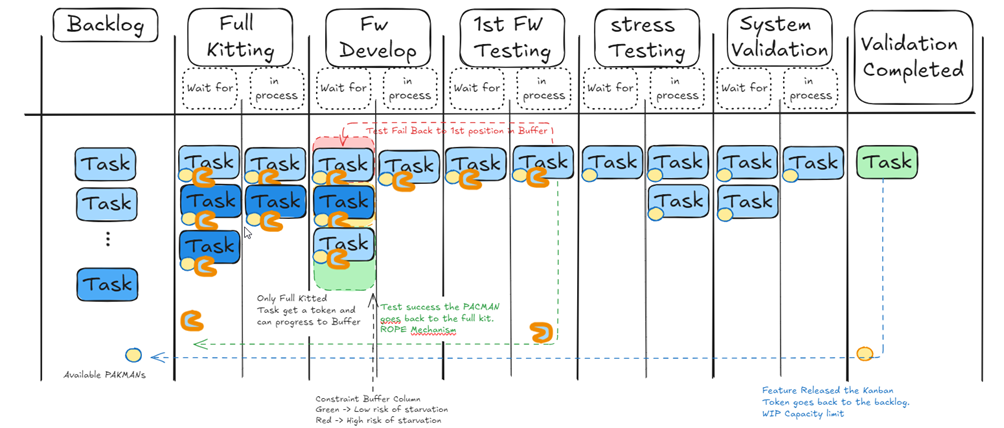
Key Concepts in TameFlow Kanban:
Kanban Tokens (Capacity Tokens): Capacity tokens limit the number of tasks that can be in process at the constraint. Each work item must have a capacity token to enter the system, ensuring that WIP is capped and the constraint is never overloaded. These tokens move through the system with the work item and are only released back to the entry pool once the item has exited the system.
Replenishment Tokens (Pacman Tokens): Replenishment tokens ensure the constraint remains fully utilized. Once the constraint consumes a work item, the replenishment token signals the system to bring in another task to keep the buffer ready for the constraint. This creates a 'pull' mechanism, ensuring a steady flow of work into the constraint.
Full Kitting: Before a task receives a token, it must be fully kitted—all necessary information, resources, and prerequisites must be available to ensure smooth progress once it reaches the constraint.
Buffering for Flow: A wait column is placed before all stages, essentially all columns are split in wait-for and in process. This allow to measure constantly wait time and touch time for all processes in the chain. A special emphasis is applied to the wait column immediately upstream of the constraint. This is the buffer column and its role is to protect the constraint. It must be reasonably full to avoid constraint starvation. Remember an hour lost at the constraint is an hour lost for the entire system.
Immediate Testing Post-Constraint: Once a task exits the constraint, it immediately moves to dedicated testing resources to ensure quality. This prevents late-stage issues and allows the task to re-enter the constraint quickly if problems are found.

Touch Time vs. Wait Time: Focusing on What Really Matters
In knowledge work, the bulk of delays occur during wait time, not touch time. While touch time (active work) typically represents only 5-10% of the total duration, the remaining 90-95% is often idle time, caused by resource constraints, information delays, or dependencies. Instead of trying to speed up touch time—which yields minimal gains—TameFlow Kanban focuses on reducing wait time. A 20% reduction in wait time can result in an 18% improvement in throughput, compared to just a 1% improvement from speeding up touch time.
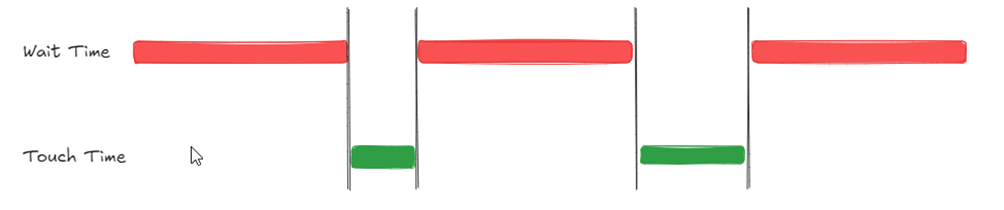
This is a crucial concept, instead of trying to have all the elements of the value chain improving to deliver faster we are actually thinking the system to allow the constraint to deliver sooner.
Managing Wait Time with TameFlow Kanban
TameFlow Kanban, with its focus on constraint management and flow, emphasizes the importance of reducing wait time over improving touch time. By visualizing bottlenecks and ensuring that tasks move through the system efficiently, TameFlow Kanban helps teams address the true root cause of delays.

Practical Implementation of TameFlow Kanban in Semiconductor NPI
Let’s break down how a semiconductor company might implement TameFlow Kanban to manage knowledge work in an NPI project.
Step 1: Designing the Kanban Board
· Create a Kanban board with key stages (e.g., Design, Review, FW Development, etc.), with FW Development as the constraint for this example.
· Split all process columns into Wait for and In Process to help visualize and measure touch and wait times.
· Designate the Wait for column before the constraint as the buffer to avoid constraint starvation.
Step 2: Implementing Full Kitting and Assigning Tokens
· Ensure all tasks are fully kitted before receiving both the capacity and replenishment tokens.
· Use capacity tokens to limit the number of tasks in process and replenishment tokens to keep the constraint buffer full.
Step 3: Implementing WIP Limits, Buffer Size, and Testing
· Set buffer size to maintain an optimal flow into the constraint.
· Use visual cues to track the status of tokens and ensure immediate testing after tasks exit the constraint.
Step 4: Tracking Touch Time vs. Wait Time
Monitor tasks as they progress through the system
Analyse which stages experience the most wait time and why. This could be due to lack of information, dependencies, or resource availability.
Monitor task age as what is moving too slowly may represent a potential issue or risk.
These changes can result in significant reductions in the overall lead time for firmware development, improved synchronization between teams, and higher overall throughput for the entire NPI process. The use of TameFlow Kanban helps not only to visualize and manage work better but also to focus on reducing wait times and managing constraints more effectively.
Notable Cases
These concepts have been applied in a leading automotive engineering company, where 4,000 engineers across 120 teams faced a monthly workload of 70,000 work orders. By applying TameFlow principles, they increased global throughput by 40%.

Conclusion and Final Thoughts
By adopting TameFlow Kanban, organizations can break free from traditional bottlenecks in knowledge work, creating systems that are not only efficient but also truly aligned with both individual and organizational goals. TameFlow can help companies manage knowledge work more effectively by focusing on flow, WIP limits, and wait time reduction. TameFlow Kanban creates a powerful framework to improve efficiency in the complex environment of semiconductor NPI, or any other knowledge intensive NPI process.
Key Takeaways:
Focus on wait time, not just touch time, to achieve significant throughput gains, with reduced investment.
Use Replenishment and WIP limit tokens to control the flow of work, ensuring that the constraint is always maximized.
Apply full kitting to ensure work items are fully prepared before entering the system constraint, avoiding unnecessary interruptions.
Ensure immediate testing after the constraint to catch issues early and allow rapid reentry into the system constraint if necessary. Reduce as much as possible the latency of the initial feedback cycle.
Create a buffer to protect the constraint from running out of work, balancing the system’s flow.
Implement visual management to make bottlenecks and progress transparent across teams.

Looking Ahead:
In the next article, we will explore Optimizing the Supply Chain with TOC Logistical Tools, diving deeper into how TOC can streamline procurement, production, and distribution in semiconductor NPI.

Call to Action
How does your team handle knowledge work bottlenecks? Do you focus on touch time or wait time? How do you manage constraints in your processes? Share your thoughts and experiences in the comments below!

Enjoyed the content?
If you found this article useful, consider supporting my work with a coffee or exploring the downloadable examples available on my Buy Me a Coffee page. Your support helps keep the motivation high and fuels more hands-on content!

Bibliography
Tendon, Steve. Standing on Bits: Agile Software Engineering Management at Scale with the Theory of Constraints.
Tendon, Steve. Hyper-Productive Knowledge Work Performance: The TameFlow Approach and Its Application to Scrum and Kanban
Tendon, Steve. The Book of TameFlow: Theory of Constraints Applied to Knowledge-Work Management
Dettmer, H. William. The Logical Thinking Process: A Systems Approach to Complex Problem Solving
Goldratt, Eliyahu M. The Goal: A Process of Ongoing Improvement.
Goldratt, Eliyahu M. Critical Chain.
Additional Resources
TameFlow Consulting. "TameFlow Approach to Performance."
Overview of the TameFlow approach, including the Four Flows and Three Transformative Forces. Available at: TameFlow Consulting.