

Series Introduction
In this series, we’ve explored how TOC tools like Goal Trees, TameFlow Kanban, Supply Chain Management, and CCPM streamline semiconductor NPI. This final article ties it all together, showcasing how Goal Trees evolve from strategy tools to dynamic dashboards for real-time focus and action. In this final article we go back to Goal Tree showing how can be used not just as a strategy communication tool but also as monitor and discussion tool during the lifecycle of the project to focus management and team attention where matter the most.
This article is the final part of a series applying the Theory of Constraints (TOC) to various facets of NPI, including:
Project Management using Critical Chain Project Management (CCPM)
Holistic NPI Management leveraging TOC principles (this article)

Disclaimer
The views, opinions, and insights expressed in this series are my own and do not reflect the official policies or strategies of my employer, Marvell Technology Italia, srl. This content is provided for educational purposes, based on personal experience and research. Any references to companies, products, or individuals are included for illustrative purposes only and do not constitute endorsements.

Introduction
In managing semiconductor New Product Introduction (NPI), trying to control everything leads to confusion and inefficiency. Success hinges on identifying and managing the constraints of the system—the vital few elements that dictate the overall performance— and communicate clearly where they are and how the rest of the system must protect them. The Theory of Constraints (TOC) offers a unified framework to focus management and teams attention, protect the constraints, and maximize throughput.
This final article synthesizes how TOC tools—Goal Trees, TameFlow Kanban, Supply Chain Management, and Critical Chain Project Management (CCPM)—work together to align teams, streamline workflows, and achieve NPI success.
The TOC Manager: Master of Buffers, Not Constraints
A true TOC manager doesn't directly manage the constraint—they protect it. The constraint itself should always operate at full capacity. Instead, management action focuses on:
Buffers that shield the constraint from variability.
Subordinate everything to the constraint. Ensuring that everything the constraint needs is ready and available.
Key Principle: Protect and Optimize the Constraint
Why Constraints Matter
The constraint determines the system’s throughput—it sets the pace for everything else. If the constraint is starved of resources, overloaded with tasks, or exposed to excessive variability, the entire system suffers.
A poorly managed constraint creates instability, missed deadlines, and inefficiencies across the system. Conversely, when the constraint is protected and its flow stabilized, the system operates at its full potential.
How to Protect the Constraint
Buffers are the primary tools to shield constraints from variability:
Time Buffers in projects absorb delays, ensuring critical tasks are not disrupted by upstream issues.
Inventory Buffers in supply chains prevent shortages, maintaining consistent inputs for production.
Backlogs and Kanban Tokens in knowledge workflows limit work-in-progress, reducing uncertainty and smoothing work flow.
Throughput Accounting: Aligning Flow with Cash
The Core Idea
Throughput Accounting shifts the focus from traditional cost accounting to prioritizing decisions that generate the most cash for the system. The constraint’s flow of work should mirror the flow of value, ensuring that:
The constraint works only on high-priority tasks that maximize throughput.
Non-value-adding work at the constraint is minimized, and the constraint is never starved nor blogged by irrelevant tasks.
Decision-Making with TA
A clear decision-making system based on TA can stabilize the entire system by:
Focusing on Cash Flow: Decisions are guided by throughput (cash generated), inventory (money tied up in work), and operating expenses (money spent to maintain the system).
Prioritizing High-Impact Work: TA helps managers choose what work should flow through the constraint, avoiding disruptions caused by subjective or siloed decisions.
Avoiding Cost-Centric Thinking: Instead of cutting costs indiscriminately, TA emphasizes increasing throughput as the key to financial stability.
Adopting the TOC Mindset
The right mental model is to accept that a constraint MUST exist. Instead of trying to eliminate it, TOC managers must:
Find or Define the Constraint: Identify the critical element that limits the system’s performance or engineer it as the central point of focus.
Stabilize its Flow: Use buffers to manage variability and ensure the constraint operates at 100% capacity without interruption. Where relevant use DBR or similar mechanism, triggering inflow of work at the right pace.
Prioritize Work Based on Throughput Accounting: Align the flow of work at the constraint with cash generation to ensure system stability and profitability.
Empower the System to Self-Regulate: Shift from controlling every detail to creating structures (Goal Trees, Kanban workflows, CCPM buffers) that allow the system to dynamically respond to challenges.
Overcoming the “Hammering the Constraint” Mental Model

The traditional approach often treats the constraint as a problem to fix by "hammering at it" until it meets top-down expectations. This approach destabilizes the system, leading to:
Overburdened teams or resources.
A self-fulfilling prophecy of micromanagement and constant firefighting.
A false belief that every part of the system must be equally optimized.
Trust and Systems Thinking
TOC requires trust in the thinking tools and the teams implementing them.
A successful TOC manager understands that people are good and seeks to align team efforts around the system’s goals, rather than micromanaging tasks.
By focusing on systems thinking, managers enable the constraint to drive the system’s success without constant intervention.
The Core Realization
Constraints are not problems to fix—they are the system’s central enablers. By protecting and stabilizing the constraint, managers can unlock the full potential of the entire system. This approach shifts the focus from trying to force outcomes to building a resilient, self-sustaining system.
TOC Tools for NPI: A Holistic Approach
1. Strategic Focus with Goal Trees
Purpose: Goal Trees identify the vital few focus areas.
Application: Align teams around the system constraint. For NPI, this often means prioritizing the launch date and ensuring smooth chip validation processes.
Output: A shared understanding of what matters most.
2. Visualizing and Managing Knowledge Flow with TameFlow Kanban
Purpose: Materialize knowledge work and track its flow through the system.
Application: Use Kanban tokens and cards to limit work-in-progress, ensuring knowledge work constraint is not starved nor subjected to excess variability.
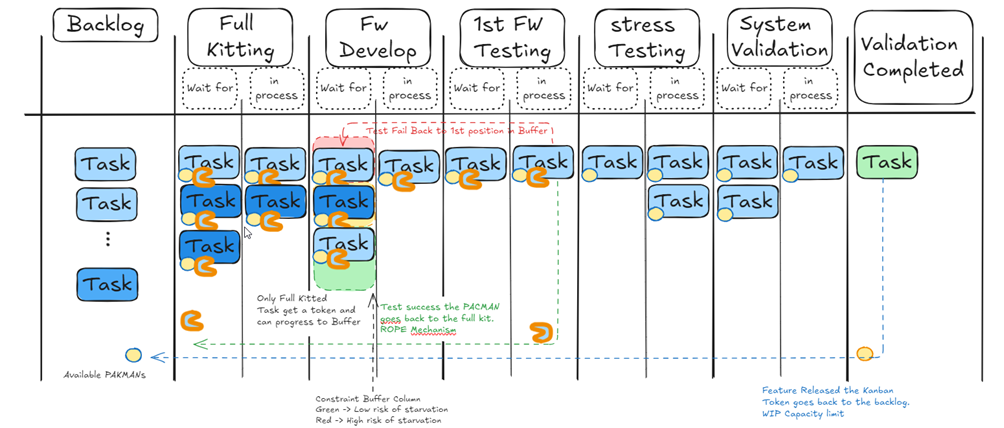
Output: Measurable improvements in throughput and flow stability.
3. Supply Chain Readiness
Purpose: Prepare hardware components to ensure the chip becomes the system’s constraint—not delayed equipment or parts.
Application: Centralized logistics and buffer management minimize delays in critical components like test setups or RF couplers.
Output: Components are always available when needed.
4. Delivering Projects on Time with CCPM
Purpose: Focus on buffer health instead of task completion to prioritize actions.
Application: CCPM provides clear indicators of where to intervene in NPI projects to ensure on-time delivery.
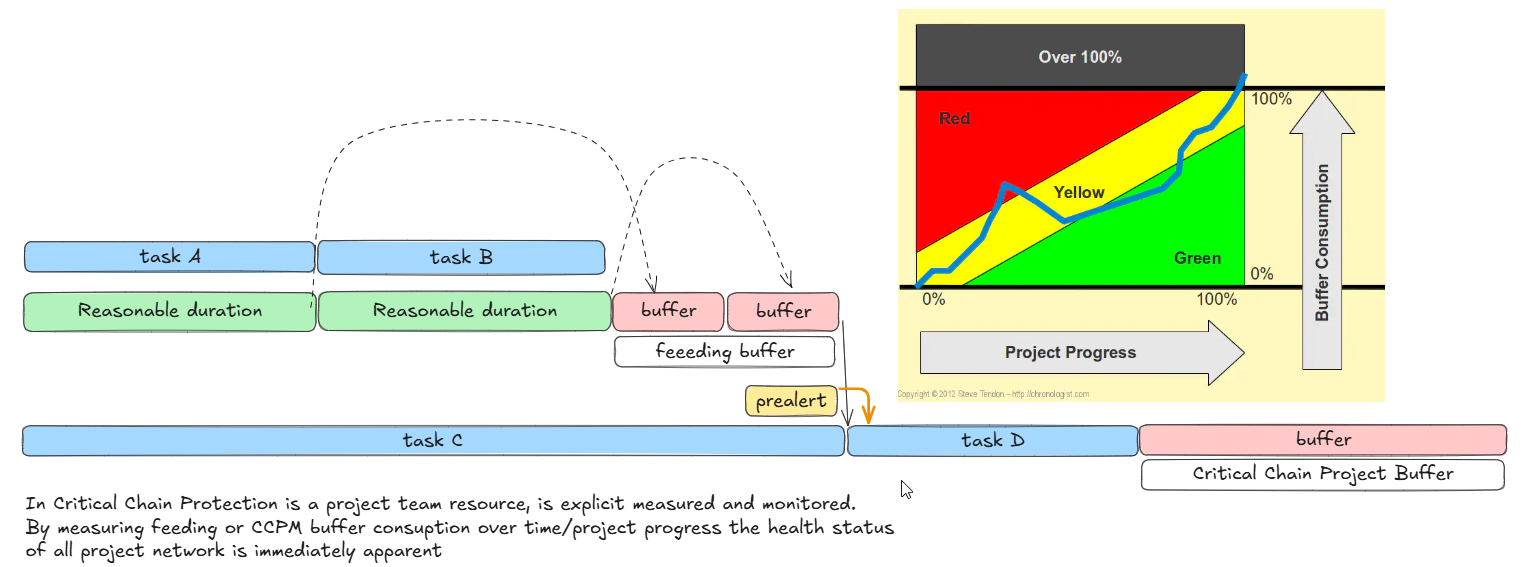
Output: Simplified communication and reduced project uncertainty.
The Manager’s Dashboard: The Goal Tree as a Monitoring Tool
Every insight from TOC tools feeds back into the Goal Tree:
Each leaf of the tree should be "green" ideally. But if it is not is a signal
Red: Immediate action required to address risks.
Yellow: Monitor closely and be proactive in to avoid worsening.
Green: On track—no action needed.
This integration ensures real-time visibility into the system’s health both by managers and teams and focuses people actions on what truly matters.
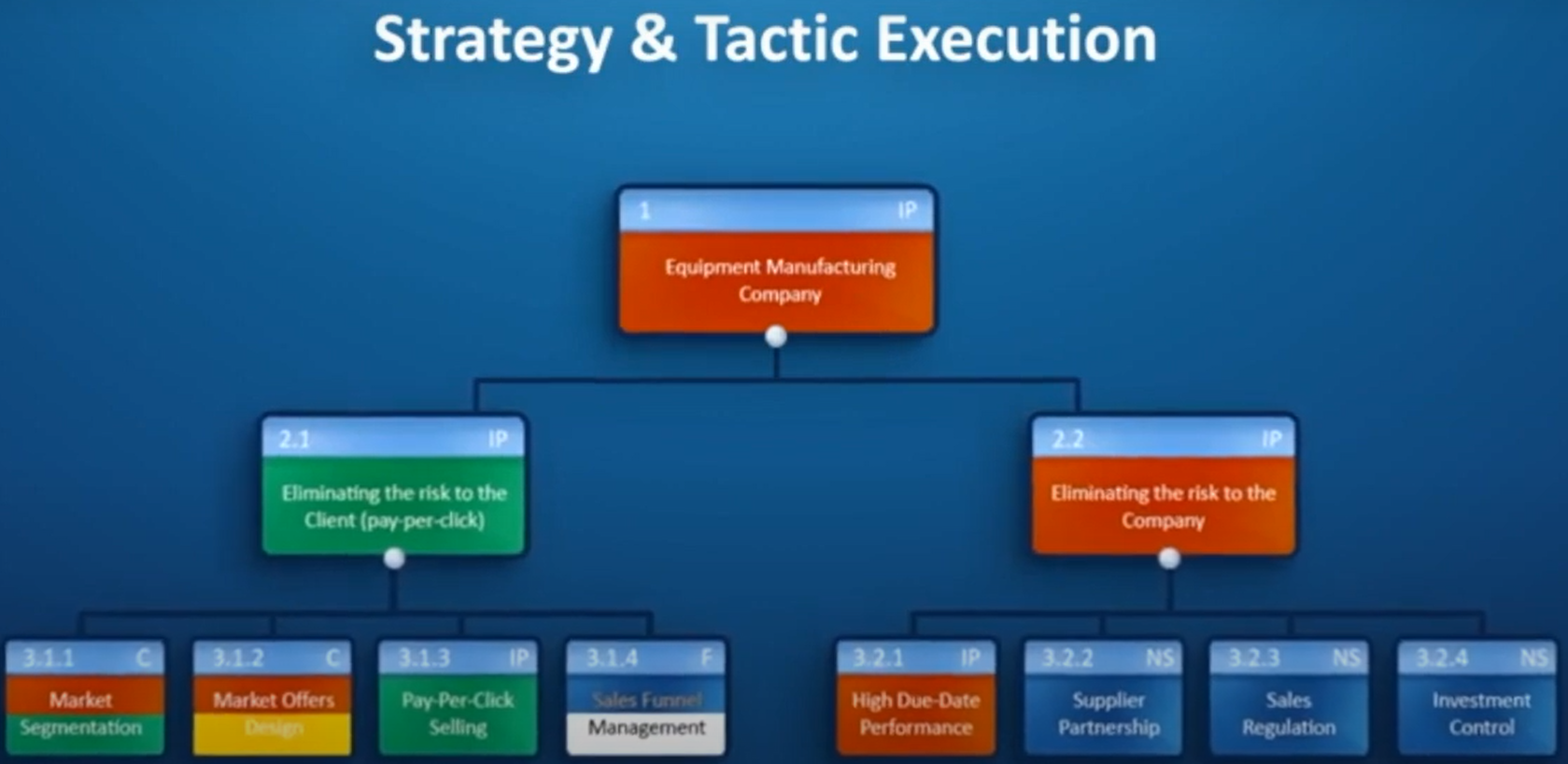
(Courtesy of https://goldrattresearchlabs.com/ video here)
Technology-Enablers: Tools for TOC Management
For managers ready to embrace TOC principles, tools like Harmony, A-Dato, and Epicflow simplify implementation:
Integration of Real-Time Data with Goal Trees: Harmony combines real-time project and resource data with Goal Trees, providing managers with instant visibility into risks and opportunities. This integration enables proactive decision-making, ensuring that constraints are effectively managed throughout the NPI process
(https://goldrattresearchlabs.com/)Comprehensive Project & Portfolio Management: LYNX is a flow-based solution that integrates Critical Chain Project Management (CCPM), TOC, Agile, and Kanban methodologies.
It offers features like automatic buffer creation and flexible scheduling parameters, allowing managers to identify resource bottlenecks and make informed trade-offs between resources, costs, and speed
(https://www.a-dato.com/)AI-Driven Multi-Project Resource Management: Epicflow utilizes AI-based predictions to manage multiple projects simultaneously. It offers features like automatic cross-project task prioritization and resource workload balancing, enabling managers to deliver more projects with available resources.
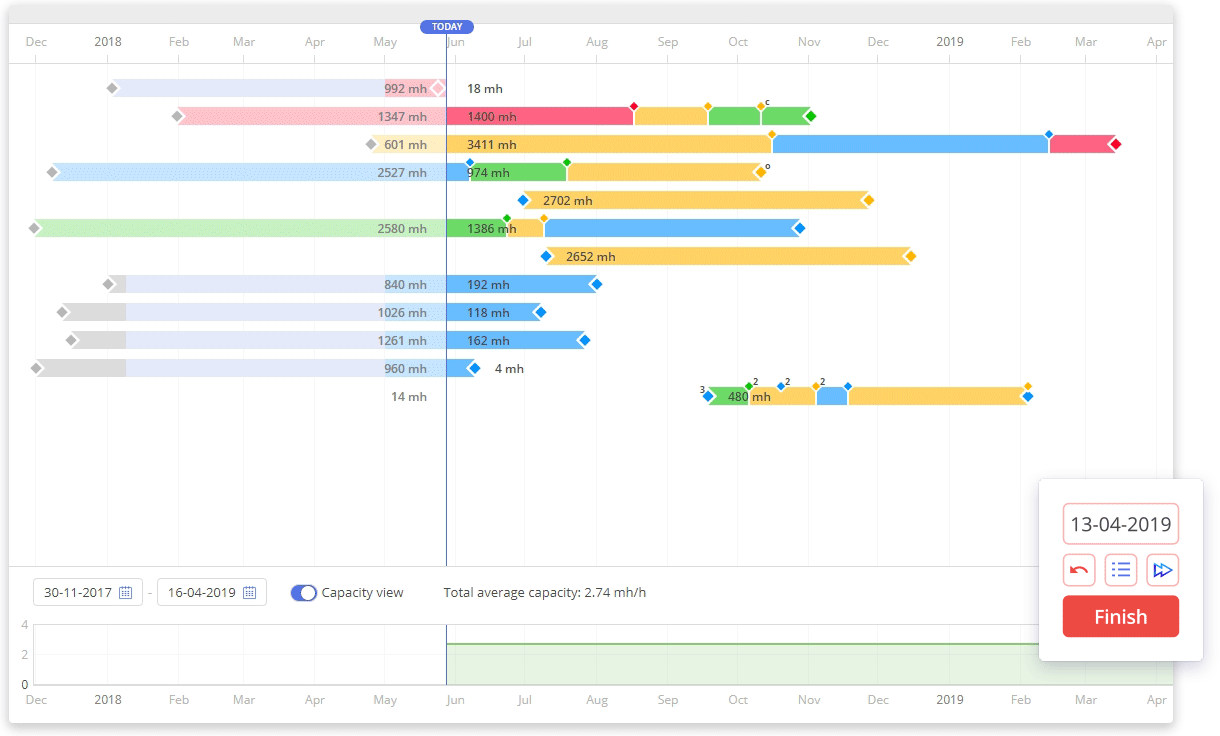 Its real-time dashboards provide insights into project performance, progress, task statuses, and potential risks, facilitating informed decision-making in complex NPI environments.Epicflow visualizes workflows, buffer consumption, and bottlenecks.
(https://www.epicflow.com/)
These tools enable managers to:
Shift focus from completing tasks aimlessly to flow through the constraint.
Simplify communication by highlighting only critical risks, where contingency buffers are at minimum, or already burned out.
Identify opportunities to streamline and adapt project portfolios in realtime.
Achieve significant performance improvements by aligning teams around the few constraints.
Conclusion: The Vital Few for NPI Success
Managing NPI through TOC means focusing on the vital few while protecting the constraint:
TOC shifts management from firefighting to proactive planning, enabling teams to focus on what matters most: maximizing the flow through the constraint and protecting it from disruptions.
Tools that consolidate insights based on TOC principles into actionable dashboards for the whole team of teams.
When managers adopt TOC principles, they create systems that are resilient, focused, and highly effective. The result is faster time-to-market, improved throughput, and a culture of collaboration.
Call to Action: Ready to revolutionize your NPI management?
Read the GOAL and explore tools like Harmony or A-Dato or Epicflow and start implementing TOC principles today.
Enjoyed the content?
If you found this article useful, consider supporting my work with a coffee or exploring the downloadable examples available on my Buy Me a Coffee page. Your support helps keep the motivation high and fuels more hands-on content!

Bibliography
Books by Eliyahu M. Goldratt:
The Goal: A Process of Ongoing Improvement
North River Press, 1984.
A foundational work introducing the Theory of Constraints (TOC), focusing on identifying and managing system constraints to improve throughput.Critical Chain
North River Press, 1997.
Explores Critical Chain Project Management (CCPM) and its application to project planning and execution.Isn’t It Obvious?
North River Press, 2009.
A TOC-based novel that applies the principles of buffer management and inventory optimization in supply chains.The Haystack Syndrome: Sifting Information Out of the Data Ocean
North River Press, 1990.
Focuses on the importance of actionable information and throughput-based decision-making.
TOC and Project Management:
Dettmer, H. William.
The Logical Thinking Process: A Systems Approach to Complex Problem Solving.
ASQ Quality Press, 2007.
A detailed guide to TOC’s logical thinking tools, valuable for understanding Goal Trees and strategic alignment.
TOC and Manufacturing:
Schragenheim, Eli, and Henry Fitzhugh Camp.
Manufacturing at Warp Speed: Optimizing Supply Chain Financial Performance.
CRC Press, 2000.
A practical guide to TOC’s application in manufacturing, emphasizing buffer management and throughput improvement.
Articles and Case Studies:
Marris Consulting.
"TOC in Practice: Applications in Industrial Projects"
PMI Luxembourg Conference Presentation, 2024.
An exploration of real-world applications of TOC tools like CCPM and Goal Trees in complex projects.
Software and Tools:
Harmony by Goldratt Research Labs.
Website: https://goldrattresearchlabs.com/
Provides insights into Goal Tree integration and real-time project monitoring.LYNX by A-Dato.
Website: https://www.a-dato.com/
Offers tools for CCPM, Agile, and Kanban integration with TOC principles.Epicflow.
Website: https://www.epicflow.com/
Specializes in multi-project resource management using TOC principles.
Online Resources:
Theory of Constraints International Certification Organization (TOCICO).
Website: https://www.tocico.org/
A hub for TOC learning, certification, and case studies.The Systems Thinker.
Website: https://thesystemsthinker.com/
Resources on systems thinking and its applications in TOC and Goal Trees.
Additional Resources on Throughput Accounting:
Goldratt, Eliyahu M.
The Race.
North River Press, 1986.
Explores the connection between throughput, operating expenses, and inventory.International Journal of Production Research.
"Adopting Throughput Accounting for Effective Decision-Making in Manufacturing Systems."
2023.