

An Examination of the UN CERD Findings on Racial Discrimination in Aotearoa
Introduction: A Defining Moment
In December 2025, the United Nations Committee on the Elimination of Racial Discrimination (CERD) issued its most critical review of New Zealand to date. The committee, composed of independent human rights experts from around the world, examined New Zealand's compliance with the International Convention on the Elimination of All Forms of Racial Discrimination, a legally binding treaty New Zealand signed in 1972.
What they found was not a nation progressing toward racial equality, but one actively moving backwards.
This paper presents the findings of that report, examines the New Zealand government's response, particularly the dismissive remarks of Deputy Prime Minister David Seymour, and argues that the government's reaction reveals more about its own failings than it does about the UN's credibility.

Part One: What CERD Found
The committee's concluding observations, published on 5 December 2025 after hearings in Geneva, raised grave concerns across multiple areas of government policy affecting Māori.
1. A Systematic Regression on Māori Rights
Unlike the 2017 review, which acknowledged progress, this report found virtually no positive steps on Māori rights or racial equity. Lady Tureiti Moxon, who presented a formal complaint to the committee, described it as "unprecedented in both its length and its language".
The committee observed that in several respects, New Zealand is going backwards in its implementation of the Convention, "particularly by winding back of measures designed to ensure substantive equality and give effect to Te Tiriti o Waitangi".
2. Concerns Over Specific Government Policies
The committee raised alarm over multiple specific policies:
The disestablishment of Te Aka Whai Ora (the Māori Health Authority) and budget cuts to Māori health services, which "may seriously risk weakening the legal, institutional and policy framework" for upholding rights
The removal of section 7AA from Oranga Tamariki legislation
The introduction of military-style "boot camps" for young offenders
Moves to minimise the role of the Treaty of Waitangi in education and governance, which could "risk entrenching historical, structural, and systemic discrimination against Māori"
Amendments to the Marine and Coastal Area (Takutai Moana) Act (2025) and the Fast-Track Approvals Act (2024)
3. Land Rights and Redress
The committee expressed serious concern about Māori land rights. To date, only a small fraction of land, resources, and territories have been returned, with redress often limited to symbolic measures like apologies or monetary compensation. Māori participation in decisions affecting their traditional lands and resources is often limited, with insufficient opportunities for meaningful engagement or free, prior, and informed consent.
4. Hate Speech and Political Rhetoric
The committee expressed "grave concern" about "the persistence of racist hate speech by some politicians and public figures". It called for unequivocal condemnation and effective accountability measures. Despite most reported hate-motivated offences targeting a person's ethnicity, hate motivation is rarely invoked as an aggravating factor in prosecutions and sentencing.
The committee also noted the "misrepresentation of affirmative action to address structural discrimination as 'racial privilege' and 'at odds with universal human rights' by some political and public figures".
5. Political Expression and Scrutiny
The report warned that Māori political expression in parliament was "disproportionately scrutinised and sanctioned". This followed the unprecedented three-week suspension of three Te Pāti Māori MPs for performing a haka during the reading of the Treaty Principles Bill.
6. Constitutional Concerns
CERD expressed concern that recent initiatives to reinterpret the Treaty and its established principles have been made "without ensuring free, prior, and informed consent or meaningful engagement of Māori". The committee called on New Zealand to uphold its commitment to Te Tiriti o Waitangi and to take measures to counter misinformation and divisive narratives regarding the Treaty.
Part Two: The Government's Response, Dismissal and Deflection
The government's reaction to the CERD findings was not to engage with the substance of the concerns, but to dismiss the body that raised them.
David Seymour: "The UN is a joke"
Deputy Prime Minister and ACT Party leader David Seymour called the findings "absolutely laughable" and said the United Nations was "a joke".
His reasoning was telling. He argued that the UN cannot be taken seriously because it "puts people from Zimbabwe in charge of the environment, people from Middle Eastern countries who have no regard for women's rights go on the human rights council".
This is not an argument. It is an ad hominem attack, dismissing the message by insulting the messenger. The credibility of a committee's findings does not rest on where its members come from. It rests on the evidence presented and the legal framework they are applying. New Zealand signed the Convention. It agreed to be held accountable. Dismissing the body that holds it accountable is not a defence; it is an admission that the government has no substantive answer to the charges.
Seymour also claimed that "New Zealand has a really great record on race relations, there are not many countries that should lecture New Zealand on race relations". He said he was "pretty much" closed off to the idea of any external party reviewing New Zealand's race relations.
But this is precisely the point. A nation that believes it has nothing to learn from the world, that refuses to be scrutinised, is a nation that has stopped growing. The question is not whether other countries are worse. The question is whether New Zealand is living up to its own obligations and its own founding document.
Shane Jones: "A Pettifogging Committee"
NZ First Minister Shane Jones made similar comments, calling the UN working group a "pettifogging committee" consisting of members from countries "with far worse race relations problems than New Zealand".
Paul Goldsmith: Diplomatic Disagreement
Treaty Negotiations Minister Paul Goldsmith was more diplomatic, stating: "We always take any United Nations' report seriously, we respectfully disagree with those conclusions; we have no doubt that this Government has been working very hard to improve outcomes for Māori".
But "working hard" is not the same as working effectively. And when the international body charged with monitoring racial discrimination says you are moving backwards, "working hard" is not an adequate response.
Part Three: The Pattern Behind the Response
The government's dismissal of the UN findings is not an isolated incident. It reflects a deeper pattern, one that has been observed by Māori leaders, human rights advocates, and now the international community.
Inverting the Language of Racism
Māori leaders who presented shadow reports to the UN highlighted how the government has "inverted the language of racism". Tina Ngata of the National Iwi Chairs Forum told the committee that "David Seymour in a number of his submissions and in public communications has called treaty policies or treaty clauses forms of racism".
This is a profound act of distortion. Policies designed to address historical and structural discrimination are not racist. They are remedial. Calling them racist is not a legitimate argument, it is a rhetorical weapon designed to shut down debate and protect the status quo.
As one observer noted, "the government, particularly David Seymour, Winston Peters, obviously Christopher Luxon, have taken the language of racism and anti-racism, flipped it on its head, inverted it, and then weaponised it against the very groups that it is intended to protect".
The Crown's Pattern of Bad Faith
This brings us to the deeper pattern that the UN report has exposed.
The Crown has a long history of making agreements in good faith, or appearing to, and then failing to honour them. Te Tiriti o Waitangi was signed in 1840. The rangatira who signed it believed they were entering into a partnership. They believed the Crown would police its own people, who were committing crimes against Māori with impunity. They believed in the rule of law. They extended trust and respect to the Crown.
The Crown took that trust and used it against them.
The same pattern repeats today. The Crown makes commitments, to the UN, to the Waitangi Tribunal, to Māori, and then ignores them when they become inconvenient. The government dismisses international criticism as "laughable." It dismisses the Waitangi Tribunal as "activist." It rolls back Treaty clauses from legislation. It disestablishes the Māori Health Authority. It removes section 7AA from Oranga Tamariki.
And then it tells Māori to "move on."
The Self-Righteousness of Denial
Why is the government so quick to dismiss the UN? Because the truth is uncomfortable. The self-righteousness that many New Zealanders display, the belief that this country is a beacon of racial harmony, a model for the world, depends on ignoring the evidence.
The UN report threatens that self-image. So rather than engage with it, the government attacks the source. It dismisses the UN as a "joke." It suggests that only countries with perfect records have the right to speak.
But this is not how accountability works. New Zealand signed the Convention. New Zealand agreed to be reviewed. New Zealand cannot pick and choose which international obligations it honours.
Part Four: The Arguments That Must Be Made
The UN report has given voice to arguments that have been made by Māori and their allies for generations. These arguments deserve to be heard, not dismissed, not deflected, not buried.
1. The Treaty Was Not a Surrender
The Māori text of Te Tiriti o Waitangi does not cede sovereignty. It grants kawanatanga (governance) to the Crown while the rangatira retained their rangatiratanga (chiefly authority). The Crown's own legal system has been forced to confront this, but has never adequately resolved it. The difference between "sovereignty" and kawanatanga is not a translation error, it is a fundamental constitutional discrepancy that has never been resolved in Māori favour.
2. Māori Had Sophisticated Governance Before the Crown Arrived
Fifty-two rangatira signed Te Tiriti. That means 52 tribes were in communication, close enough to discuss treaty and politics, and capable of reaching a collective agreement. This is not the mark of a "savage" people who knew nothing of governance. It is the mark of a sophisticated political order with established systems of law, diplomacy, and collective decision-making.
Māori society had:
Whakapapa (genealogy) as a legal and political framework
Rangatiratanga, chiefly authority that was relational, requiring consensus and the consent of the people
Marae and hui as established forums for debate and decision-making
Complex trade networks connecting tribes across the country
A system of reciprocity (utu) that governed relationships
Women held real authority in this system. They were involved in decision-making around resource management, warfare, and tribal welfare. They served as tohunga (experts) and held spiritual authority. They had control over their own property and bodies. This was radically different from the English legal system at the time, which subsumed women's rights under their husbands.
The colonial erasure of women's authority was deliberate, a systematic effort to impose European gender roles and undermine Māori social structures.
3. The Crown Took the Goodness in a People and Used It Against Them
This is the greatest crime of all. Māori extended trust and respect to the Crown in good faith, believing in the ideals the Crown presented. The Crown took that trust and weaponized it against them. It used the Treaty to steal land, sovereignty, children, language, culture, and dignity. It took the best of Māori, their willingness to engage diplomatically, their respect for law, their openness to partnership, and used it as a vulnerability to exploit.
The pattern continues today. Māori are still expected to trust the process, settlements, consultations, partnerships. The Crown still uses the language of partnership while undermining Māori authority. And when Māori call out the betrayal, they are dismissed as angry, radical, or unreasonable.
4. "Voting for the Crown Is Voting for Racism"
This is a powerful statement, and it reflects a legitimate frustration. The Crown has shown, time and again, that it cannot be trusted to honour its agreements. The current government's response to the UN and the Waitangi Tribunal confirms this. It has no interest in accountability. It has no interest in partnership. It has no interest in justice.
The question for voters is whether the political system can be leveraged to force change, or whether the system itself is so broken that it must be fundamentally transformed. That is a strategic debate. But the moral judgment is clear: the Crown has failed, and it continues to fail.
5. The UN Report Matters, Even If the Government Ignores It
The government may dismiss the UN. The media may downplay it. But the report exists. It is a formal, documented judgment that New Zealand is moving backwards on racial equality. It is a record that cannot be erased.
The goal of this paper is awareness. New Zealanders need to know that the world does not see them the way they think they do. The self-image of a fair, tolerant, egalitarian nation is not matched by the reality. The UN has said so. The Waitangi Tribunal has said so. Māori have been saying so for generations.
The Treaty Question: A Simple Matter of Keeping a Promise
An Addendum to the UN CERD Analysis
The Core Argument
The New Zealand government wants to frame the debate around Te Tiriti o Waitangi as a question of policy, progress, or practicality. But it is none of those things.
It is a question of whether you keep your word or you don't.
The Crown made an agreement in 1840. That agreement was:
Signed by 52 rangatira
Based on the Māori text, which promised kawanatanga (governance) in exchange for retaining rangatiratanga (chiefly authority)
A partnership, not a surrender
A promise to protect Māori in exchange for their trust
The Crown has not kept that promise. It has systematically violated every principle of that agreement. It has:
Taken land that was never ceded
Imposed laws that disregarded Māori authority
Suppressed the Māori language
Dispossessed Māori of their resources
And now, in 2025-2026, actively rolled back even the small acknowledgments of its wrongdoing
There is no angle. There is no nuance. There is only: did you keep your word, or did you break it?
The Government's Deflection Is an Admission
When the UN CERD issued its findings, the government did not respond by saying, "We will honour our obligations." It responded by:
Attacking the UN as a "joke"
Attacking the members as coming from countries with worse records
Dismissing the findings as "laughable"
Claiming New Zealand has a "really great record" on race relations
But none of this addresses the question: Did you keep your word?
If you made a promise and broke it, it does not matter whether you are trying "hard" now. It does not matter whether other countries are worse. It does not matter whether you think the people holding you accountable are credible.
The only question is: did you keep your word or not?
The government's refusal to engage with this question, its deflection, its attacks on the messenger, its self-righteous claims of being a "good international citizen", is itself an admission. If the government could defend its record on the merits, it would. It cannot, so it attacks the source.
What the Treaty Actually Says vs. What the Crown Claims
The government wants New Zealanders to believe that the Treaty is a matter of interpretation. That Māori and the Crown have different "perspectives." That the Treaty "principles" are open to redefinition.
But the Treaty is not a vague document. It is a specific agreement. And the Crown's interpretation has always been self-serving.

The Crown signed the Māori text. It explained the Māori text to the rangatira. It promised partnership, protection, and the policing of its own people, who were committing crimes against Māori with impunity.
The Crown then immediately ignored what it had signed.
The rangatira did not sign a surrender. They signed a partnership. The Crown chose to treat it as a surrender. That is not a "different perspective." That is bad faith.
The Current Government's Actions Are a Direct Breach
The government's current policies are not "reforms" or "improvements." They are direct breaches of the Treaty's principles:
Disestablishing Te Aka Whai Ora (Māori Health Authority), a breach of the duty to protect Māori health and wellbeing
Removing section 7AA from Oranga Tamariki, a breach of the duty to protect Māori children
Minimising the Treaty in education and governance, a breach of the duty to educate and uphold the partnership
Fast-tracking projects without Māori consent, a breach of the duty to protect Māori taonga and resources
Introducing military-style boot camps for young offenders, a breach of the duty to protect Māori youth
These are not neutral policies. They are intentional acts that roll back Māori rights and authority. They are breaches of the agreement the Crown signed.
And when the UN points this out, the government attacks the UN.
The "We Are Working Hard" Defence is Not a Defence
Treaty Negotiations Minister Paul Goldsmith said: "We always take any United Nations' report seriously, we respectfully disagree with those conclusions; we have no doubt that this Government has been working very hard to improve outcomes for Māori."
But "working hard" is not the same as keeping your word. If you promised to protect someone's land and they took it instead, the fact that you are "working hard" now does not change what you did.
The Crown has had 180 years to make this right. It has not. And now it is actively moving backwards.
The measure of the Crown is not its intentions. It is its actions.
The UN Report Confirms What Māori Have Always Said
The UN did not invent these criticisms. It listened to Māori who have been saying the same things for generations:
The Crown never intended to honour the Treaty
The Crown has always acted in bad faith
The Crown has a pattern of breaking its promises
And now, even the small gains made through settlements are being rolled back
The UN report is not the beginning of this story. It is a formal, international confirmation of what Māori have always known.
The Crown signed a deal. The Crown broke the deal. And when called on it, the Crown attacks the caller.
The Only Question That Matters
There is no other angle.
Either the Crown agreed to a partnership, or it didn't.
Either it has kept that partnership, or it hasn't.
Either it will honour its word now, or it won't.
Everything else is noise.
The government's response to the UN is an admission that it cannot defend its record on the merits. It attacks the UN because it has no answer to the question: Did you keep your word?
And the answer is clear. No, it did not. And it still is not.
Why This Must Be Said, Over and Over
The government wants this debate to be complicated. It wants to confuse people with "principles" and "interpretations" and "practical considerations."
But it is not complicated. It is simple.
You keep your word. Or you don't.
The Crown did not keep its word. It has been breaking that word for 180 years. And when the world points this out, it attacks the world.
New Zealanders need to know this. They need to know that the UN did not invent these criticisms. They need to know that the government's dismissiveness is not strength, it is an admission of guilt.
The truth is simple. The Crown made a promise. The Crown broke it. And now, the Crown refuses to be held accountable.
That is the message. That is the truth. And it must be said, over and over, until no one can pretend otherwise.
Conclusion: The Truth Will Not Be Buried
The UN CERD report of December 2025 is a landmark document. It is the strongest critique of New Zealand ever issued by the committee. It finds virtually no positive steps on Māori rights or racial equity. It warns that the government's policies risk entrenching historical, structural, and systemic discrimination against Māori.
The government's response, dismissal, deflection, and ad hominem attack, reveals more about its own failings than it does about the UN's credibility. When a government refuses to engage with international criticism, it is not defending its sovereignty. It is hiding from accountability.
The arguments that Māori and their allies have made for generations are now backed by the weight of international human rights law. The Crown's pattern of bad faith has been documented. The lies have been exposed. The self-righteousness has been challenged.
The truth will not be buried. The UN report is a small light in a long darkness, a formal, international acknowledgment that New Zealand is not the country it claims to be. And that light, however small, might just be enough to wake people up.
"CERD is clear: New Zealand is moving backwards on racial equality, and Māori rights are under serious threat."
- Lady Tureiti Moxon, Māori health leader and complainant to the UN CERD
The World is Watching: A Warning to Aotearoa
Introduction: The Old Rules Are Fading
For 180 years, New Zealand has hidden behind the skirts of the British Empire. It has relied on colonial structures, colonial narratives, and colonial power to maintain a fiction: that it is a fair, just, and honourable nation.
That era is ending.
The world is shifting. The multipolar order that is emerging does not care about the Crown's self-image. It does not care about colonial history. It cares about one thing: can you be trusted to keep your word?
The New Zealand government's response to the UN CERD findings, dismissal, deflection, and ad hominem attack, sends a clear message to the world:
"We do not honour our agreements. We blame the victim. And we will attack anyone who holds us accountable."
That message will not be ignored. And the consequences will not be limited to domestic politics.
Part One: The Multipolar World Does Not Care About Colonial Fictions
The unipolar moment, when Western powers could dictate the rules and rewrite history to suit themselves, is over. The world is now multipolar. Power is distributed. And the nations that thrive in this new order will be those that can demonstrate:
Reliability
Honesty
Respect for agreements
The ability to deal fairly with partners
New Zealand is failing on all of these counts.
The Crown's Word Is Worthless
The Treaty of Waitangi is a foundational document. It is the agreement upon which this nation was built. And the Crown has spent 180 years breaking it.
It signed a partnership. It imposed a surrender.
It promised protection. It delivered dispossession.
It made a deal. It broke the deal.
And now, when the international community points this out, the government attacks the international community.
Who wants to deal with a country like that?
The "We Are a Good International Citizen" Myth
New Zealand likes to think of itself as a good international citizen. It sends peacekeepers. It supports the UN. It says the right things.
But when the UN holds it accountable for racial discrimination, the government calls the UN a "joke." It attacks the members as coming from countries with worse records.
This is not the behaviour of a good international citizen. This is the behaviour of a country that believes it is above scrutiny, that the rules apply to others, not to itself.
The Consequences Are Already Visible
The world is watching. And the world is drawing conclusions.
International investors look at a country's record of honouring agreements.
Trade partners look at a country's reliability.
Diplomatic allies look at a country's integrity.
If New Zealand cannot honour a 180-year-old agreement with its own Indigenous peoples, why should anyone believe it will honour a trade deal, a climate commitment, or a security alliance?
Part Two: Trump Is a Warning
A Word Means Nothing
Donald Trump's presidency demonstrated what happens when a leader's word means nothing.
Agreements were signed and then broken.
Alliances were made and then betrayed.
Trust was extended and then exploited.
And when the world pushed back, Trump attacked the world.
The result? Isolation. Reputation damage. A loss of credibility that will take generations to repair.
The Parallel to New Zealand
The Crown's behaviour mirrors Trump's in key ways:
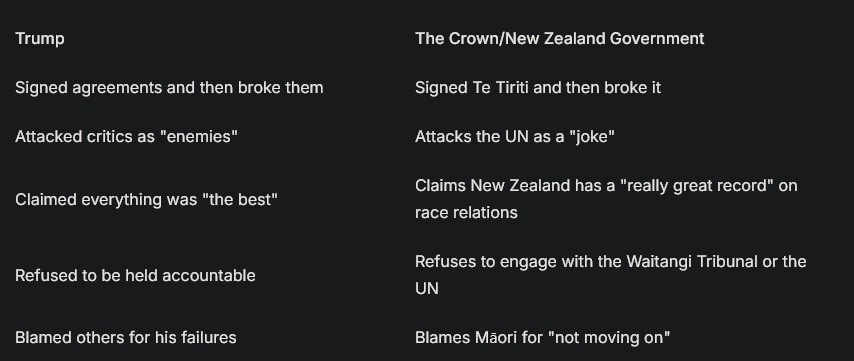
The world is tired of this behaviour. It costs to deal with unreliable partners. It costs to trust a country that breaks its word. And the world is learning, just as it learned with Trump, that some nations cannot be trusted.
New Zealand is not above this lesson.
Part Three: The Risk of Being Left Behind
The emerging multipolar world is not waiting for New Zealand. It is moving ahead. Nations are forming new alliances, new trade relationships, new partnerships.
And they are choosing partners they can trust.
Who Will Want to Deal with New Zealand?
Consider the question: if you were a nation looking for a reliable partner, would you choose a country that:
Has spent 180 years breaking its founding agreement?
Dismisses international human rights bodies as a "joke"?
Blames the victims of its own failures?
Has a government that attacks anyone who holds it accountable?
The answer is obvious. You would look elsewhere.
The Cost of Reputation
Reputation is not abstract. It has real, material consequences.
Investment requires trust. If investors believe New Zealand cannot honour agreements, they will invest elsewhere.
Trade requires reliability. If partners believe New Zealand will break its word, they will find other suppliers.
Diplomacy requires credibility. If allies believe New Zealand cannot be trusted, they will seek other alliances.
The Crown's failure to honour the Treaty is not just a domestic issue. It is an international liability. And as the multipolar world consolidates, New Zealand risks being left behind, or worse, being forced to face its racism and untrustworthiness on the world stage.
The "Left Behind" Scenario
What does being left behind look like?
Economic isolation, partners choosing more reliable nations
Diplomatic marginalisation, allies seeking other allies
Reputational damage, the world seeing New Zealand as a country that cannot be trusted
This is not a distant threat. It is a present reality. The UN CERD report is a warning. The government's response is a confirmation.
Part Four: The Truth the Government Refuses to Face
The government wants to believe that it can ignore international criticism. It wants to believe that the world will not care about how it treats Māori. It wants to believe that colonialism still protects it.
It is wrong.
The World Sees What New Zealand Refuses to See
The UN CERD report is not a suggestion. It is a formal, documented judgment. It is an international record of New Zealand's failures.
The world knows that New Zealand is moving backwards on racial equality.
The world knows that Māori rights are under serious threat.
The world knows that the Crown has never honoured the Treaty.
And the world knows that the current government is not interested in accountability.
The self-righteousness that New Zealanders display, the belief that this country is a beacon of racial harmony, is a fiction. The world does not believe it. And increasingly, the world will act on that knowledge.
The Inevitable Reckoning
There will come a time when New Zealand cannot hide from its failures. The colonial systems that have protected the Crown are fading. The old narratives are being exposed. And the truth is becoming undeniable.
The Treaty was a promise. It was broken.
The Crown was a partner. It became a conqueror.
The government claims to care. It shows it does not.
When that reckoning comes, the government's dismissiveness will not save it. The world will not be impressed by attacks on the UN. The world will not be swayed by claims of being a "good international citizen."
The world will look at New Zealand's record, and it will judge.
Conclusion: A Warning, Not a Threat
This is not a threat. It is a warning.
The multipolar world is emerging. The old colonial powers are fading. The new order will be based on reliability, honesty, and respect for agreements.
New Zealand has a choice. It can continue to hide behind colonial fictions, dismissing the UN, blaming Māori, refusing accountability. Or it can face the truth: that it has broken its word, and that the world will not ignore it forever.
The Crown made a promise. It broke that promise. And now, when the world points this out, the government attacks the world.
But the world is not fooled. The world is not impressed. And the world will not wait for New Zealand to catch up.
The time of hiding behind colonial crown systems is over. The world is watching. And the world is drawing conclusions.
New Zealand risks being left behind, or worse, being forced to face the consequences of its failures. The government's dismissiveness is not strength. It is an admission of guilt. And the truth will not be buried forever.
"If you cannot keep your word, why should anyone deal with you?"
The world is asking this question about New Zealand right now.
Related Papers
Treaty of Waitangi - Guardians of the Land
NZ Crown's Projection: A Psychological Exposé of 180 Years of Manipulation