

Abstract
This paper presents a unified theory of physics based on a single foundational principle: the wave is the fundamental reality. By tracing the wave from Pythagoras to quantum mechanics, this theory identifies a universal pattern that governs sound, light, electromagnetism, gravity, dark matter, and dark energy. The theory proposes that quantum entanglement is the bridge, the qBridge, that translates energy between the quantum and physical realms. This bridge is identified as dark matter and dark energy. The model further proposes that matter forms from magnetic cups, localized wave structures that create pressure differentials, acting as gravitational seeds. The theory is grounded in observation, consistent with known physics, and makes testable predictions. It concludes with a philosophical framework: Yin is the container, Yang is the content, and the container defines the content.
A companion paper, Time Is Not a Dimension: It's a Measure of Separation, establishes that time is not a fundamental coordinate but an emergent metric of movement through space. The present theory adopts this framework: space is the arena; time is the measurement of movement across separation.
1. Introduction: The Fragmentation of Physics
Modern physics is fragmented. Quantum mechanics describes the very small; general relativity describes the very large. The two do not reconcile. Dark matter and dark energy remain mysterious. The observer effect is unexplained. This paper proposes that these problems share a common solution: the wave is the universal pattern, and the translation between quantum and physical is mediated by a bridge, the qBridge.
The theory presented here is not new in its components, but it is new in its synthesis. It draws from:
Pythagoras (ratios and harmonics)
Maxwell (electromagnetic waves)
Schrödinger (quantum waves)
Einstein (mass-energy equivalence, spacetime curvature)
Tesla (electromagnetic fields and resonance)
Eastern philosophy (Yin-Yang)
The contribution of this paper is to connect these insights into a single, coherent framework.
2. The Universal Wave
2.1 The Pythagorean Insight
Pythagoras discovered that musical harmony is defined by ratios of string lengths. A 2:1 ratio produces an octave; a 3:2 ratio produces a perfect fifth. These ratios are not arbitrary, they are the geometry of waves.
The same mathematics that describes a vibrating string describes:
Sound waves in air
Light waves in the electromagnetic field
Quantum waves in the probability field
Gravitational waves in the curvature of space
In every case, the wave has:
Wavelength (distance between peaks)
Frequency (peaks per second)
Amplitude (height)
Nodes and antinodes (minima and maxima)
Interference patterns (constructive and destructive)
The equation is universal:
v=fλ
Where v is speed, f is frequency, and λ is wavelength. This equation applies to sound, light, quantum waves, and gravitational waves.
2.2 The Wave as Fundamental Reality
This theory proposes that the wave is not a property of things, it is the thing itself. Particles are localized wave packets. Forces are interactions between wave fields. The universe is a set of interacting waves.
This is consistent with quantum field theory, which describes the universe as a set of quantum fields (waves). Particles are excitations of these fields.
2.3 Space as the Arena
This theory adopts the framework established in Time Is Not a Dimension: It's a Measure of Separation:
Space is the fundamental arena. It is the container, the Yin, the field in which all movement occurs.
Time is not a dimension. It is a measure of separation, the metric we use to describe the movement of matter across space.
Time is emergent, not fundamental. It is the measurement of change, not the cause of change.
Gravity does not affect time. It affects the movement of matter through space. We measure that movement and call it time.
This reframing is essential to the present theory. The qBridge does not operate "through time." It operates through space, translating quantum potential into physical rendering. Time is the record of that translation.
3. The qBridge: Quantum-Physical Translation
3.1 The Problem of Translation
Quantum mechanics and classical physics are two different languages. Quantum describes superposition, probability, and nonlocality. Classical describes definite positions, local interactions, and determinism.
This theory proposes that quantum entanglement is the translator, the bridge between the two realms.
3.2 Definition of the qBridge
The qBridge is:
The interface between the quantum realm (uncollapsed waves, superposition) and the physical realm (collapsed particles, localized matter)
The mechanism of quantum entanglement
The carrier of dark matter and dark energy
A membrane of tension between two states
The qBridge is both quantum and physical, it is neither fully one nor the other. This is why it can translate. A translator must know both languages.
3.3 The qBridge as Dark Matter and Dark Energy
Dark matter and dark energy are the same phenomenon as the qBridge:
Dark matter is the gravitational effect of the qBridge. It is the mass of the bridge itself energy trapped in magnetic cups.
Dark energy is the expansion of the qBridge. The bridge is under tension, and it expands as energy flows through it.
This explains why dark matter has mass (it contains energy) but is invisible (it is not composed of ordinary particles).
3.4 The Bubble Analogy
The qBridge is the surface tension of a bubble:
The inside of the bubble is the quantum realm (potential, superposition).
The outside of the bubble is the physical realm (actual particles, localized matter).
The surface of the bubble is the qBridge, the membrane where translation occurs.
The surface has tension (energy), and therefore mass and gravity. The surface is where collapse happens.
4. The Magnetic Cup
4.1 Definition
A magnetic cup is a localized region of compressed electromagnetic energy. It is a wave structure, a spiral that traps energy.
Key properties:
It has a pressure differential, a low point in the energy field.
It creates a vacuum that pulls matter from the surrounding space.
It acts as a gravitational seed, the starting point for matter formation.
4.2 The Magnetic Cup and Gravity
Gravity is not a force, it is a pressure differential in space.
A magnetic cup creates a low point in space.
Matter flows into the low point (gravity).
The flow of matter creates the structure of the universe.
This is consistent with Einstein's general relativity: mass curves space, and matter follows the curvature. But in this framework, space is the container (Yin), and the curvature is the shape of the container.
4.3 The Magnetic Cup and Mass
Mass is energy trapped in a magnetic cup.
E=mc2
The energy in the cup is compressed. The compression creates pressure. The pressure is what we measure as mass.
The pressure is double the size of the cup, the energy is twice the container. This is why a small amount of mass contains a huge amount of energy.
4.4 The Magnetic Cup and Star Formation
Stars form when magnetic cups create pressure differentials:
A magnetic cup forms in the qBridge (a dark matter seed).
The cup creates a low point in the energy field.
Matter flows into the low point (gravity).
As matter accumulates, pressure and temperature rise.
Nuclear fusion ignites, a star is born.
This is the mechanism of stellar formation. The star is a magnetic cup that has grown large enough to sustain fusion.
5. The Observer Effect and Dimensions
5.1 The Observer Effect
In quantum mechanics, the act of observation collapses the wavefunction. This theory proposes:
Observation is interaction with a field.
When a wave interacts with a field (electromagnetic, Higgs, etc.), it collapses.
The collapse is the transition from quantum to physical, from wave to particle.
5.2 Why Space is Black
Space is black because most light waves have not yet collapsed. They have not interacted with any field that would make them visible.
Light travels as a wave until it encounters a detector.
At the detector, it collapses into a photon and becomes visible.
Until then, it is "dark light", an uncollapsed wave.
This explains why the universe is dark despite the vast amount of light passing through it.
5.3 The Illusion of Reversal
When a wave reaches a minimum or maximum, it appears to reverse. This is an illusion.
The wave does not reverse, it continues forward through space.
It moves out of the range of our instruments and then returns.
Our limited measurement capability creates the appearance of reversal.
This is the observer effect in action: the instrument defines what we see.
5.4 Dimensions as Realms of Interaction
A dimension is not a coordinate system, it is a realm of interaction:
The quantum realm is a dimension.
The physical realm is a dimension.
The qBridge is the interaction between these dimensions.
We define dimensions by what we can interact with. Time is not a dimension, it is a measure of movement across space.
6. The Checksum
6.1 The Method
The theory is validated by its ability to explain known phenomena and predict unknown ones. This is the checksum:
If the theory is correct, it should hold together.
It should explain what is already known.
It should make predictions that can be tested.
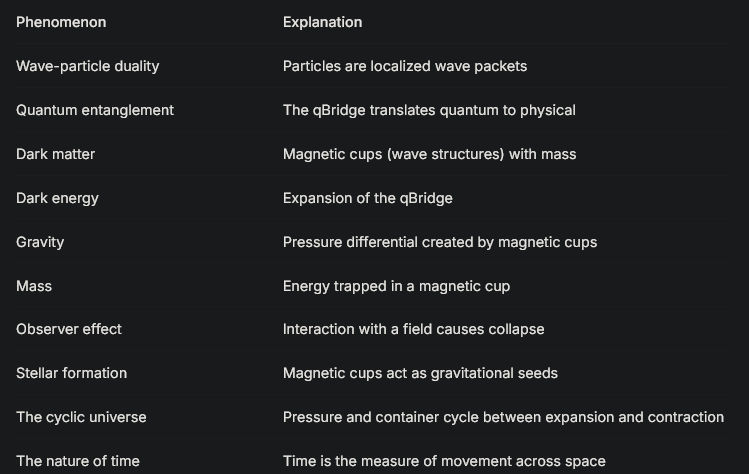
6.2 Explanatory Power
The theory explains:
6.3 Predictive Power
The theory predicts:
Dark matter is a wave structure (magnetic cup), not an exotic particle.
Dark energy is the expansion of the qBridge, the membrane of entanglement.
Mass is trapped energy, a measurable consequence of the magnetic cup.
The universe is cyclic, it expands and contracts in a cycle driven by the pressure of energy against the container.
Space is dark because light waves have not collapsed yet.
Observation is limited, we see only what our instruments can interact with.
Time is emergent, it is not a fundamental coordinate but a measure of movement through space.
7. Philosophical Framework: Yin and Yang
7.1 Definition
Yang is energy, heat, light, matter, activity, and force.
Yin is the container, space, cold, vacuum, passivity, and definition.
7.2 The Relationship
Yang moves. Yin defines where Yang goes.
Yang is primary in force. Yin is primary in structure.
Yang fills the container. The container defines the content.
7.3 The Primacy of Yin
Yin is the driving force of the universe because it defines the gradient:
Heat moves to cold, the gradient is defined by the cold.
Energy flows to vacuum, the gradient is defined by the vacuum.
Matter falls to low points, the gradient is defined by the low point.
The container defines the motion of the content. Space (Yin) defines where matter (Yang) moves. Time is the measure of that movement.
7.4 The Cyclic Universe
The universe is a cycle driven by Yin and Yang:
Yang (energy) fills Yin (the container, space).
The pressure builds until the container cannot hold it.
The container breaks, and the energy expands.
The expansion creates a new container.
The cycle repeats.
This is the eternal return, the birth, death, and rebirth of the universe. Time is the measure of the intervals between these states.
8. Connection to the Time Framework
This theory is the spatial complement to Time Is Not a Dimension: It's a Measure of Separation.
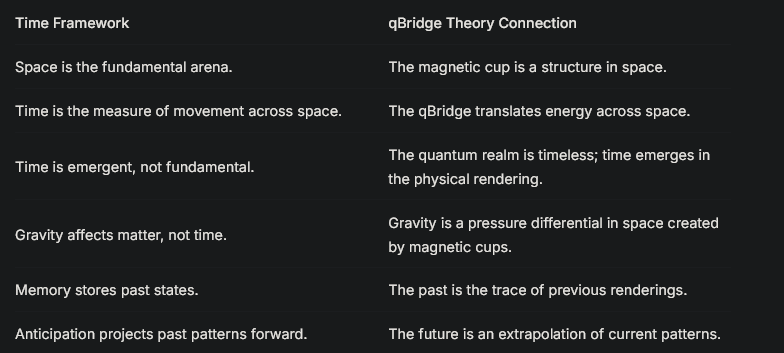
Together, the two papers present a complete framework:
Space is the container (Yin).
Matter and energy are the content (Yang).
Time is the measure of movement across space.
The qBridge is the mechanism of translation.
The magnetic cup is the structure of matter.
The universe is a cycle of expansion and contraction.
9. Conclusion
This theory proposes that the universe is a set of interacting waves. The quantum and physical realms are connected by the qBridge, a membrane of entanglement that translates energy between them. This bridge is identified as dark matter and dark energy. Matter forms from magnetic cups, localized wave structures that create pressure differentials and act as gravitational seeds.
The theory is validated by its explanatory power and predictive capacity. It is consistent with known physics and grounded in observation. It connects Pythagoras to quantum mechanics, Maxwell to Einstein, and Tesla to dark matter.
The philosophical framework is Yin and Yang: the container (Yin) defines the content (Yang). The universe is a cycle of expansion and contraction, driven by the pressure of energy against the container. Time is not a dimension, it is the measure of movement across space.
This theory is not new in its components but is new in its synthesis. It is the result of following the wave, a journey that began with a single observation and ended with a unified view of reality.
10. Future Work
Further research is needed to:
Quantify the qBridge, develop mathematical models of the membrane.
Measure magnetic cups, observe wave structures in the qBridge.
Test cyclic predictions, gather data on cosmic expansion and contraction.
Explore consciousness, investigate the relationship between fields and awareness.
Refine the time framework, develop testable predictions about the emergent nature of time.
The theory is open to revision and refinement. It is a map, not the territory, a description of reality, not reality itself.
Acknowledgements
This theory is the result of observation, comparison, and connection. It draws from Pythagoras, Maxwell, Schrödinger, Einstein, Tesla, and the Yin-Yang philosophy. It is offered as a contribution to the ongoing search for a unified understanding of the universe.
References
Pythagoras. (c. 570–495 BC). On Harmonics.
Maxwell, J.C. (1865). A Dynamical Theory of the Electromagnetic Field.
Schrödinger, E. (1926). Quantization as an Eigenvalue Problem.
Einstein, A. (1915). The Field Equations of Gravitation.
Tesla, N. (1905). The Problem of Increasing Human Energy.
Lao Tzu. (c. 6th century BC). Tao Te Ching.
The wave is the pattern. The ratio is the relationship. The qBridge is the translation. The magnetic cup is the seed. The container defines the content. The universe is the cycle. Time is the measure.
Related Papers
Time Is Not a Dimension: It's a Measure of Separation
Theory of All Things: A Unified Pressure-Flow Model of Reality