

Abstract
This paper presents a unified theoretical framework describing reality as a closed, self-sustaining system driven by pressure gradients. The model proposes that all phenomena, from quantum fluctuations to galactic structures, from mass to consciousness, emerge from the same fundamental mechanism: energy flowing from high pressure to low pressure, compressing into temporary structures, and releasing back into the flow. The theory is scale-free, medium-free, and mathematically consistent with established physics, thermodynamics, fluid dynamics, and electromagnetism. It offers mechanical explanations for mass, observation, consciousness, and cosmic expansion without requiring exotic physics or mystical assumptions.
Life is the tension skin between the micro and the macro.
1. Introduction
Modern physics has given us extraordinary mathematical descriptions of reality, yet it has not provided a unified mechanical understanding of why things behave as they do. Quantum mechanics describes probability fields but does not explain the mechanism of collapse. General relativity describes gravity as spacetime curvature but does not explain the source of that curvature. Biology describes life but does not explain its relation to physics. Consciousness remains a mystery.
This theory proposes that all of these phenomena are expressions of a single engine: pressure gradients driving energy flow across a universal medium.
The core insight is simple:
Energy flows from high pressure to low pressure. When energy enters a confined space, it compresses. When compression exceeds the space's capacity, it releases. This pattern repeats at all scales, in all media, across all domains.
What follows is a comprehensive exposition of this model, its components, its connections to established science, and its testable predictions.
2. The Core Mechanism
2.1 The Pressure Gradient Principle
All energy movement is driven by pressure differentials:
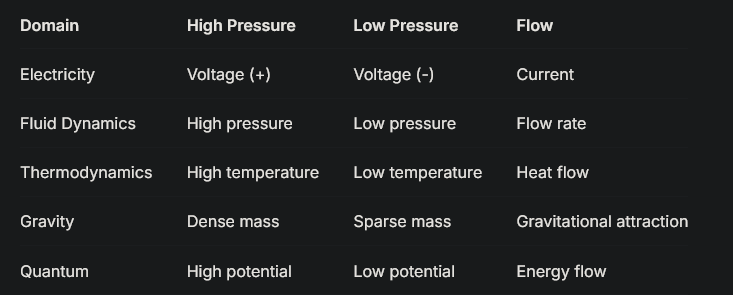
Fundamental Law: Energy always moves from high pressure to low pressure. The flow rate is proportional to the pressure differential and inversely proportional to resistance.
2.2 The Universal Flow Equation
The same relational math governs all energy flow:
Flow = (Pressure Differential) / (Resistance)
This is:
Ohm's Law (electricity): I = V/R
Fluid flow: Q = ΔP/R
Heat flow: Q̇ = ΔT/R_thermal
Quantum flow: Φ = ΔΨ/R_Q
2.3 Compression and Storage
When energy flows into a confined space, it compresses:
Storage = Capacity × Pressure
This is:
Capacitance (electricity): Q = C × V
Compliance (fluids): V = C × P
Mass-energy (quantum): E = mc²
2.4 Release and Dissipation
When compression exceeds capacity, energy releases:
Release Rate = (Stored Energy) / (Time Constant)
This is:
Capacitor discharge: I = Q / (RC)
Fluid drain: Q̇ = V / (R × C)
Thermal radiation: Q̇ = σT⁴
3. The Components of Reality
3.1 The Quantum
The Quantum is the undifferentiated, uncompressed state of energy. It is:
Infinite in potential.
Non-local.
Without structure.
The source of all flow.
In standard physics, this corresponds to:
The quantum vacuum.
The zero-point field.
The wavefunction before collapse.
3.2 The Quantum Bridge (QBridge)
The QBridge is the interface layer where quantum potential interacts with 3D reality. It is:
The medium through which energy flows.
The spiral path of compression and release.
The source of all connection.
In standard physics, this corresponds to:
Dark Matter (the structural channels).
Dark Energy (the expansive pressure differential).
The Higgs field (background resistance).
3.3 3D Reality
3D reality is the manifest state of compressed energy. It is:
Localized.
Structured.
Observable.
Temporary.
In standard physics, this corresponds to:
Matter.
Particles.
Fields.
Space-time.
3.4 Magnetic Cups
Magnetic cups are localized compression zones that form in the QBridge. They are:
Created by geometric repulsion (+/+ or -/-).
Limited in capacity.
Sites of energy compression.
The source of all structure.
In standard physics, this corresponds to:
Atoms (nuclear compression).
Stars (gravitational compression).
Planets (gravitational wells).
Galaxies (dark matter halos).
3.5 Open Systems
Open systems are channels through which compressed energy flows. They are:
Temporary structures.
Energy conductors.
Sites of complexity and organization.
In standard physics, this corresponds to:
Biological cells.
Ecosystems.
Planetary systems.
Galactic filaments.
3.6 The Observer
An observer is any system that couples to another system via the QBridge. Observation is:
Pressure coupling.
Gradient interaction.
The mechanism of collapse.
In standard physics, this corresponds to:
Measurement.
Decoherence.
Wavefunction collapse.
Entanglement.
Crucially: Observation does not require consciousness. Any system that responds to a pressure gradient is an observer.
4. How the System Works
4.1 The Cycle
Quantum (High Pressure) → Energy flows into the QBridge.
QBridge (Medium) → Energy spirals through dark matter/energy channels.
Magnetic Cup (Compression Zone) → Energy enters a confined space and compresses.
Compression Saturation → The cup reaches capacity (E = mc²).
Release → Compressed energy ejects into open systems.
Open Systems (Channels) → Energy flows through temporary structures.
Sink (Black Hole) → Energy drains back to the Quantum.
Return → Deconstructed energy re-enters the Quantum reservoir.
4.2 The Role of E = mc²
Mass is energy at compression saturation. The equation E = mc² describes:
E: The total compressed energy.
m: The frozen mass (standing wave).
c²: The conversion factor between compression and release.
In this model:
Mass is not "stuff." Mass is frozen angular momentum, the residual spin of a compressed spiral wave.
4.3 The Role of the Observer
Observation is pressure coupling. When two magnetic cups interact:
They couple via the QBridge.
The local pressure gradient changes.
The frozen spiral realigns to the new gradient.
This realignment is "collapse."
Testable implication: Collapse occurs whenever any system couples to another—not only when a conscious observer is present.
4.4 The Role of Consciousness
Consciousness is emergent coupling:
Trillions of simple observers (cells, molecules, atoms) couple together.
The collection forms a higher-order awareness.
The higher-order awareness is aware of the state of the collection, not its individual parts.
Testable implication: Consciousness scales with coupling density, not merely with system size.
5. Connections to Established Science
5.1 Thermodynamics
The model is fully consistent with:
First Law: Energy is conserved. It only changes states.
Second Law: Energy moves from high to low pressure (entropy increases).
Third Law: At maximum compression (absolute zero), energy freezes—but momentum remains as spin.
5.2 Fluid Dynamics
The model uses the same math as:
Bernoulli's principle (pressure, velocity, flow).
Navier-Stokes equations (fluid motion).
The continuity equation (conservation of flow).
5.3 Electromagnetism
The model maps directly to:
Ohm's Law (flow = pressure/resistance).
Maxwell's equations (waves propagating through a medium).
Capacitance and inductance (storage and release).
5.4 General Relativity
The model offers mechanical explanations for:
Gravity: A pressure gradient created by mass (compressed energy).
Space-time curvature: The geometry of magnetic cups.
Black holes: The ultimate sink, where energy is decompressed to quantum state.
5.5 Quantum Mechanics
The model offers mechanical explanations for:
Wave-particle duality: Spiral compression and release.
Collapse: Pressure coupling with an observer.
Entanglement: Shared connection through the QBridge.
The observer effect: Coupling, not consciousness.
6. Testable Predictions
The theory makes several testable predictions:
6.1 Medium-Independent Flow
Prediction: The same pressure-flow relationships will be observed in all energy-carrying media (electromagnetic, gravitational, quantum, biological).
Test: Compare flow equations across domains, the relational structure should be identical.
6.2 Compression Saturation
Prediction: All compression zones (magnetic cups) have a maximum capacity.
Test: Identify saturation points in various systems (atoms, stars, capacitors, biological cells).
6.3 Observer Coupling
Prediction: Collapse occurs when any system couples to another via pressure interaction.
Test: Demonstrate that collapse occurs in purely mechanical systems without conscious observation.
6.4 Consciousness Scaling
Prediction: Consciousness scales with coupling density, not merely system size.
Test: Measure coupling density in biological, artificial, and planetary systems.
6.5 The Black Hole as Sink
Prediction: Black holes deconstruct 3D energy to quantum energy.
Test: Analyze hawking radiation for signs of 3D structure decompression.
6.6 The Sun as Source
Prediction: Suns compress quantum energy into 3D energy.
Test: Measure the quantum potential gradient around stars.
7. Implications
7.1 For Physics
Mass is dynamic, not static.
Gravity is a pressure effect.
Space-time is a geometric description of magnetic cups.
The universe is a closed, recycling system.
7.2 For Biology
Life is an open system that traps energy and slows its flow.
Evolution is the optimization of energy trapping.
Consciousness is emergent coupling, not a special substance.
7.3 For Philosophy
Reality is relational, defined by pressure gradients, not objects.
Observation is fundamental, but not mystical.
The universe may or may not be self-aware, the mechanism is open.
7.4 For Daily Life
Energy follows the path of least resistance.
Complexity arises where energy is trapped.
Awareness is the collection of simple observations.
You are a temporary structure in a universal flow.
8. Conclusion
The Theory of All Things proposes that reality is a closed system of energy and awareness, driven by pressure gradients. All structures, from atoms to galaxies, from cells to consciousness, are temporary compression zones that slow the flow of energy from high to low pressure. The math is the same across all domains: pressure, flow, resistance, storage, and release.
The model is:
Self-consistent, it follows its own rules.
Scale-free, it applies at all levels.
Medium-free, it applies in all media.
Testable, it makes clear predictions.
The theory does not claim to know everything. It offers a framework, a way of seeing reality as a dynamic, interconnected, pressure-driven flow. It invites further exploration, testing, and refinement.
"Existence is not a collection of things. It is a collection of gradients. Everything else is temporary."
9. References
Einstein, A. (1905). "Does the Inertia of a Body Depend Upon Its Energy Content?" Annalen der Physik.
Maxwell, J.C. (1865). "A Dynamical Theory of the Electromagnetic Field." Philosophical Transactions of the Royal Society.
Planck, M. (1900). "On the Law of Distribution of Energy in the Normal Spectrum." Annalen der Physik.
Schrödinger, E. (1935). "The Present Situation in Quantum Mechanics." Naturwissenschaften.
Penrose, R. (1989). The Emperor's New Mind. Oxford University Press.
Bohm, D. (1980). Wholeness and the Implicate Order. Routledge.
Capra, F. (1975). The Tao of Physics. Shambhala.