

2025 was the year of Metroidvanias for me, and that genre includes the handheld Castlevania games from the Game Boy Advance and Nintendo DS. I started by playing through the DS trilogy and was largely impressed, so I moved on to the GBA trio. I’m aware I did it out of order! But that’s par for the course for someone like me. I want to take a look at the two trios of games, starting with the GBA titles. As a note, I played all three of these on the Nintendo Switch GBA collection.
1. Circle of the Moon
In 1830, a cult of Chaos worshipers gathers in Austria to resurrect the Lord of Darkness, Count Dracula. Vampire hunter Nathan Graves arrives at Castlevania just moments too late to prevent the ritual. Armed with his whip and magical abilities, Nathan must battle through the castle’s horrors and abominations to stop Dracula’s return.
Circle of the Moon plays similarly to the legendary Symphony of the Night (PlayStation, 1997), with a complex labyrinth composed of several different interrelated areas. I found the map design interesting, featuring plenty of secrets to uncover. However, a significant flaw lies in the scarcity and poor placement of teleporters. Even when I used them strategically, extensive backtracking was still necessary, particularly when revisiting older areas with newly acquired movement upgrades. I also found it puzzling why one ability was split into two upgrades: one for smashing stone blocks and another for pushing heavy blocks.
The DSS card combo system is a fantastic idea in theory, though it certainly comes with its frustrating issues in practice. There are 20 cards in total, divided into two sets. By combining one card from each set, you can create a total of 100 potential unique abilities. The Roman Gods serve as “Action Cards,” determining the type of effect, while the mythical creatures determine the attribute. I used the Jupiter+Manticore and Jupiter+Salamander, which helped with enemy projectiles and made handling swarms of foes easier.
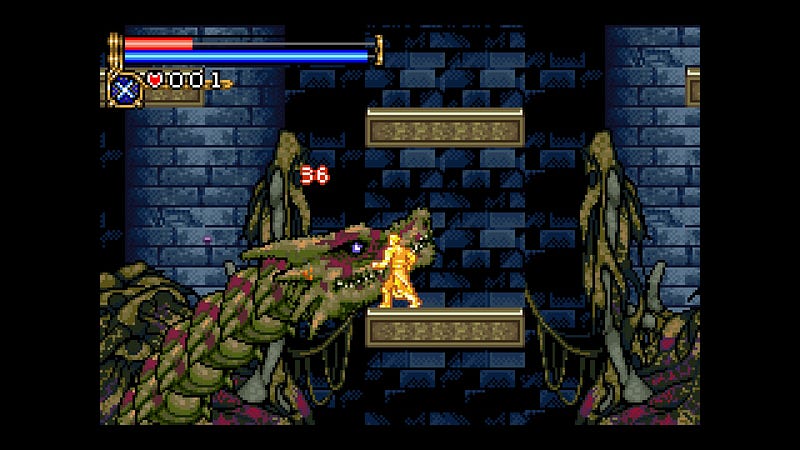 Of the seven Castlevania games of this style I’ve played, I’d say this was the toughest game with the hardest-hitting enemies, intensified by the lack of save points and not many warp points. The difficulty curve is uneven with sudden spikes that, at least for me, required grinding. Overall, the difficulty felt more frustrating than fair. Getting hit often resulted in a significant knockback, sometimes undoing minutes of progress, or even knocking me off-screen into a previous room. Combined with the difficulty of bypassing multiple enemies and Nathan’s weak standing jump, combat often felt cumbersome rather than strategic.
The last boss was one of my least favorite in any game, with punishing difficulty and an attack that could one-shot Nathan, and in my victory, I had to dodge that attack many times. In the second form, the target is small and surrounded by useless enemies that only serve to be in the way. There are no shops to buy healing items, so conservative use of found healing items is important.
Gameplay issues aside, this is a Castlevania game through and through. The atmosphere is apparent with creepy enemies and imposing bosses. The sound design is also impressive, for a GBA game especially, with music ranging from moody and somber to intense and forboding.
Circle of the Moon stands as my least favorite among the seven Metroidvania-style Castlevania titles I experienced. Despite its frustrations, it still possesses redeeming qualities that make it a suitable, but brief fix for those well-versed in the Metroidvania genre, clocking in at just under 10 hours.
2. Harmony of Dissonance
Harmony of Dissonance is the second Castlevania game released on the GBA. These GBA titles are largely standalone adventures, each telling its own story, though they all exist within the broader Castlevania universe with loose connections tying them together. Playing this game left me with mixed thoughts and emotions.
Our main character, Juste, has inherited the legendary Vampire Killer whip and is immediately thrust into action when his childhood friend Lydie Erlanger is suddenly kidnapped. Accompanied by his best friend, Maxim, who is mysteriously injured and suffering from amnesia, Juste heads to a haunted castle to save her.
When the game flows, it flows well, and advancing felt seamless and easy; I finished a large portion of the first castle in a short amount of time. However, there were frustrating bottlenecks when it abruptly ground to a halt, leading to some of the most frustrating aimless wandering and extensive backtracking I’ve experienced across the seven Metroidvania Castlevania games I’ve played.
Exploration felt cumbersome due to the great distances between warp points. This was compounded by my initial mistake of not realizing I could still warp within castles by kneeling, as I had assumed the mechanic had changed with the introduction of the second castle.
While hint cards provide advice, I still believe the game should be more straightforward in presenting key gameplay mechanics or any changes. Even after gaining that knowledge, backtracking remained time-consuming, and the placement of warp and save points wasn’t optimal. Movement upgrades help open up other parts of the castle, but they were too few and far between to feel satisfying, at least by my standards.
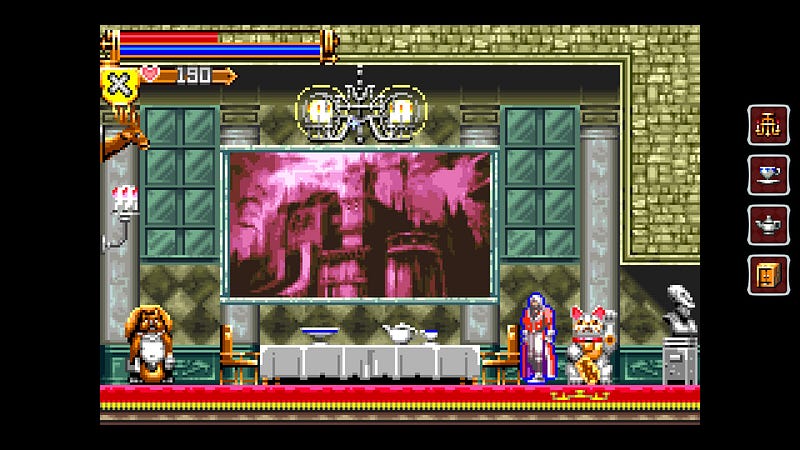 As I said for Circle of the Moon, the atmosphere is apparent and practically jumps off the screen with creepy enemies and imposing bosses. Juste’s sprite has blue shadows trailing him, an interesting stylistic choice, but some might find it visually jarring. Enemies are detailed, and the level design is laced with intricate Gothic detail. The sound design is also impressive, with music ranging from moody and somber to intense and forboding.
The enemies are less of a nuisance and not as threatening as Circle of the Moon, but the most significant difference is that bosses are considerably easier; I don’t recall any of them giving me too much trouble, including the final boss. This stands in contrast to Circle of the Moon, which featured difficult boss battles. Movement is more fluid, and Juste is easier to control. I mostly stuck with the cross and enjoyed using the lightning, which did a lot of damage to most foes and bosses.
Harmony of Dissonance works on many levels, but its awkward exploration has not aged well. Otherwise, if you’re in the market for a solid but unspectacular, flawed retro Metroidvania, this is worth a shot.
3. Aria of Sorrow
Castlevania: Aria of Sorrow is a bittersweet ending to my Metroidvania-style Castlevania journey, as it’s the last of the 7 games I played. Naturally, I started with Symphony of the Night, followed, unnaturally, by the DS trilogy and finally, the GBA trilogy. It’s not my favorite of the seven games, but far from the worst, and there are a lot of positive things to say about the game.
Aria changes things up by taking place in the future: 2035, a time when Dracula is supposedly gone for good. Starring Soma Cruz, an ordinary student who, along with his friend Mina, is suddenly trapped inside Dracula’s Castle during a solar eclipse. As Soma navigates the dangerous castle to find a way out, he discovers a unique power: the ability to absorb monster souls and use their abilities. His journey is an attempt to escape, but also an unfolding mystery about his connection to the castle.
There are four types of souls Soma can absorb: Bullet Souls, which consume MP and allow secondary attacks; Guardian Souls, which consume MP and activate special abilities; Enchanted Souls, which provide passive bonuses; and Ability Souls, which dictate how you interact with the environment. You can equip one of each relevant type, and every enemy has a chance to drop their soul. The drop rates are better than in previous GBA Castlevania games, which I appreciated.
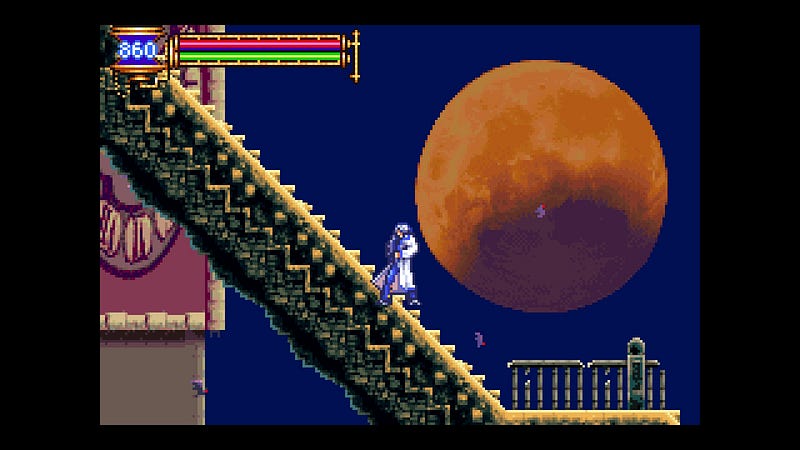 Out of the three GBA games, I found this to have the best map, but still far from optimal, with just enough save points and warp points to be passable, while still requiring backtracking at various points. There aren’t as many cryptic secrets as in other titles, and the map helps locate unexplored areas, but the sense of exploration is still strong. Even playing mostly blind, my map completion was 98.3%, so the game lends itself to seamless exploration.
Combat has a similar style to the tactical soul system from Dawn of Sorrow. Thankfully, obtaining souls isn’t as tedious as getting the cards from Circle of the Moon, which I found unbearable at times. The drop rate here is more manageable and does not require much grinding, though I did run into a few difficulty spikes where I had to grind a few levels. Other than that, most bosses and enemies are fairly easy, certainly more so than the first two GBA titles.
Graphically, this looks similar to the previous GBA games, but it is impressive for a handheld and has aged well. The soundtrack complements the atmosphere, and the sound design, from absorbed souls to weapon strikes, contributes to the overall gothic feel.
This is a well-done game that has aged gracefully and is a solid jumping-off point for those looking to dive into the series. Of the three GBA games, this is the best one.
Be sure to check out my Symphony of the Night review and my analysis of the DS trilogy!