
2025 was the year of Metroidvanias for me, and in May and June, I played through the six handheld Castlevania Metroidvanias. I started by playing through the DS trilogy and was largely impressed, so I moved on to the GBA trio. I’m aware I did it out of order! But that’s par for the course for someone like me. After looking at the GBA trio on Friday, I’m moving on to the DS trio for Monday. As a note, I played all three of these on the Nintendo Switch DS collection.
1. Dawn of Sorrow
One year after the events of Aria of Sorrow, protagonist Soma Cruz finds his attempts to relax disrupted by a zealous cult led by the mysterious Celia, whose evil ambition is to resurrect the Dark Lord. With Soma’s unique power, he is thrown into an intense struggle that leads to a vast, foreboding castle. While the premise holds promise, the narrative settles into an all too straightforward game of cat and mouse between Soma and Celia, and I felt the game too often failed to explore character motivations.
Most people come to the Castlevania series for the massive maps, ready to explore and uncover numerous secrets, and this is where Dawn of Sorrows truly shines. The exploration is intuitive, and more of the castle is uncovered for each newly acquired soul. These souls come in various types, offering diverse combat and traversal abilities. Some of these souls are automatically gained at specific points, usually after a boss battle.
However, many other skills and attacks are random enemy drops, often demanding significant grinding. It’s easy to unknowingly bypass specific enemies with souls that unlock optional parts of the castle, or a soul needed to break down one of three barriers to obtain the true ending.
With that said, I enjoyed the flexibility and customization provided by so many souls. I stuck with a few favorites, namely the throwing axe, as well as a throwing card, and the swarm of locusts found towards the end of the game. Those three attacks, as well as the most up-to-date sword or spear/lance, saw me through to the end credits.
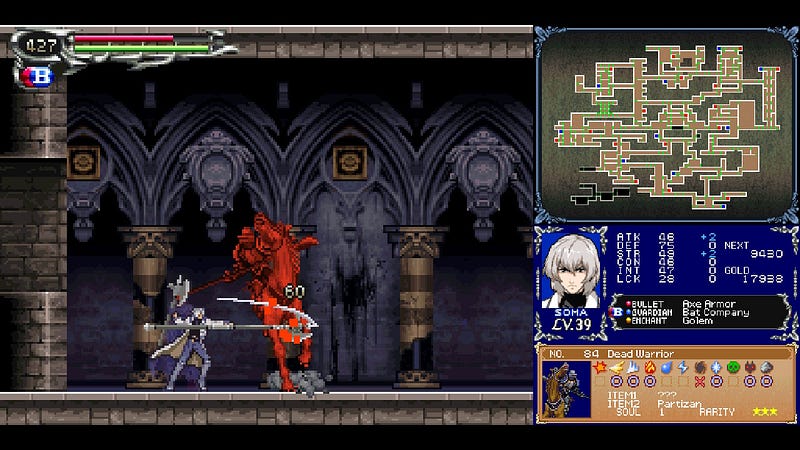 One aspect that sticks out is that this looks impressive for a DS game, with detailed sprite work, diverse hideous beasts, and imposing bosses ready to punish even the slightest misstep. Foes and bosses alike call for a wide range of strategies to beat.
My biggest gripe is that trying to jump and attack with your main weapon often has the unintended outcome of using your subweapon, which requires pressing the attack and up buttons simultaneously. This can leave you vulnerable or disrupt a combo. Otherwise, controls are precise, and maneuvering around rooms and jumping from platform to platform isn’t an issue.
While the bosses were generally a highlight, my overall enjoyment was significantly hampered by the magic seal system. After winning, you are tasked with quickly inputting a button combo to truly end their existence. Late-game seals require lengthy and accurate execution, and if you fail, the boss is revived with a portion of their HP.
Where Dawn of Sorrows shows its age is with the music, which should be expected as the DS hardware is not as capable as the PlayStation. Symphony of the Night had a more impressive collection of songs, whereas Dawn of Sorrow was good but not great.
In the end, Dawn of Sorrows isn’t the masterpiece that Symphony of the Night is, but it is still a solid game and worth playing.
2. Portrait of Ruin
What a difference a year makes! I played Portrait of Ruin immediately after Dawn of Sorrow, and while it was a solid effort, I was impressed by the improvements made here.
Similar to previous Castlevania games, the main villain is Dracula, but the immediate threat is Brauner, who has resurrected Dracula’s castle using the tormented souls of World War 2 victims. Driven by grief and a desire for revenge after the loss of his daughters, Brauner seeks to draw power from the castle to destroy humanity. He creates twisted paintings with mini-worlds that use the castle’s power to further his goals. Confronting him are Jonathan, with the legendary but weakened whip, and Charlotte, a powerful mage.
Like the first game, this looks impressive for a DS game with detailed sprite work, diverse hideous beasts, and imposing bosses ready to wreak havoc. Foes and bosses call for a range of strategies. Controls are precise and improved over the Dawn, and maneuvering around rooms and jumping from platform to platform is seamless. Adding further depth to exploration is Charlotte, who lets you jump on her shoulders to reach higher places. I still have yet to see anything quite like it in the dozens of Metroidvanias I’ve played. What a novel idea, jumping on someone's shoulders!
Nation of Fools is perhaps my favorite section of any of the six handheld games; it was interesting to explore and advance. Unlike many other Metroidvanias, there isn’t one gigantic, interconnected map. Dracula’s Castle serves as the central area, with portraits scattered throughout with separate maps. While I enjoyed the first four worlds, the next four portraits were rehashes of the first four, and I felt the developers missed a chance for further variety.
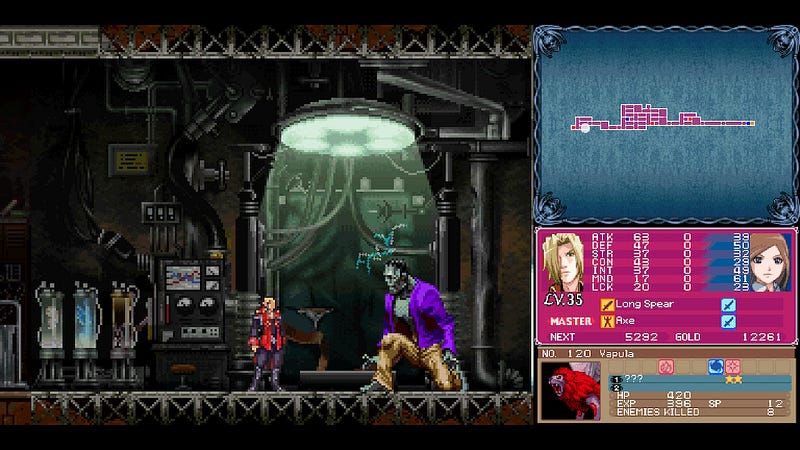 Save points and warps are generously scattered around to ensure ease of travel. This is the best map system I’ve seen from any of the Castlevania MV games, and the progression always felt well-paced.
It took some getting used to, but the dual-protagonist system was a blast to use. I mostly focused on Jonathon solo, but a timely magic attack from Charlotte helped in some difficult situations. I found the bosses tough but fair, and the overall difficulty curve felt well-balanced. However, the last two bosses represented a significant spike and were hard. If you’re used to brute-forcing bosses in games, this isn’t for you. Come in ready to change up your strategies.
Adding depth to the mechanics of the game is Wind, who gives several side quests. I completed 81.08% of the 37 possible missions, and this helped in eventually being able to beat the game. Most of them are highly worth it and reward useful items and stat increases.
The music in Portrait is greatly improved over Dawn, with each portrait showcasing unique tracks.
Overall, a year (2005 vs 2006) made a huge impact as far as how much of an improvement Portrait of Ruin is over an already respectable, but flawed Dawn of Sorrows. Portrait is an excellent entry point into the series, and, when I really think about it, my favorite of the six handhelds.
3. Order of Ecclesia
Portrait of Ruin was a Sophomore surge after a solid but flawed first game in the DS trilogy of RPG/Metroidvania-style Castlevania games. So, upon starting Ecclesia, I was interested to see if it would continue the upward trend or come back down to earth.
Order of Ecclesia takes place after the famous, beloved Symphony of the Night, in the 1800s. Shanoa is part of a research organization tasked with finding ways to prevent Dracula’s return. However, she loses her memories and emotions after some key items are stolen by her colleague, Albus. She journeys to retrieve them and discovers horrible information about Albus. The story is fairly engaging, and Shanoa is one of the most memorable female leads I’ve seen in gaming.
But the meat of the game is still in the exploration and battles. Some of the flaws that seemed to be largely corrected in Portrait of Ruin make a return in Order of Ecclesia. Most notably, it is too easy to unintentionally trigger a glyph union when fighting foes, especially when trying to jump and attack; you need to be deliberate with the button presses. Press jump, small split-second pause, then attack. Just be aware of MP levels, as every attack depletes this meter. Glyph unions deplete Shanoa’s heart count, so careful conservation of hearts as you move through each area is key. While glyphs can feel cumbersome at times, controls make moving around the levels seamless.
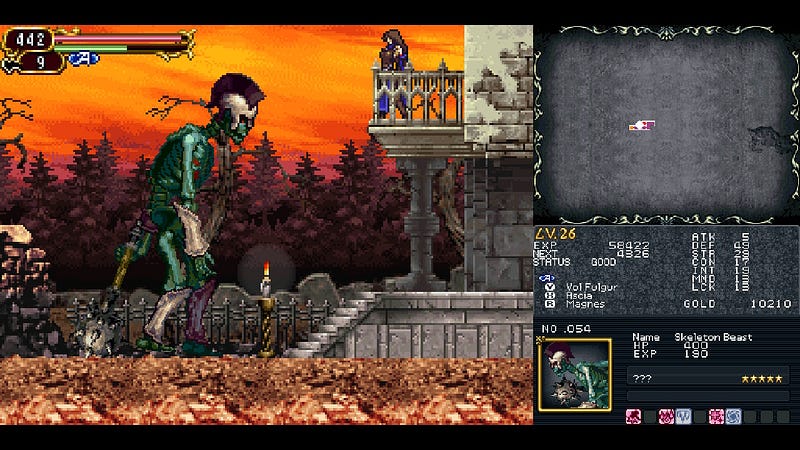 Out of the three DS Castlevania games, I found this the hardest, with punishing enemies and brutal bosses. If you tend to stick with your favorite attacks, like me, this game will prove to be a slog. I begrudgingly learned that changing approaches on the fly can turn the tide of even the most challenging battles, but in the end, that flexibility saw me through to the end credits.
The key approach to all bosses is to have the correct glyphs, which can be collected from defeated enemies, but sometimes have low drop rates. Shanoa leans more towards a mage role. I liked the axes the most and paired them with a suitable magic spell. Properly alternating attacks between the two glyphs can speed up the onslaught. Support glyphs, such as stat increases and field skills, are assigned to R1.
Side missions are highly beneficial in helping to advance through the game, so don’t ignore them! Villagers can be found scattered around the world, some well hidden, and while they mostly focus on mundane tasks, they offer excellent rewards. Be aware that some quests require grinding, which might hurt the overall pacing of the game to an extent.
As a fan of Metroidvania’s gigantic, interconnected maps, Order of Ecclesia’s initial two-thirds felt more linear. I started to wonder if the entire game would be like that, but thankfully, the last location is massive.
Order of Ecclesia looks similar in style to the two previous DS titles. For a handheld game from 2008, it is impressive, boasting detailed sprite work and beautiful backdrops. Plus, it has, in my opinion, the best music not just in the DS trilogy, but of the six handhelds overall.
Despite its heightened difficulty and some frustrating design features, Order of Ecclesia is a rewarding Metroidvania for fans of the series and genre and a fitting end to the DS trilogy.
Check out my Symphony of the Night Review and my analysis of the GBA trilogy.