

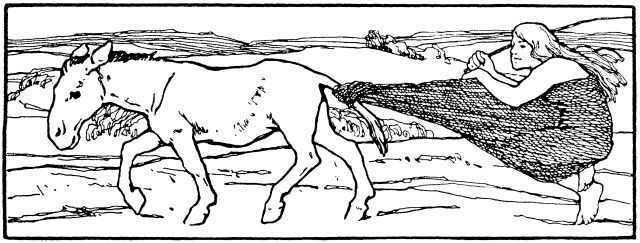
Illustration by Otto Ubbelohde, 1909
{Image description: Illustration in black and white. A donkey pulls a girl wrapped in a fishing net attached to its tail. The girl has long hair, and is otherwise naked. The background is a field with scarce vegetation.}
*
The first time I read this tale, about the thoughtful and righteous daughter of a poor peasant, I immediately associated it with the sign of Libra. The story, included in the second volume of Children's and Household Tales by Brothers Grimm, is far less popular than so many others already mentioned in the articles of this series. Still, it has a few television adaptations and an opera version by Carl Orff. As all other tales, this one also has several other versions from the most varied origins.
The protagonist of this tale is a young girl, of rather humble social status, whose great quality is what we nowadays would call social intelligence. Throughout the story the heroine solves riddles, neighborly disagreements, and relationship dilemmas with her innate ability to find balance and justice in all things and in all situations.
The sign of the Scales, as indicated by the object that symbolizes it, also weighs and ponders all issues in order to avoid conflict and clash, and is always seeking the middle ground, justice, and harmony. The story is divided into four short episodes in which the young girl proves her ability to find compromises and form agreements, always in a very diplomatic and elegant way, illustrating in such a complete manner the energy of this sign.
In the first part of the tale, the girl suggests to her poor father that he should ask the king for a piece of land to farm. It should be noted that the initiative comes from the girl, although one would expect that it would be the father's duty to find the livelihood for himself and his daughter. This sign is known for hesitation and difficulty in making decisions, but Libra belongs to the cardinal mode, and after considering both sides of the question and finding the middle ground, this energy can be quite determined.
The king offers them some land, and as they begin to plow it, the peasant and his daughter find a mortar of gold. The poor man decides to offer it to the king, since he found it on the land the king had given them. However, his daughter, more knowledgeable about the human nature, advises him not to do so, because the king will also want the pestle that the man doesn't have. The daughter is sensitive enough to realize that the mortar without the pestle is not a complete object, her ability to understand the balance of all things and also the human nature is very clear here.
Aries is the first sign of the zodiac and Libra is the one that opposes it. When the former says "I am the one" the latter replies "I am the other". Libra understands that everything has its mirror and complementarity.
Despite his daughter's warning, the peasant presents the king with the mortar. However, as his daughter had warned, the monarch demands that the peasant also give him the pestle. Faced with the poor man's inability to fulfill this demand, the king thinks he is cheating and has him arrested.
In prison the repentant man continually repeats "If only I had listened to my daughter...". Intrigued, the king calls the peasant again and the peasant tells him how clever his daughter is and had predicted the monarch's reaction. The king is fascinated by the girl's finesse of spirit and asks her to come visit him at the palace. But he imposes a challenge on her, and if she could solve the riddle, he will take her as his wife.
The challenge included several contradictions: the girl must go neither clothed nor undressed, neither on foot nor on horseback, neither on the road nor off the road. With her sense of balance and her ability to find the middle ground of everything, the peasant's daughter arrives at the palace wrapped in a fishing net: neither dressed nor undressed; with the net tied to a donkey that drags her behind: neither on foot nor on horseback; and making her way along the roadside: neither on nor off the road. As he had promised, the king marries the peasant's daughter.
Libra is an Air sign, the most social and relational element, but it also symbolizes thought and our mental processes. In this sign, the rational and objective side helps us build bridges between two seemingly opposite shores, to find compromises and make agreements. This sign also symbolizes pacts, alliances, contracts between two parties, and in a more personal and intimate way, marriage.
A few years later, while the king is searching his troops, some men who are there selling firewood start a dispute. One of them has three horses and the other has some oxen, near which is a freshly-born colt. The owner of the oxen claims that the colt belongs to him, and the one with the horses claims the colt for himself.
The king is called to settle the controversy and decides that the colt stays where it is and thus hands it over to the man with the oxen, to whom the animal obviously does not belong. This incident shows us a less bright side of Libra, the fear of taking risks and getting into confrontations often gives way to indecision and superficiality, without owning their own opinion on a certain subject.
The owner of the horses mourns his loss, and having heard of the intelligence and thoughtfulness of the queen, herself of humble origins, decides to ask her for help. The next day, on the queen's advice, the man stands in the road, where the king has to pass, with a fishing net. When the king asks him what sense it makes to fish on dry land, he replies that it makes as much sense as an ox giving birth to a colt.
Libra is the sign of justice, and although they sometimes tend to stay on the fence without committing to either side, these people are capable of anything to restore parity and harmony threatened by asymmetry and inequality, as long as they believe they are contributing to social peace and collective well-being.
However, when the man confesses that it was the queen who helped him to countermand the king's judgment, the king is so angry that she has gone against his judgment that he throws her out of the palace and orders her to return to her father's house. Nevertheless, he grants her one last favor: she can take what she holds most dear inside the palace with her. The girl agrees and gives her husband a drink that makes him fall deeply asleep so that she can then take him with her to her modest home.
When the king wakes up, he realizes what has happened, and the peasant's daughter tells him that he is everything she values most in her life. Moved by this proof of love—Libra is a romantic and charming sign—the king takes her back to the palace, where they live very happily.
Venus, the goddess of beauty and love, is the ruling planet of Libra and lends it qualities of elegance, tact and charm. This sign can also fall into superficiality and futility, giving importance to protocol and rules of etiquette just to keep up appearances and forgetting its initial purpose, which is to find symmetry and reconcile concepts that at first seem contrary.
The vocation for relationships, the ability to put themselves in the other people's shoes, to be the mirror, and their romantic nature are the most beautiful characteristics of the Libra. Building bridges, using diplomacy to find consensus and making compromises are attitudes that have as a major goal to build more balanced and harmonious relationships, on a personal level, but mainly on the social and collective sphere.
*
2014