

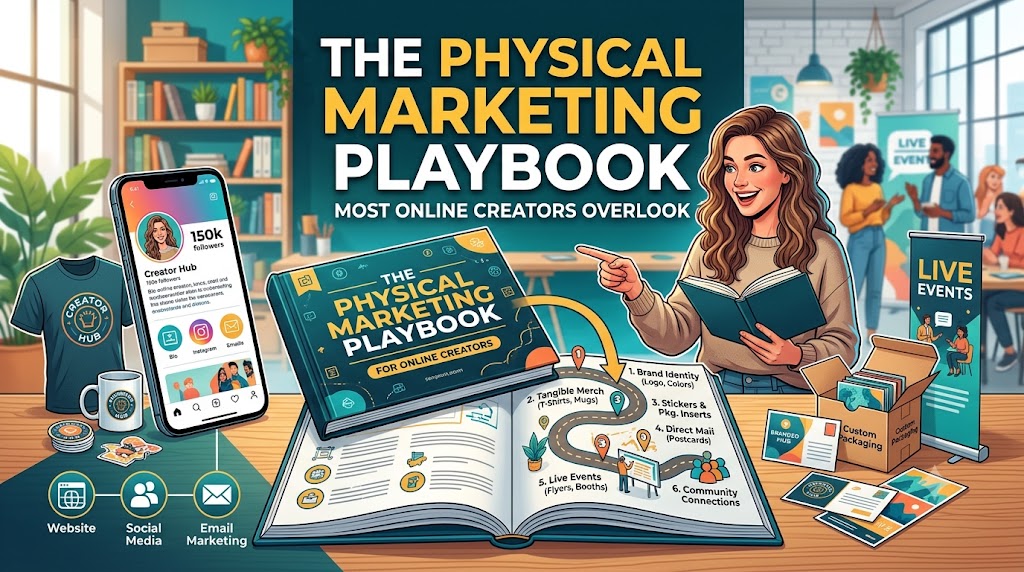
If you create things on the internet for a living, or even as a serious side pursuit, your entire marketing strategy probably lives on a screen. You post to social platforms, you send newsletters, you run ads if the budget stretches that far, and you hope the algorithm delivers your work to people who actually care about it.
That approach works until it does not. And lately, for a growing number of creators, it is working less often. Organic reach has been declining across every major platform for years. Paid reach gets more expensive each quarter. Email open rates have plateaued as every creator, brand, and business discovered newsletters at the same time.
Meanwhile, there is a marketing channel sitting right in front of you that almost no creator uses. It does not require an algorithm. It does not get filtered into a promotions tab. It does not vanish when someone scrolls. It is paper.
Why creators dismiss print
The reasons are predictable, and I held every one of them myself for a long time.
Print feels old. It feels expensive. It feels disconnected from the world you operate in. When you build your audience one follower at a time through digital content, the idea of printing something physical and handing it to someone feels like stepping backward into a medium that your grandparents used.
But the reason print feels irrelevant is the same reason it works: nobody else in your space is doing it. Every other creator in your niche is fighting for the same digital attention. The physical world is empty by comparison. A well-designed printed piece at a convention, in a merch package, or mailed to a top supporter does not compete with a thousand other notifications. It just exists, quietly, on a desk or a fridge or a bulletin board, reminding someone you are real.
Where print actually fits a creator's workflow
You do not need to run a direct mail campaign to ten thousand strangers. That is not the play for most creators. The play is smaller, sharper, and much cheaper than you think.
Convention and event handouts
If you attend any kind of gathering, whether it is a craft fair, a comic convention, a podcast festival, a music showcase, or a tech meetup, a one-page printed piece puts your name and your link into someone's bag. They carry it home. They find it later. They visit the URL or scan the QR code at a moment when they actually have time to explore, rather than in a noisy convention hall where they are already overstimulated.
A hundred handouts at an event can generate more engaged visits than a hundred dollars spent on social ads, because the people receiving them already showed interest by stopping at your booth or table.
Inserts in merch and product shipments
If you sell anything physical, whether it is stickers, prints, zines, T-shirts, or handmade goods, you are already shipping a package. Adding a printed card inside costs almost nothing and creates a moment that feels personal. A thank-you note with a link to your membership page. A card announcing your next project. A coupon code for your next drop. These small touches convert casual buyers into repeat supporters at a rate that a follow-up email cannot match, because the card arrives with something they paid for and are already excited about.
Supporter rewards and milestone gifts
Creators using platforms like Buy Me a Coffee often look for ways to reward their best supporters beyond digital content. A printed piece, even something as simple as a signed postcard or a limited-run art card, adds a physical dimension to the relationship. It does not need to be elaborate. The fact that it exists in the real world, that you took the time to send something tangible, communicates more than another exclusive post ever could.
Local promotion for in-person creators
Musicians playing local venues. Artists with gallery shows. Writers doing readings. Podcasters hosting live events. If any part of your creative work happens in a physical space, printed materials do work that digital cannot. A flyer on a coffee shop bulletin board reaches people in your neighborhood who may never find you on Instagram. A stack of postcards at a bookstore or record shop puts your name in front of a self-selected audience that already cares about the type of work you do.
The cost is genuinely trivial
This is where most creators' assumptions fall apart. They imagine print is expensive because it used to be, or because they are picturing a glossy brochure from a corporate print shop that charges setup fees and requires minimum orders in the thousands.
Modern online printers operate differently. Gang-run production, where many small jobs share a single press sheet, made short runs economically viable. You can order two or three hundred full-color, double-sided rush prints for somewhere between fifteen and thirty dollars. That is less than what most creators spend on a single boosted post. The per-piece cost at those quantities is measured in cents, not dollars.
If your concern is committing money to a paper stock or finish you have never seen in person, order a free sample kit first. Hold the options, feel the weight, see how the colors look on different stocks. It removes the guesswork entirely and costs nothing.
You do not need to be a designer
This is the second objection I hear from creators who are interested but hesitant. They make beautiful things on screen but do not know how to prepare a print-ready file. Bleed margins, CMYK color profiles, resolution requirements. It sounds technical because it is technical, but it does not need to be your problem.
Many online print shops will set up the design for free. You provide the content: your artwork, your text, your logo, a rough idea of the layout. Their team handles the technical preparation, adjusts everything for print, and sends you a proof to approve before anything goes to press. You do not pay until you confirm you are happy with how it looks.
That means a creator with zero print experience can go from idea to finished stack of handouts without learning a single thing about print production. The knowledge barrier is gone. The cost barrier is gone. The only barrier left is the assumption that this is not for you.
Measuring what print does
The fair criticism of print has always been attribution. How do you know it worked? In a digital world where every click gets tracked, print can feel like shouting into the wind.
Except it is not, if you set it up correctly. A unique QR code on each printed piece points to a tracked link. A custom short URL lets you see exactly how many visits came from a specific batch. A dedicated coupon code ties revenue directly to a print campaign. Even something as low-tech as "mention this card for 10% off" gives you a clear signal.
You do not need sophisticated analytics. You need one trackable element on the piece so you can distinguish print-driven traffic from everything else. That takes five minutes to set up and gives you data that is just as concrete as anything your social dashboard provides.
A practical starting point
If you have never tried print, here is the smallest possible experiment. Pick your next event, your next product shipment, or your next supporter milestone. Design a single piece: one side with your strongest visual, one side with a QR code and a single call to action. Order a hundred copies. Distribute them in the context that makes sense for your work.
Then watch your analytics for two weeks. See if the QR code gets scanned. See if the custom URL gets visited. See if anyone mentions the card. If nothing happens, you spent less than a pizza dinner and learned something useful. If something does happen, you just discovered a channel that almost none of your peers are using.
The creators who build sustainable careers tend to share one trait: they diversify. Not just their income streams, but their attention streams. They do not rely on a single platform to deliver their audience. They build multiple paths to the people who care about their work. Print is one of those paths. It is older than the internet, cheaper than most digital alternatives, and completely ignored by the creator economy. That last part is exactly what makes it worth trying.