

This is the premier installment of a new series I am debuting exclusively on my Buy me a Coffee Page. My goal is to explore a major situation in the financial markets as fully as possible in order to understand its causes and its potential repercussions throughout the markets and the economy.
Is California Tumbling into the Sea?
In its 1973 hit single, famed bicoastal jazz pop group Steely Dan sang: “California tumbles into the sea. That’ll be the day I go back to Annandale.”
The song was about a drug bust that took place at Bard College in Annandale, New York and describes a social situation in which children of the well to do were caught in a bad situation and its unfortunate consequences.
The current situation in California seems to have some similarities.
Of course, I am referring to the perception that California is a well to do state whose riches are based on the state’s natural beauty and the financial success of Silicon Valley. It is also a generally held perception that well to do states, like well to do people have no problems and are exempt from consequences regardless of their actions.
But just like the Annandale events in the Steely Dan song revealed otherwise, it seems as if the economics in California are changing, as the state’s hard line COVID policies during the pandemic spawned the work from home trend, which has not reversed and which in turn has led to several unintended and perhaps irreversible consequences.
I’ve listed them before, but it’s worth listing them again:
The Great Migration – population shifts to suburbs, rural areas, and the sunbelt;
The implosion of commercial real estate resulting from an oversupply of office space;
Bullish Supply Dynamics for Homebuilders; and
The Evolving End of Globalization.
Reduced Revenues
Let’s start with the recent announcement by Governor Newsom that the state is facing a $32 billion fiscal deficit. Bloomberg cites the layoffs in the high tech sector as a significant factor in the shortfall as their job losses have led to a decrease in tax collections for the state as 50% of the state’s tax receipts come from 1% of the population.
Here are some other facts to consider:
· This deficit (FY 2024) comes after five years of surpluses;
· The Silicon Valley Bank collapse has exacerbated the situation;
· San Francisco and Los Angeles are the #1 and #3 cities being fled by homeowners according to Redfin; and
· The number of people leaving states like California may increase in 2023 according to a late 2022 survey from Wirepoints.
San Francisco is the Epicenter
Once considered one of the world’s most beautiful and wealthy cities, the City by the Bay is a totally different place these days. Its problems with drugs and other substances, as well as homeless people cluttering their streets have led some to call the city's downtown a "ghost town."
Perhaps, the most revealing events that illustrate the city’s problems are the closures of downtown retail stores. The latest, and perhaps the most dramatic is the closure of the flagship Australian home furnishings chain’s Coco Republic Union Square store after only seven months of doing business there. The reason cited was a lack of customers due to the lack of safety in the area.
Coco, unfortunately, is not alone. Recently Nordstrom (JWN), Amazon’s Whole Foods, and T-Mobile USA (TMUS), among others have closed stores. And the commercial real estate (CRE) situation seems to be getting worse as downtown S.F. sports a 31% office building vacancy rate. Consider the following:
· Salesforce (CRM) is leaving its namesake building;
· Meta (META) has ended its lease in the Bay City; and
· The Transamerica Pyramid is considering adding so many amenities to its office space offerings that its tenants feel as if they are in a luxury hotel.
We Work is the Poster Child
As I’ve stated in previous posts, the poster child for the entire situation may be the close to bankrupt former high flying real estate company We Work (WE). Their concept was simple enough. If we have a nice place where gig economy people can work and network they will come and we can charge rent. Everything worked well enough until the pandemic when no one showed up to their gig desk and revenues for the highly indebted company dried up.
At one point, We Work boasted 26,000 members in San Francisco. Recently, the company walked away from a $240 million lease in the Bay City.
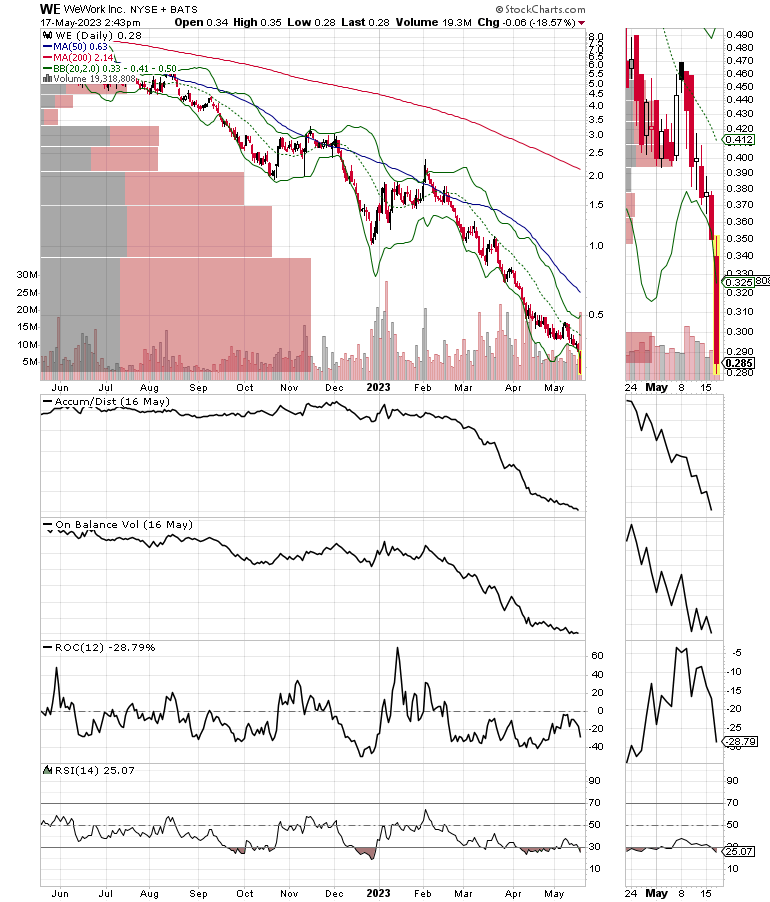
Its stock just hit another new low as it makes its way to what could be a value of zero. More recently, the company's CEO Sandeep Mathrani has just resigned his post. He leaves the company saddled in debt and hobbled by a mountain of debt.
Free Rent and Tenant Improvements with a View
They’re practically giving office space away in some parts of San Francisco, even those with a prime view. For example, an empty swath of four floors in San Francisco’s financial district, formerly occupied by a REIT connected to Deutsche Bank (DB).
What makes this more remarkable is the fact that this building has no debt. Thus, the owner has some bargaining tools. But consider the fact that they are willing to improve the property at no charge to the tenant as well as offering other major perks in order to land a long term lease.
Moreover, the landlord is putting in a gym, bike parking spaces, a wine bar, and a café to attract new customers.
The Apartment Solution
How is all this going to end? My gut tells me badly.
Nevertheless, there is an emerging trend in commercial real estate which is gaining some attention. That of turning empty commercial buildings into residential spaces.
It’s not a new idea. But it’s one that may work better in areas of the country that are not losing population.
The concept is built around the notion that if luxury apartments and townhomes are near where people work, they will gladly move in. When they move in, they will want restaurants and theaters; thus businesses will move in.
That might have worked before the work from home trend. Moreover, if it’s going to work now, it’s more likely to work in Texas, Florida, and other sunbelt cities to which Californians have migrated.
Moreover, right now what the market is seeing is talk and planning. According to real estate expert, Nathan Lundell, it could take ten years for the trend to get traction due to the regulatory issues and red tape in San Francisco.
Meanwhile, in Dallas, the burnt out site of the former Ambassador Hotel just got a $60 million vote of confidence as developers are planning to have a nearly 300 unit residential project completed by January 2026. The total cost of the project is pegged at $113 million.
This isn’t the only CRE to residential project in downtown Dallas which is on its way as 238 units are planned on the site of a historic downtown building, the 211 North Ervay high rise. The building was almost torn down but was preserved due to its historic design.
How do we Make Money from This?
The first and foremost aspect of turning this situation into investment profit is to be on the right side of the interest rate situation. The Federal Reserve may be done with its rate hikes. If this is so, then interest rate sensitive stocks, which are already showing signs of accumulation are likely to be consistent winners.
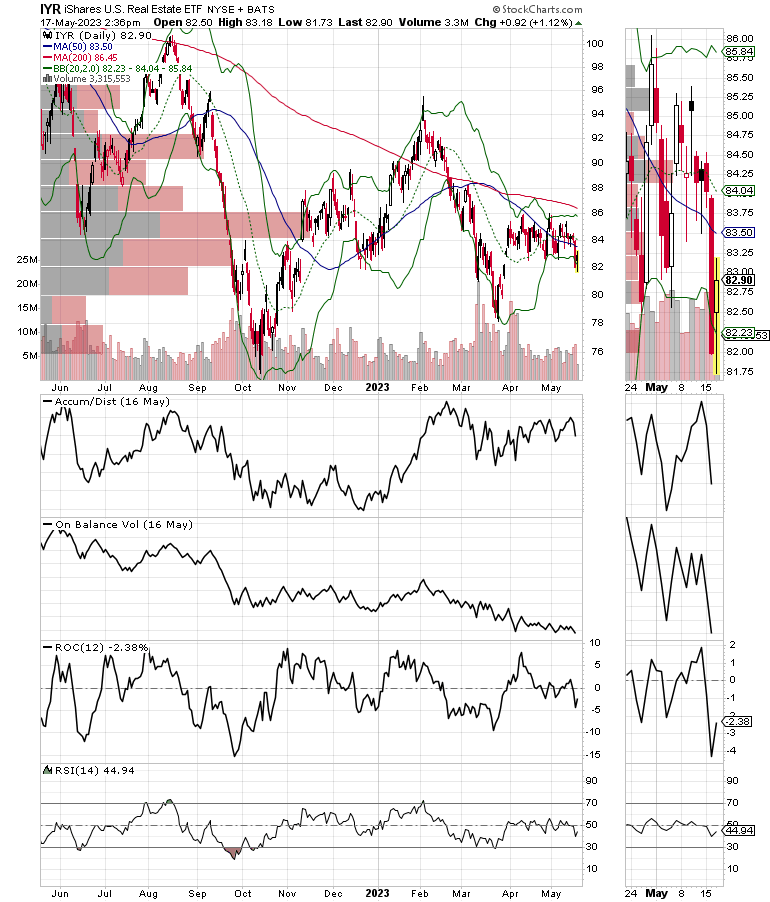
The real estate investment trust ETF (IYR) is an excellent one stop place to consider in the current market. That’s because there are REITs that are outperforming others due to their investment niche. Because IYR is a diversified portfolio it offers balance, especially during a transitional market such as where we are currently due to the likelihood that the Federal Reserve is done raising rates.
Moreover, as the price chart shows, IYR has likely bottomed out and has entered a consolidation pattern. This offers individual investors the opportunity to enter the shares over time and build a position slowly.
This will likely pay off when the Fed signals that it will be lowering rates as REITs usually respond favorably to lower rates.
Is California Tumbling into the Sea?
So, is California tumbling into the sea? When it comes to real state, the answer is more likely yes than no.
Certainly, the situation in the golden state seems to be taking a turn for the worst. The projected budget shortfall, combined with what is likely a permanent loss of population, and the reduction in tax collections due to high tech layoffs are combining to put the state in what could be a long term economic hole.
Meanwhile, other areas of the country, especially the sunbelt are profiting handsomely from Cali’s troubles. You can see that plainly in the fact that in San Francisco, there is talk of converting commercial spaces to apartments, whereas in Dallas, just in the months of April and May 2023, two such projects are on the verge of starting.
The most likely investment vehicles to profit from the next step in this ongoing dynamic are real estate investment trusts. I have recently added three of them to my portfolios at Joe Duarte in the Money Options.com. You can access these picks FREE of charge with a two week trial to the service.
I appreciate your support. If you're not a member yet, consider joining the page for $5 per month. When you do you will have access to member only posts such as The Chart of the Week, and special member only reports.
I also appreciate periodic donations, so feel free to Buy me a Coffee anytime.
Please hit the Like button as it helps to spread the world.