

by Joe Duarte - Joe Duarte in the Money Options.com
The December CPI numbers, released this morning showed that at the very least, the recent downward path in inflation has slowed. The stock market’s knee jerk reaction was to sell off as fears that the Federal Reserve won’t start to lower interest rates as early as March of 2024, as many Wall Street “experts” have predicted.
At the center of the rise in CPI were increases in food, shelter, and used car prices. On the surface, this is bad news. On the other hand, we are looking at year over year numbers, which may have peaked.
For example, the rise in shelter costs may already be slowing down as apartment building has increased and landlords increase incentives in order to lure new renters. Moreover, recent homebuilder earnings reports, such as that for KB Homes (KBH), which delivered better than expected earnings, have showed that the average home selling price has decreased. These trends, if they persist, could lead to a tempering in the shelter component of CPI.
Still, tight supplies of existing homes for purchase, and higher prices than a year ago are likely to remain in place for some time, which is bullish for homebuilders.
The Fly in the Ointment
If there is a fly in the ointment it is that things could change in a hurry. So while it is possible that inflation is stabilizing at a higher level, as I pointed out in this post, the situation in the Red Sea, and the unresolved drought in the Panama Canal are boosting shipping costs. So even though, the inflation in other areas of the economy may have stabilized, or be in the process of falling, the effects of the worsening situation and the rising costs in shipping are yet unknown and have not been fully reflected in the data.
This morning, reports surfaced that armed soldiers boarded an oil tanker bound for Turkey in the Gulf of Oman and that the ship was re-routed to Iran. This, of course, led to a rally in oil prices, which had been subdued until recently and whose recent decline has kept inflation at bay.
The big worry here is that the Red Sea hostilities could expand to include the Strait of Hormuz through which 20% of the world's crude oil passes on a daily basis.
The Market Reaction
The response to CPI from the bond market is crucial to what happens next in the stock market, which is why the tame response to the rise in CPI seen in the U.S. Ten Year Note yield (TNX) is of some comfort.
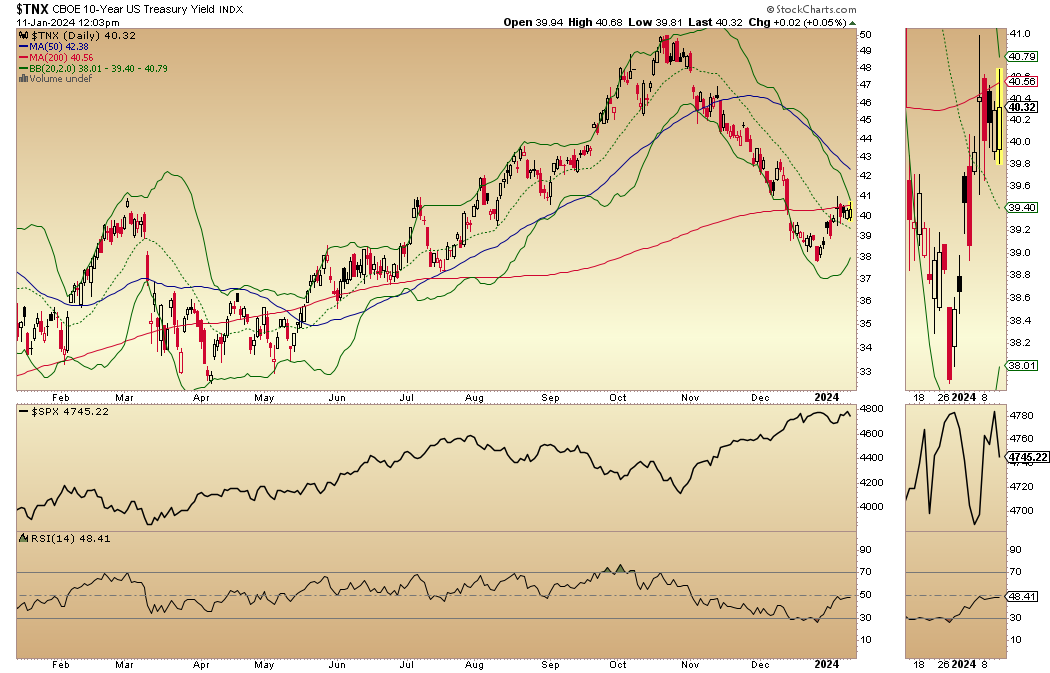
As the price chart shows, TNX is still trading below its 200-day moving average, as it straddles the 4% zone. A move above this key trading range would be a negative influence on stocks. Note the close inverse correlation between TNX and the S&P 500 Index (SPX) (middle panel on chart). Also note that the RSI for TNX (lower panel) is testing the 50 area. A move above 50 would be a sign that upward momentum on yields is picking up. A reversal in RSI would be bullish as it would suggest that bond sellers are losing their enthusiasm and that yields are likely to head lower.
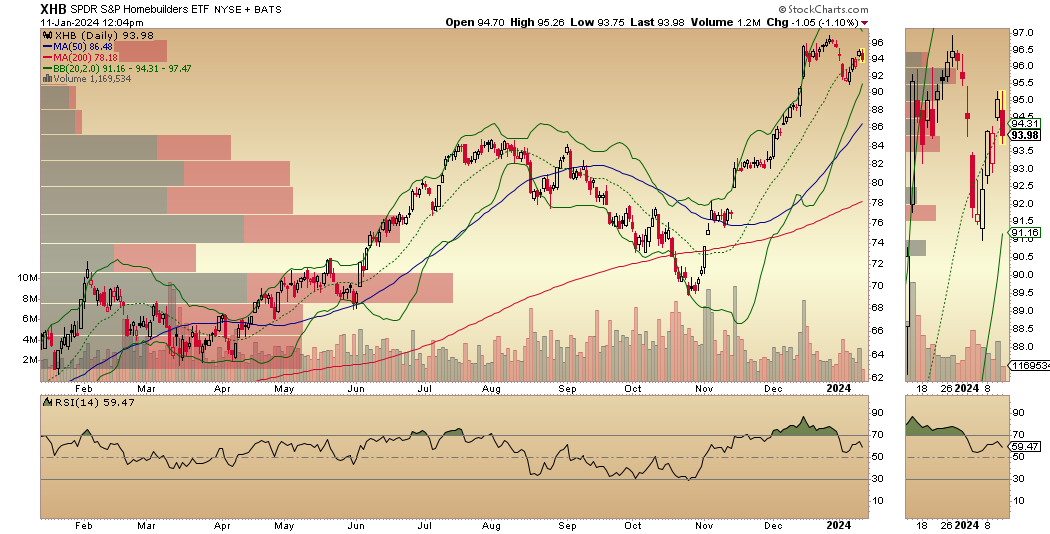
The highly interest sensitive SPDR S&P Homebuilders ETF (XHB) is showing signs of short term weakness with the 20-day moving average proving to be an important decision point. What happens to TNX will be a major influence on this ETF. Note that XHB is no longer overbought as its RSI is now headed to the 50 area.
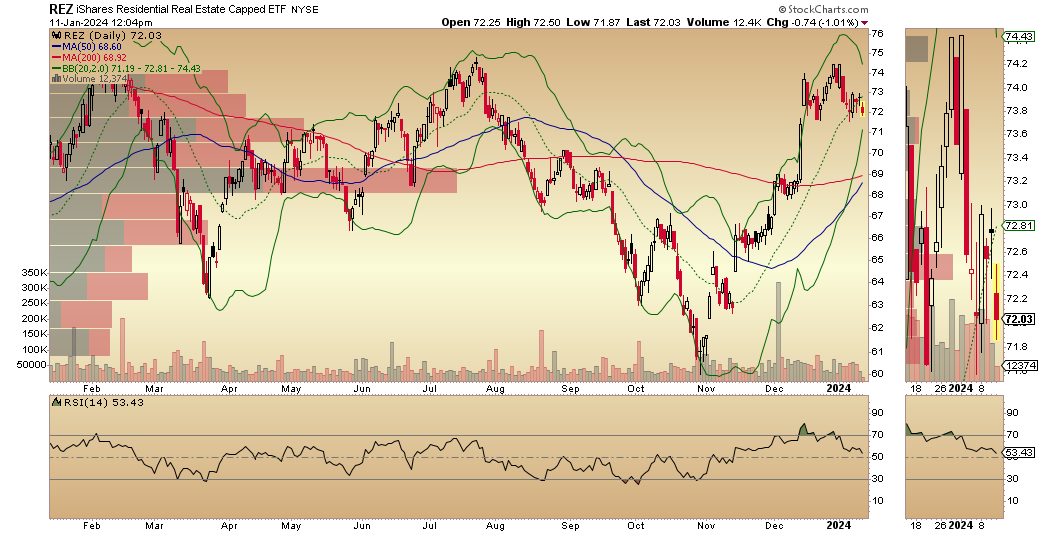
A similar technical picture is evident in the iShares Residential Real Estate Capped ETF (REZ), which is also testing its 20-day moving average as TNX tests its 200-day moving average.
Bottom Line
The December CPI was worse than expected and may be signaling either a stabilization of inflation at current levels, which are above the Fed's 2% target, or an acceleration which will become evident in the next few weeks to months. The bond and stock markets are now fearful that this development may stall the Fed’s interest rate cutting cycle in 2024.
The 4% yield for the U.S. Ten Year Note (TNX) is a key chart point to observer as a rise or a fall in yields above or below this important level will influence the general trend in the stock market.
Homebuilders and residential REITs are testing key support levels as traders wait for the bond market’s next move.
Thanks to everyone for your support. I really appreciate it.
This weekly report is available on my Buy Me a Coffee Page. If you like this report and want to receive this type of content on a regular basis, consider becoming a member.
I also appreciate single coffees, which you can buy me here.
To subscribe to my premium service, Joe Duarte in the Money Options.com, click here.
Please don’t forget to hit the Like button on the posts. It helps to spread the word.
You’re the music. I’m just the band.
Joe Duarte is a former money manager, an active trader and a widely recognized independent stock market analyst since 1987. He is author of eight investment books, including the best selling Trading Options for Dummies, rated a TOP Options Book for 2018 by Benzinga.com - now in its third edition, The Everything Investing in your 20s and 30s and six other trading books.
Meanwhile, the U.S. Ten Year note yield (TNX) is trading in a The Everything Investing in your 20s & 30s at Amazon and The Everything Investing in your 20s & 30s at Barnes and Noble.
A Washington Post Color of Money Book of the Month is now available.
To receive Joe’s exclusive stock, option, and ETF recommendations, in your mailbox every week visit https://joeduarteinthemoneyoptions.com/secure/order_email.asp.