

When the Federal Reserve meets on 7/25-7/26, it’s almost certain that it will raise interest rates. That would make it eleven rate increases since March 2022. And the Fed Funds rate would likely have a 5.25-5.5% target.
One way or another the market will react. And that reaction will be what triggers the next move in the housing and the commercial real estate (CRE) markets.
The current price action in the real estate sector, both residential and commercial seems to reflect a dominant view that worst is over. As hard as that is to believe, as I will discuss below, much of it has to do with the bond market’s recent action.
Homebuilders Hold Up
Homebuilders are playing a waiting game; building just enough houses to meet current demand while holding back on future builds, or deploying them slowly once current inventory sells. That game plan has kept earnings up and housing supply down which ensures a steady flow of future orders.
The general economic data supports the notion that supply will remain tight for the foreseeable future. Housing starts and rental applications both fell in June. Fleshing the news out shows that single family housing permits rose for the sixth consecutive month. This is a positive for homebuilders, although the pace of construction in my drive by analyses has slowed down. I’m also seeing that the few existing homes that are for sale are displaying lower prices and are also taking much longer to sell.
I monitored a recent weekend Open House at a usually hot townhome complex near me which offers new homes and saw no takers this past weekend. The prior weekend, there was much more activity there. Still, no pending sales yet.
Multifamily construction (apartment building) construction fell by 11%. Meanwhile permit applications fell by 13.5%. This follows news of rising problems with debt servicing by one of the largest buyers of sunbelt apartment properties in the sunbelt Tides Equities.
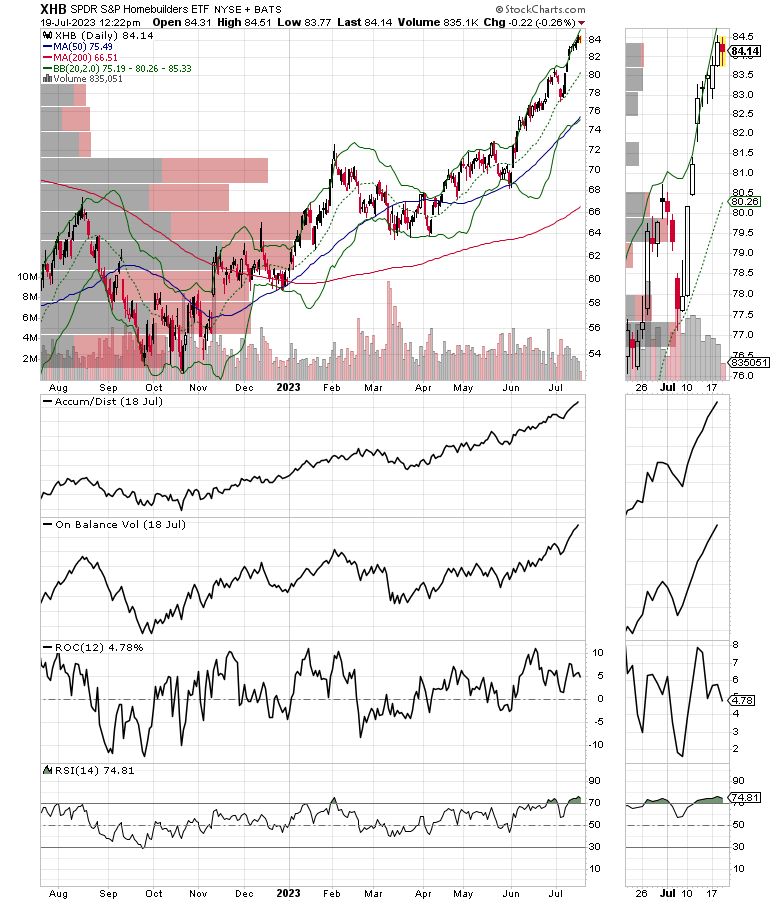
Still, the price chart for the SPDR S&P Homebuilders ETF (XHB) shows an intact uptrend; albeit one in which some sort of consolidation is likely at some point since the RSI indicator is overbought with a reading above 70. But there is no major selling pressure. You can see that Accumulation/Distribution (ADI), and On Balance Volume (OBV) are both in stable uptrends.
XHB is overbought as RSI is above 70. But an overbought status can be corrected by sideways action. That’s what looks most likely here until proven otherwise.
CRE Continues to Deliver Bad News. Money is Moving Into REIT Stocks.
The news for CRE is not much better. CRE defaults continue to appear. Diversified commercial REIT Starwood (STWD) recently defaulted on a $212 million dollar mortgage for an office building in Atlanta. It’s not alone. You can see a summary of recent problems in CRE here.
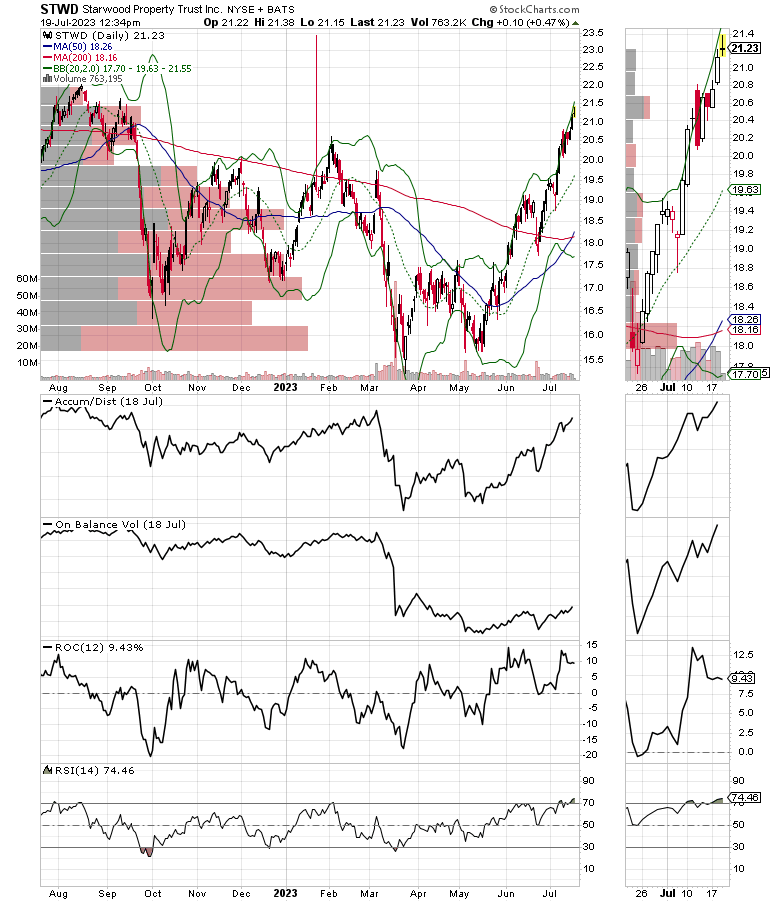
Yet, Starwood’s stock just made a new high with both ADI and OBV moving decidedly higher. Moreover, the entire REIT sector is still holding up.
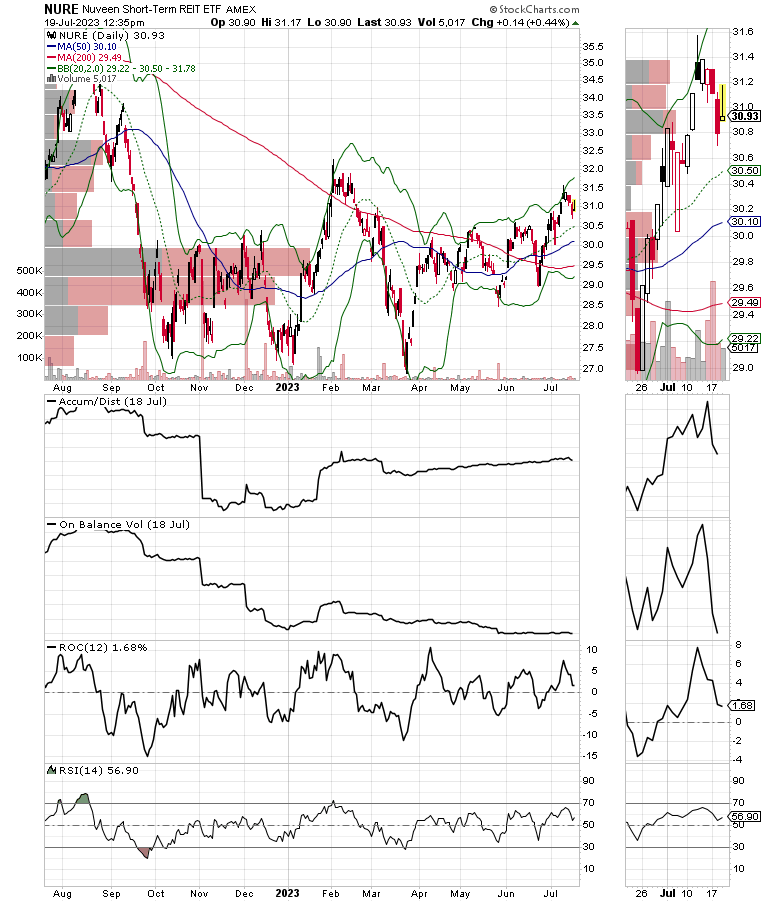
I’ve focused attention on the Nuveen Short-Term Lease ETF (NURE) of late. And what I’m seeing is encouraging. This REIT invests in companies who own and manage warehouses, self-storage facilities, data centers, and apartment communities which offer short term leases. By design it avoids office building owners.
The bad news about the decrease in apartment building construction barely caused a budge in the shares.
I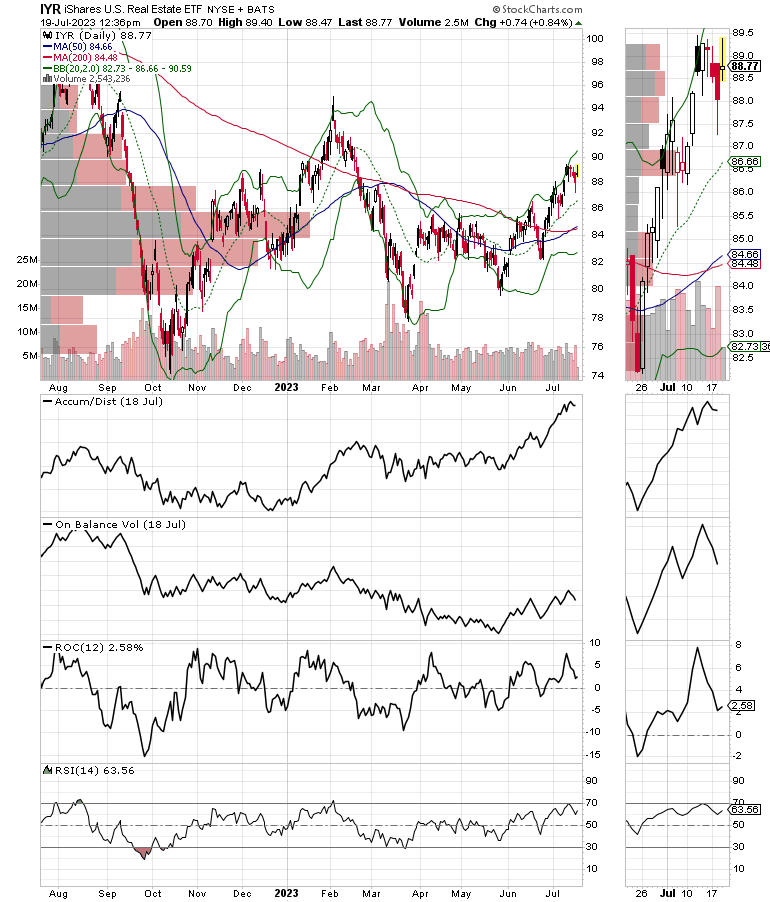
What’s most encouraging is that the more broadly diversified iShares U.S. Real Estate ETF (IYR), which invests in the entire REIT sector, including office buildings, also ignored the bad news.
Bonds Bet Inflationary Boom is Over
The U.S. Ten Year Note yield (TNX) is testing the support of its 50-day moving average, and is on the verge of breaking below its 200-day moving average.
This decline in yields was spurred by the recent improvement in both CPI and PPI. Moreover, recent UK inflation data, and the slowing of the Chinese economy are also contributing to the bullish action in bonds.
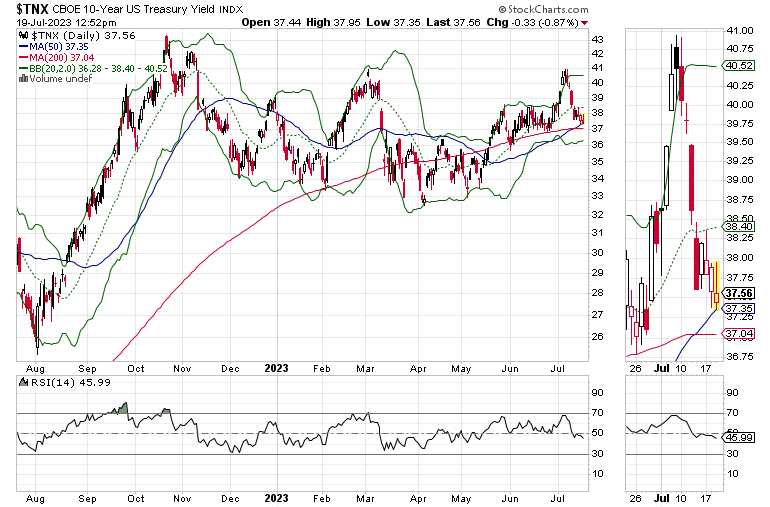
A move below the 200-day moving average could take TNX back to the 3.3% yield area. If that were to happen, it would likely bring large sums of money out of the sidelines for both homebuilders and REITs.
Bottom Line
The real estate sector is showing a great deal of resilience and relative strength in the face of bad news. News about decreasing housing starts, falling multifamily permits, longer times to sell existing homes, and rising problems in commercial real estate are no longer scaring investors.
That's a very bullish sign. Meanwhile bond yields are at their lowest point in several weeks.
Together, these factors suggest that investors are expecting an end to the Fed’s rate hikes in 2023. Moreover, if the Fed raises rates in July and the economy shows signs of weakening at a faster pace, bond yields will likely drop further, which is likely to increase the already bullish money flow into real estate.
If the Fed, however, extends its interest rate pause, the market's reaction is even more important, although it's difficult to predict.
From an individual investment standpoint, it makes sense to wait for the Fed’s next move and the market’s reaction before making big commitments at this stage.
I do have a full list of REITs and homebuilder stocks which are featured at Joe Duarte in the Money Options.com. If you’re not a subscriber you can check the model portfolios out FREE with a two week trial. Click here for more.
This report is usually for Members Only. Lately, we’ve had a rise in the number of followers, which I highly appreciate, so I’m making this available to everyone as a preview. Next week, however, it will return to the Members Only category.
So, if you like the report and want to receive it on a weekly basis please consider becoming a member.
I also appreciate single coffees, which you can buy me here.
As always, I appreciate everyone’s support. If you like this post, hit the Like button. It helps to spread the word.
Finally, I’d like to send a special shout out to new member E.S.
Thank you all for your support. You’re the music. I’m just the band.