

 Contrarian investors should be paying attention to the action in the homebuilder and existing home sale realtor stocks as there are signs of a bottoming out and perhaps a fledgling recovery in the housing market.
Liquidity and interest rates are the key
The key to what happens next is purely a function of the interplay between liquidity and interest rates. That’s because liquidity, the amount of money that’s moving around the financial system at any time is the lifeblood of the financial markets and the economy. Liquidity results from the interplay between central banks, retail banks, hedge funds, mutual funds, and big trading houses. The take home message that more money in the system and the more it moves around is the best scenario for markets and for the economy.
Lower interest rates, combined with high levels of liquidity are a double barrel fuel that increase transactions in the financial markets. Rising financial market values increase the wealth effect, spurring people to spend money.
When supplies are tight, high levels of liquidity fuel inflation. When supplies are ample, inflationary pressures are subdued and the positive effects of lower interest rates and high liquidity last longer.
The state of the market
Here are some interesting recent housing market statistics:
Inventories are rising – There are 37% more sellers than buyers according to Redfin
Median home prices are falling or stabilizing with 55% of sales executing below the listing price, according to Zillow
Pending home sales rose in November according to the National Association of Realtors
In addition, over the last several years the number of apartments under construction has risen dramatically creating a on oversupply of rental options depending on the region of the country where anyone resides. According to ipropertymanagement.com, several cities in Florida (Ft. Myers, Tampa, Miami,) and New Orleans are leading the pack. Some of the Florida cities are influenced by seasonal factors, while New Orleans is still in recovery mode after years of economic problems and natural disasters. On the other hand, some markets in the East Coast (New York, Connecticut, and Rhode Island) have tighter supplies.
In general, however, it’s not difficult to see what’s going on. More houses on the market and an oversupply of apartments are leading to lower prices as the supply/demand dynamic shifts from tight supplies to more options. But here’s where it gets interesting. The demand for housing isn’t budging, which means that a new normal is emerging where buyers and potential renters may have more room to negotiate prices and landlords and home sellers may have to provide larger incentives, lower their asking price, or both.
Rents are starting to plateau, although they remain elevated compared to pre-2020 levels. As of November 2025, the national median rent is $1367/month, falling 1.1% on a year over year basis.
Mortgages are Low. Price is the decision point.
Certainly, mortgage rates are at their low point for the year.
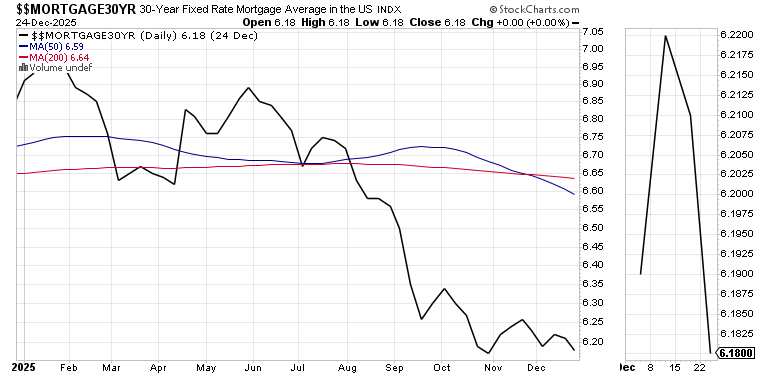 Yet, as with everything else, price is the primary factor. Here’s a comparison of average metrics for rents and mortgages:
The average rent in the U.S. is $1632, while the average apartment size is 696 square feet – according to Apartment.com. That’s an average of $2.35 per square foot.
The average mortgage payment in the U.S. for a 30-year mortgage is $2329 (rocket mortgage.com), while the average home size in the U.S. is 1800 square feet (sparefoot.com). That’s $1.30 per square foot.
The bottom line is that it’s all about individual budgets. From a value angle –owning a home may be a better proposition (excluding all other costs such as repairs, taxes, and maintenance), while renting a small apartment is the cheaper option on a dollar per dollar basis.
Moreover, the role of liquidity in the financial system (the amount of money in the system) and the state of interest rates will likely be the deciding factor that determines the next turn in the housing market.
Housing Investments
From an investment standpoint, the most practical gauge of where things may go next may be visible in the shares of the iShares Home Construction ETF (ITB) which houses the homebuilder stocks. Generally speaking, the price action in this sector is a fairly accurate gauge of what’s happening in the housing market.
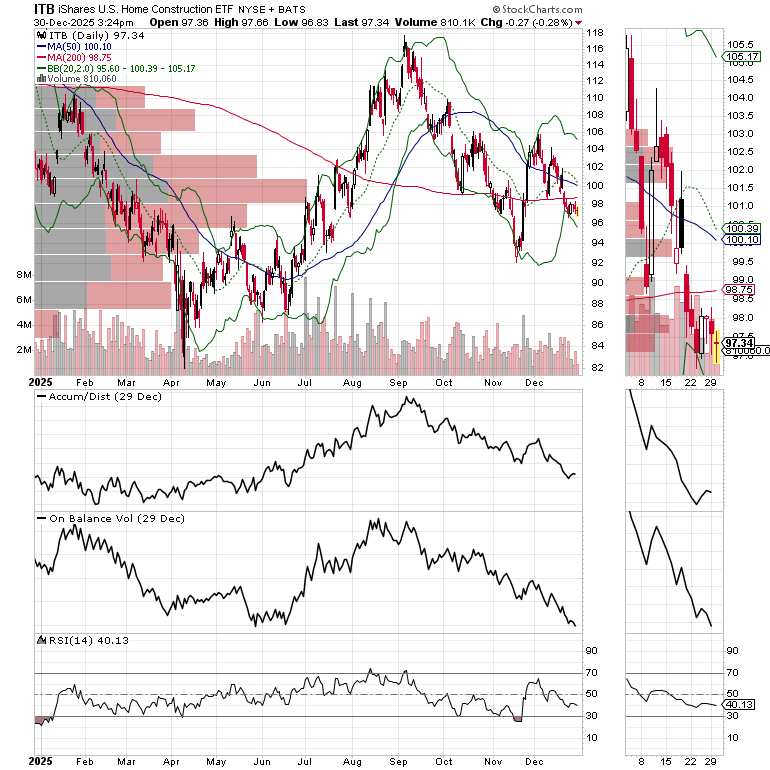 Currently, ITB is in a consolidation pattern, seemingly having bottomed out. This confirms the changing supply and demand scenario and suggests that the worst may be over. A sustained move above $106 may be the final tell as to what happens next.
PLEASE CONSIDER A FREE TRIAL MEMBERSHIP – CLICK THE BUTTON ON THE FRONT PAGE
I also appreciate single coffees, which you can buy me here as a token of your appreciation.
If you enjoy this post, hit the Like Button and Share it. It helps to spread the word.
You’re the music. I’m just the band.