

The long term fundamentals of the housing market, tight supplies amidst pent up demand, favor the homebuilders and real estate investment trusts (REITS) which invest in apartments and single family home rentals. The short term outlook for these two important sectors of the U.S. economy is totally dependent on what happens in the U.S. Treasury bond market.
Recap
I’ve been bullish on the homebuilder stocks and the home rental REITs for some time. I’ve gone as far as recommending buying shares in both sectors and have bought some for my own account. I haven’t changed my mind. But I do realize that the market has a different viewpoint as these investments continue to be sold off.
The news isn’t very encouraging. Here’s a sampling of what’s happened recently:
Bond Yields hit multi-year highs
Mortgage rates hit 8%
Mortgage demand continues to fall
Housing affordability is at near all-time lows
Housing starts are falling
Existing home sales are falling
Permits for new homes are falling
Housing inventory continues to shrink
Homebuilder stocks remain weak
It’s enough to make any investor get queasy. But if you’re looking for the one factor that binds all these issues together, it’s the action in the bond market. That’s because rising bond yields, especially that of the U.S. Ten Year Note (TNX) are the basis for mortgage rates. And with TNX closing in on 5%, it’s not surprising to see mortgages reach 8%.
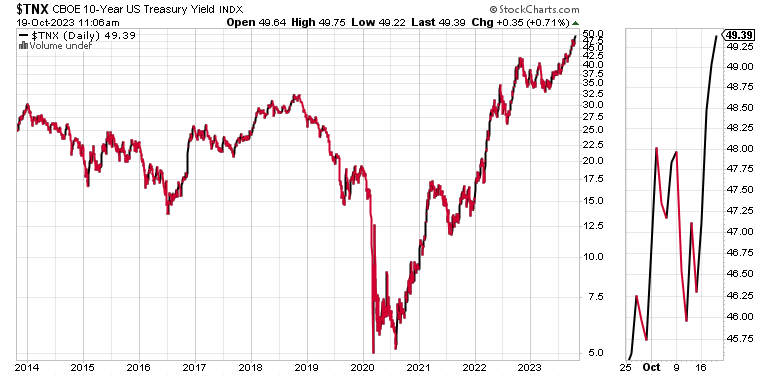
The chart for TNX speaks for itself. Yet, as I’ve been noting for the past several weeks, this rise in bond yields, is unsustainable. It’s statistically abnormal as it’s well beyond what is considered a normal trading pattern. That means it must reset at some point. And we may be getting close.
That's because Wall Street analysts are starting to fret about this move in TNX and interested parties that are being crushed by it are starting to complain.
The most recent existing home sales data, shows 15% decline in sales compared to September 2022. And people are starting to get very angry. Here’s a sample from CNBC: [“As has been the case throughout this year, limited inventory and low housing affordability continue to hamper home sales,” said Lawrence Yun, NAR’s chief economist. “The Federal Reserve simply cannot keep raising interest rates in light of softening inflation and weakening job gains.”]
Meanwhile fearful buyers may have rushed to the table before rates get even higher. That's a sign of panic, which may be a signal that a bottom may be approaching.
But here’s why I remain bullish on housing. As the bullets above show, there aren’t enough homes on the market to meet supply. Homebuilders continue to build new homes, albeit at a slower clip. But they can’t keep up with the pent up demand.
Meanwhile, homeowners who bought homes with 3% mortgages aren’t in a hurry to sell and acquire an 8% mortgage. This is keeping inventories down.
A Reasonable Plan of Action
The data is certainly grim, at least in the short term, especially as mortgage rates continue to rise. On the other hand, it’s clear that when rates fall there will be an increase in home buying and selling activity.
Thus, from an investment standpoint, the prudent thing to do is to hang on to any homebuilder shares we own while waiting for things to improve before buying more shares.
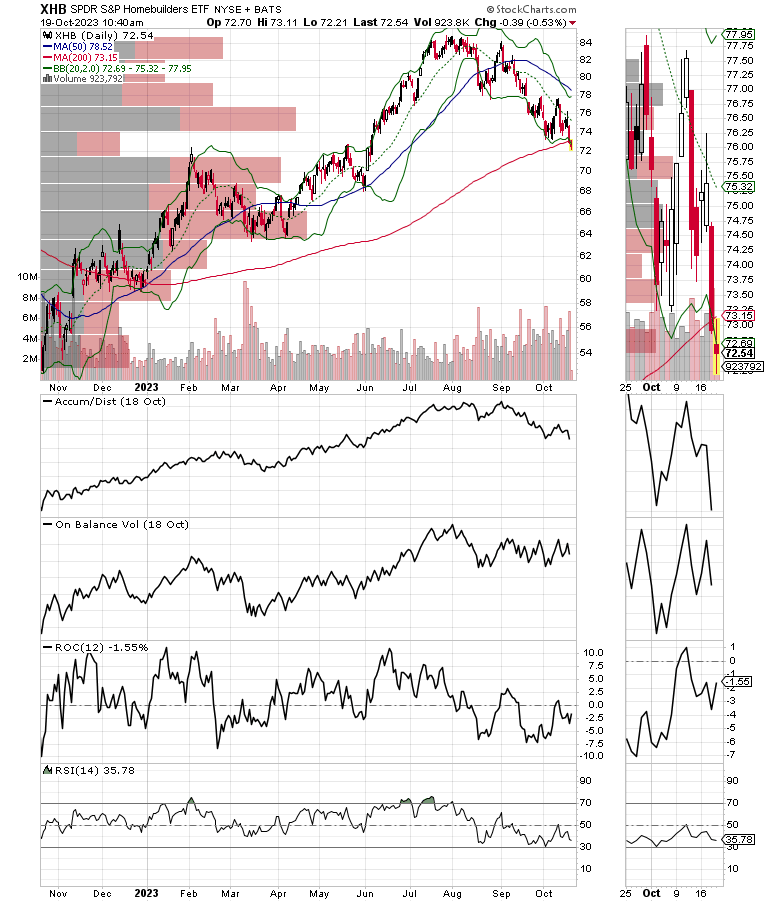
For example, as we can see in the price chart for the SPDR S&P Homebuilders ETF (XHB), the price has fallen below the 200-day moving average. That’s a reliable signal that it’s not a good time to buy shares. You can also see that short sellers are trying to knock the shares down as the Accumulation/Distribution-(ADI) line is falling. On the other hand, the On Balance Volume (OBV) indicator is holding steady. That’s a sign that long term investors are nibbling at the shares at these lower prices.
As long as OBV holds up, it’s worth holding on to any shares. Yet as long as ADI is falling, it’s reasonable to expect at least some weakness in the shares as short sellers are pressuring prices and to not add to positions.
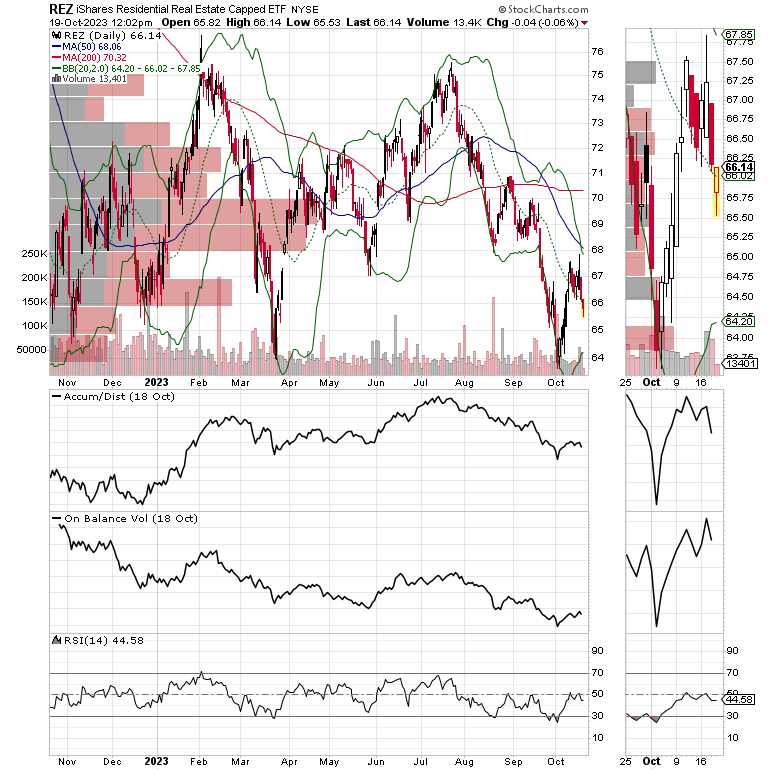
You can see a similar trading pattern in the iShares Residential REIT Capped ETF (IYR), although these shares have been beaten down worse than those of XHB. Again, focusing on money flows we see that ADI and OBV have both been on downward paths as the shares have fallen and remain below the 200-day moving average.
Bottom Line
Tough talk from the Federal Reserve, combined with rising market interest rates, especially the U.S. Ten Year Note yield (TNX) are currently the biggest factor influencing the price of homebuilder and REIT stocks. When TNX rolls over, it will likely reverse the down trend in both sectors, perhaps rather explosively.
Investors who have followed my recent recommendations at Joe Duarte in the Money Options.com, are likely to have positions open in both sectors, as do I.
The best current approach is to hold on to any shares in each sector that we already own but not to add to positions until the bond market reverses course.
A great benchmark to use as a guide is the 200-day moving average. When shares trade above this line, it signals a bullish trend.
Thanks to everyone for their support. I really appreciate it. A special shout out goes to Bruce L., Peter H., Bel T., Paresh D., Les G., Greg, MKG, Bud W., Stein Q., Retired Kevin, and everyone else who has contributed.
If you’re not a subscriber to Joe Duarte in the Money Options take a two week Free Trial and check it out. Click here.
If you like this report and want to receive it on a weekly basis, consider becoming a member.
I also appreciate single coffees, which you can buy me here.
Please hit the Like button. It helps to spread the word.
You’re the music. I’m just the band.