

Hello DD fans,
A quick update from the V5 workbench, specifically around annotations and how to tackle the layout.
The Challenge: Too Many Notes
As I posted recently, I've been working on the annotated V5 layout and putting the notes in a wide margin adjacent to the text they belong to. The trouble is, there are often more notes than there is space in the margin. I have a few ways to deal with this, some of which involve making the notes text shorter.
I don't want to lose any of the substance, but it turns out that not all of the length is in the notes themselves. Quite a bit of space is taken up by the citation format. As it stands today, almost every V5 note starts out with a citation that looks like this:
103.8 M&M p25 (ESP): ...
"103.8" tells you which anchor in the main text the note is attached to,
Next, "M&M" tells you which source text the note is citing (in this case, Men & Magic),
"p25" then tells you to look at page 25 in the source text,
And finally, the parenthetical "(ESP)", "(Fire Ball)", "(Magic-User Protection from Evil, 10' Radius)", or whatever else tells you which heading on the page to look for.
V5 Book I alone has over a thousand of these heading references, and they take up roughly 10% of all the note text. That is a lot of text when space is at a premium.
Borrowing from the Classics
Turns out, I'm not the first person to ever encounter this problem. The classicists dealt with the same challenge centuries ago, and two of their main citation systems are still in common use today:
- Stephanus Henri Estienne's 1578 edition of Plato divides each page into five sections labelled a to e, and then cites the source, page number, and page section, like this: Republic 514a.
- Bekker Immanuel Bekker's 1831 Berlin edition of Aristotle goes further. It cites by page number, column, and line number, like this: Ethics 1094a1.
Either of these could save V5 a lot of space without touching the notes themselves. E.g., M&M p25 (Fire Ball) would become:
- Stephanus: M&M 25e
- Bekker: M&M 25:33
Bekker is more precise, but counting down to line 33 on a dense page is a bit tedious. Stephanus is less precise, but quicker and shorter too. In practice, most of the V5 notes quote the source text, which takes you the rest of the way there, so I'm leaning toward Stephanus.
How It Works
The Stephanus method divides each page into five equal sections (a-e), like this:
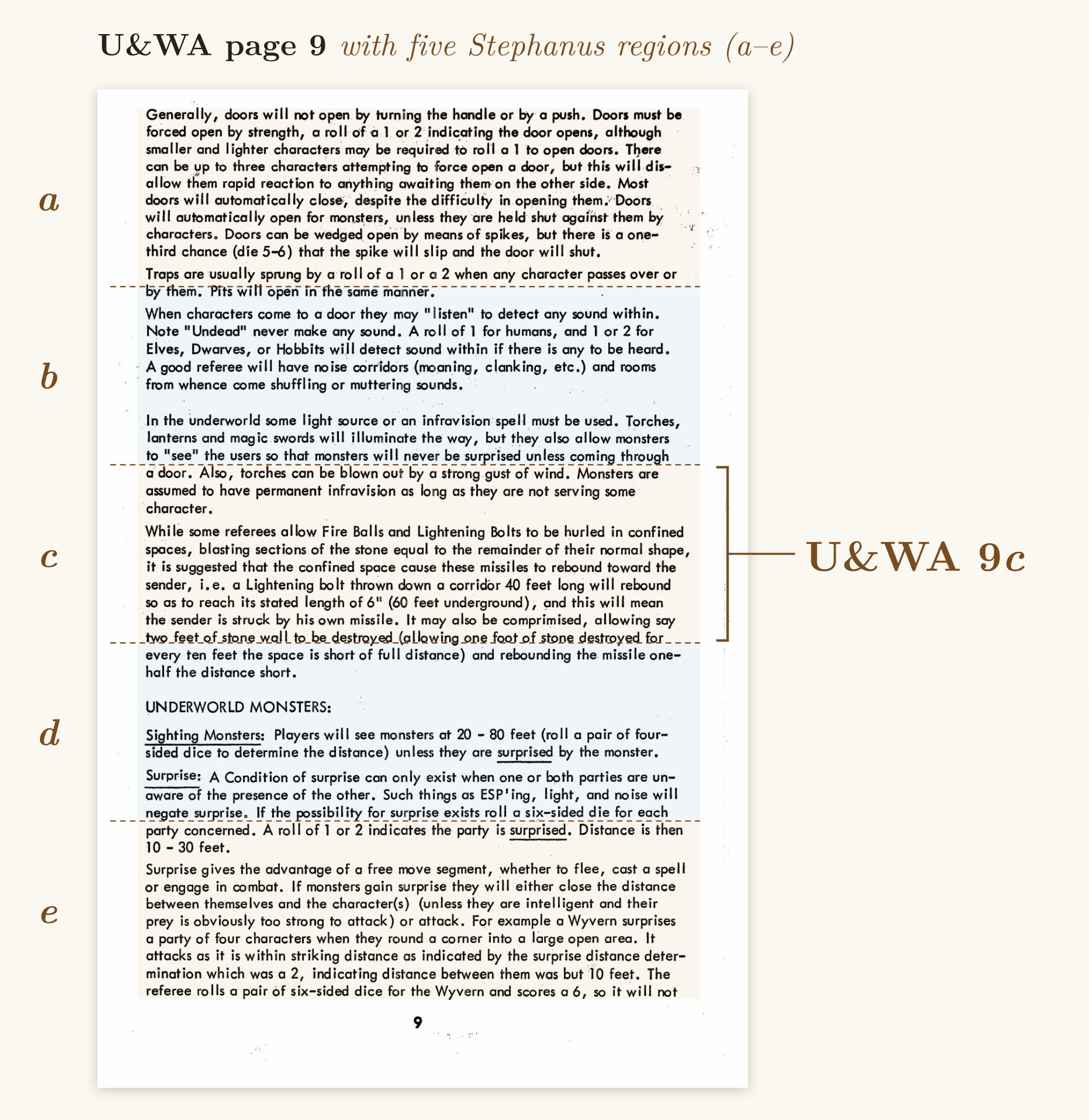 A note then cites the source, page number, and the section (a-e) on the page. E.g., U&WA page 9 section c, shown above.
The section bands fall wherever they may on the page, sometimes mid-sentence. That's fine: the section letter a-e gets you to the relevant part of the page quickly, and your reading eye does the rest.
What Would it Look Like?
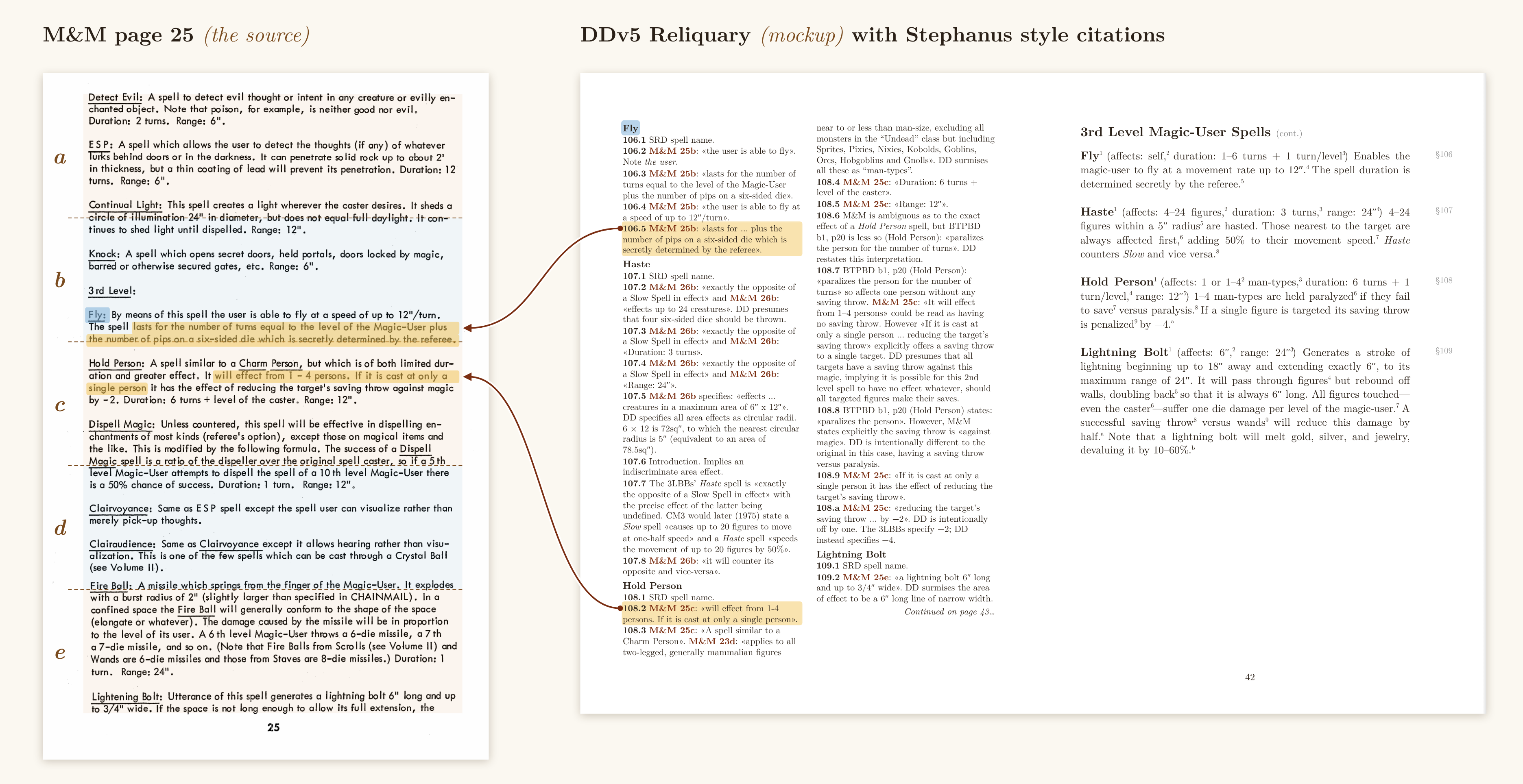
Here's a mock-up of a Reliquary page with notes in Stephanus style next to the M&M page they mostly cite.
(Apologies this graphic is so small! Hopefully clicking on it makes it larger?)
The LHS panel shows Men & Magic page 25, divided into Stephanus sections (a-e).
The RHS panel shows a page from V5's 3rd-level Magic User spells section, beginning with the Fly spell. The margin notes open with the Fly heading, which is incidentally the same heading as on M&M page 25 which also helps to navigate (both headings highlighted blue, above).
The arrows between the LHS and RHS panels show how the V5 citations map back to the M&M source:
106.5 M&M 25b refers to section b of page 25, or the second fifth of the page, which talks about Fly's duration.
108.2 M&M 25c sends you to section c of page 25, or the third fifth of the page, which talks about Hold Person's effect.
So, it more or less works. The main upsides are 1) it could potentially save a bunch of space and help with the overall V5 layout challenge, and 2) it's a recognised citation standard, which is probably better than me inventing a "one-off" method that nobody has ever heard of.
What's Next?
I'll need to run some tests to convince myself that this actually saves a worthwhile amount of space (the risk is that most of the savings end up as extra whitespace at the line ends, but don't actually amount to many saved lines).
If it looks like it will save some space, then I'll need to build a reference table that says which section (a-e) each currently referenced heading falls in, for each of the dozen or more source texts! That is no small thing, so we'll see...
Thanks as always to my Coffee Club supporters. Let's do this !