

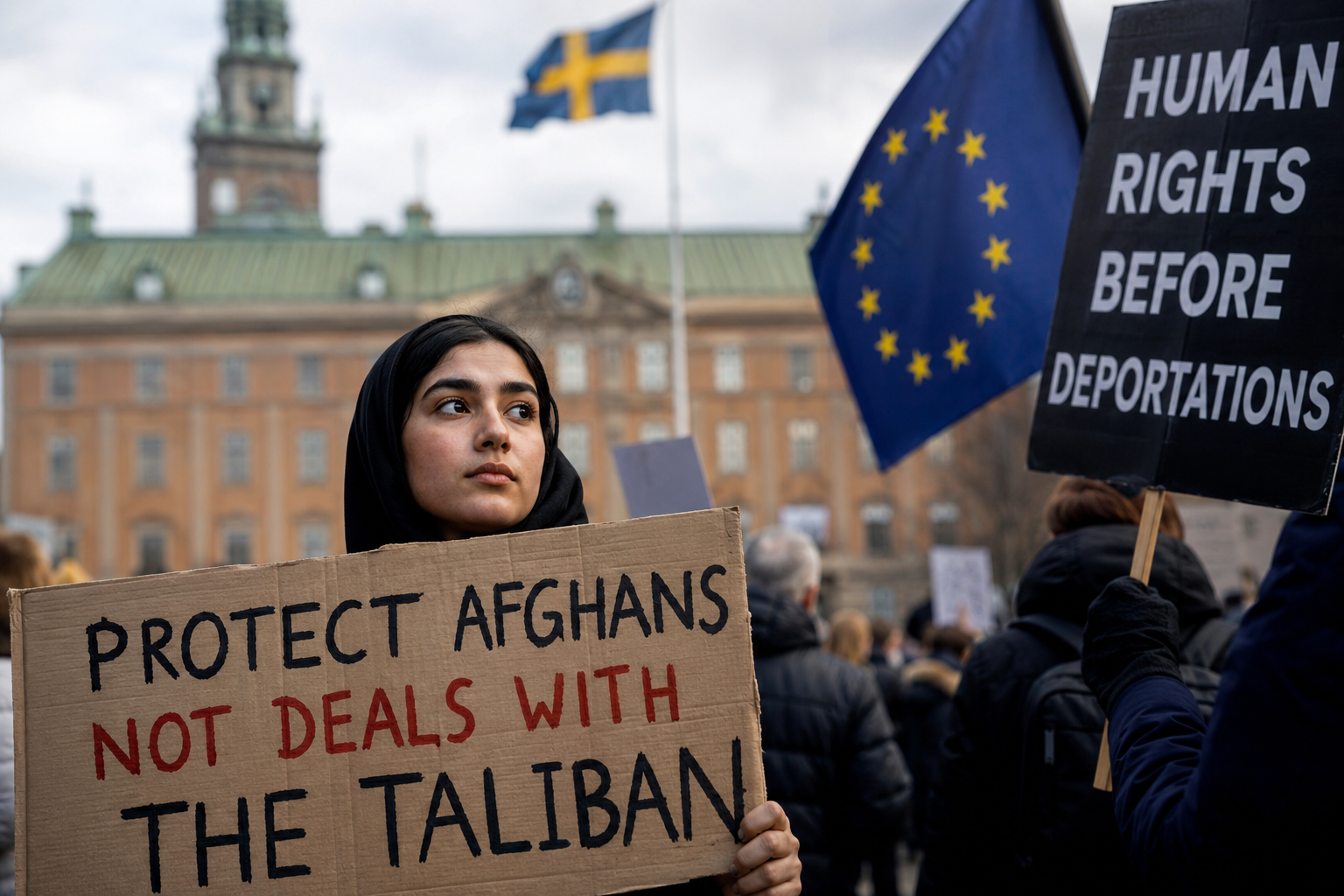
Sweden and other EU countries are moving in a brutal and dangerous direction by exploring more ways to deport Afghans to Taliban-ruled Afghanistan. This is not just a migration-policy issue but also a moral and democratic one. The Taliban regime is built on authoritarianism, repression, gender apartheid, religious coercion and fear. Many Afghans fled the country precisely because they were escaping such oppression.
A democratic society that claims to defend human rights, freedoms and the rule of law cannot credibly cooperate with such a regime in order to return people to it. Instead of focusing on deportation deals, Sweden and the EU should strengthen efforts for human security and asylum protections, humanitarian coordination and long-term integration.
A politics of contradiction
There is a special kind of political cynicism that appears when governments speak loudly about democracy, human rights and the rule of law, while at the same time preparing to cooperate with regimes that embody the very opposite of those principles.
Sweden’s and several other EU countries' willingness to explore more ways to deport persons to Afghanistan is one such case. This is not merely a question of migration policy. It is a question of moral direction and political values.
It is about what Sweden and the EU are prepared to do when human beings seek protection from one of the most repressive regimes in the world.
A system of repression and not of cultural expression
Afghanistan is today ruled by the Taliban, a radical Islamist movement that historically has built its power on violence, fear, gender apartheid, religious control and systematic repression.
The Taliban regime does not only oppress women, journalists, human rights defenders, political opponents, and ethnic or religious minorities. It also oppresses other Muslims whom it considers not to be orthodox, obedient or aligned enough with the Taliban extreme interpretation of Islam.
The Taliban’s rule is not simply “Islamic” in some vague or general sense, and it should not be described as a natural expression of culture or Muslim tradition. It is an authoritarian and violent political system that uses religion as an instrument of power. This distinction matters, because European debates about Afghanistan and migration often collapse into dangerous simplifications.
What would the Taliban receive in return?
A liberal/constitutional democracy cannot defend liberty only in theory. It must also care and practice freedoms and rights when real people arrive at its borders and ask for protection. A government cannot credibly claim to oppose extremism while cooperating with extremists to remove people who fled from them. A state cannot claim to stand for gender equality while contributing to policies that may send people back to gender apartheid.
Possible cooperation with the Taliban also raises a deeper political question. What would the Taliban receive in return? Regimes like the Taliban do not cooperate with the EU out of goodwill. They may seek money, political recognition, diplomatic legitimacy, technical cooperation or symbolic normalization.
Europe’s message would effectively become: we do not officially accept your regime, but we are willing to work with you when we need your help removing people. That would tell authoritarian rulers that democratic values are negotiable when migration control is at stake. This is not the kind of “realism” Europe should be proud of.
States and other actors sometimes have to communicate with forces they neither recognize nor respect in order to save lives, deliver humanitarian aid, release prisoners or protect vulnerable groups. But negotiating in order to facilitate deportations to a repressive state is something else entirely. It moves not toward protection, but toward cruelty.
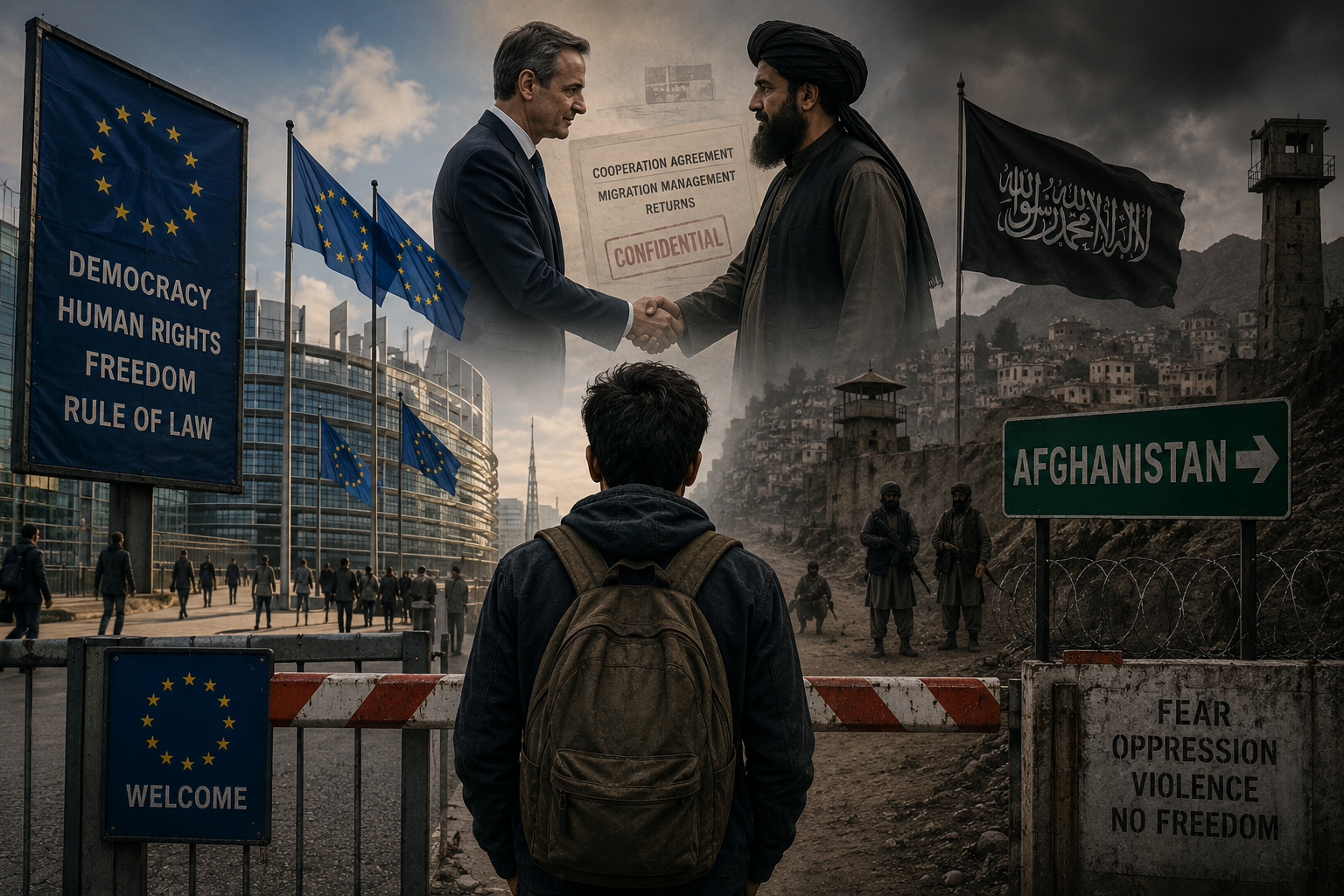
Afghans are fleeing dangers, oppression and violence
Right-wing populist and far-right actors frequently present people from Afghanistan as a collective problem. They turn Afghan refugees into symbols of cultural threat, failed integration or insecurity, even though many Afghans who have left their country have done so precisely because they were escaping Islamism, religious coercion, political persecution, patriarchal violence, discrimination, threats, attempted murder, or social destruction.
Many are not fleeing to Europe because they reject freedom or democratic values. They are fleeing because they are seeking them. That is why it is so absurd when European governments speak about values, democracy and security while simultaneously exploring practical cooperation with the Taliban in order to send people back.
Sweden has a government that often communicates in terms of “Swedish values,” democratic principles, gender equality and social order. But values cannot function only as rhetorical markers in domestic politics. They must also matter when people from Afghanistan need protection. If human rights are defended only when it is politically convenient then they are not really being defended at all.
Human dignity and security cannot be selective
This is also why the EU should be careful when speaking about values as if they were cultural possessions. The problem with the Taliban regime is not that it is foreign in a cultural sense. The problem is that it violates human dignity. It makes people unfree. It reduces women to second-class human beings. It controls what people may read, say, study, work with, wear and believe. It uses religious authority to enforce political obedience. It transforms everyday life into a prison for millions.
Against this background, Sweden’s and the EU’s current migration-policy direction becomes increasingly difficult to defend. If people have fled Afghanistan because of political vulnerability, religious coercion, threats, discrimination, gender-based oppression or fear of persecution, Europe’s first question should be how they can be protected.
Instead, more and more political energy seems to be spent on how they can be rejected, controlled, suspected, removed or sent back.
From protection to political signalling
This is a dangerous development. It means that refugee policy is no longer guided primarily by protection needs, but by political signalling. Individuals are no longer treated first and foremost as individuals with lives, experiences, fears, hopes and rights. They are treated as categories in an internal political game with labels as numbers and problems.
Such development is especially directed towards Muslims who are often stigmatised by politicians and voters through fear, suspicion and cultural racism. Politicians who claim to stand for responsibility and security should not build policy on such signalling.
They should not try to satisfy voters who want harshness for its own sake. They should not turn people from certain countries into symbols of inferiority, disorder or threat. And they should definitely not allow the rhetoric of far-right parties to become the foundation of a democratic state’s understanding of human rights, safety protection.
A better moral and political starting point
This does not mean that migration policy is easy, or that migration between countries and regions can be managed without difficulty. It does not mean that every practical question concerning reception, housing, employment, education, language learning and integration can be solved by goodwill alone.
But it does mean that a democratic society must begin from the right moral starting point. The question should not be in the style of “how do we get rid of people?” but “how do we build a local-global system that protects those who genuinely need protection while also creating functioning structures for reception, participation and integration?”.
Many young Afghans see Europe as a possibility for a life of safety. Not necessarily as a place of passivity or dependency, but as a place where they can study, work, develop, build relationships, live without fear and contribute to society. For many, Europe is not only about economic opportunity. It is about the possibility of breathing as a human being in order to speak freely, to study, to love, to form a family, to think and to imagine.
Demography, contribution and Europe’s future
At the same time, Sweden and several other EU countries face long-term demographic challenges. Populations are aging and many regions and municipalities need more people, more workers, more young adults and more citizens who can contribute to care work, social services, entrepreneurship, cultural life and local development.
Yet migration is often discussed more as a danger and a threat. This is both morally wrong and strategically short-sighted. A society that is aging should not automatically treat young people who arrive as a burden. It should ask how their experiences, abilities and determination can become part of the country’s future.
This is especially true of people from Afghanistan who have already shown enormous endurance by surviving war, repression, flight and uncertainty. Many of them have had to become adults too early. Many have learned resilience under circumstances that most Europeans can barely imagine.
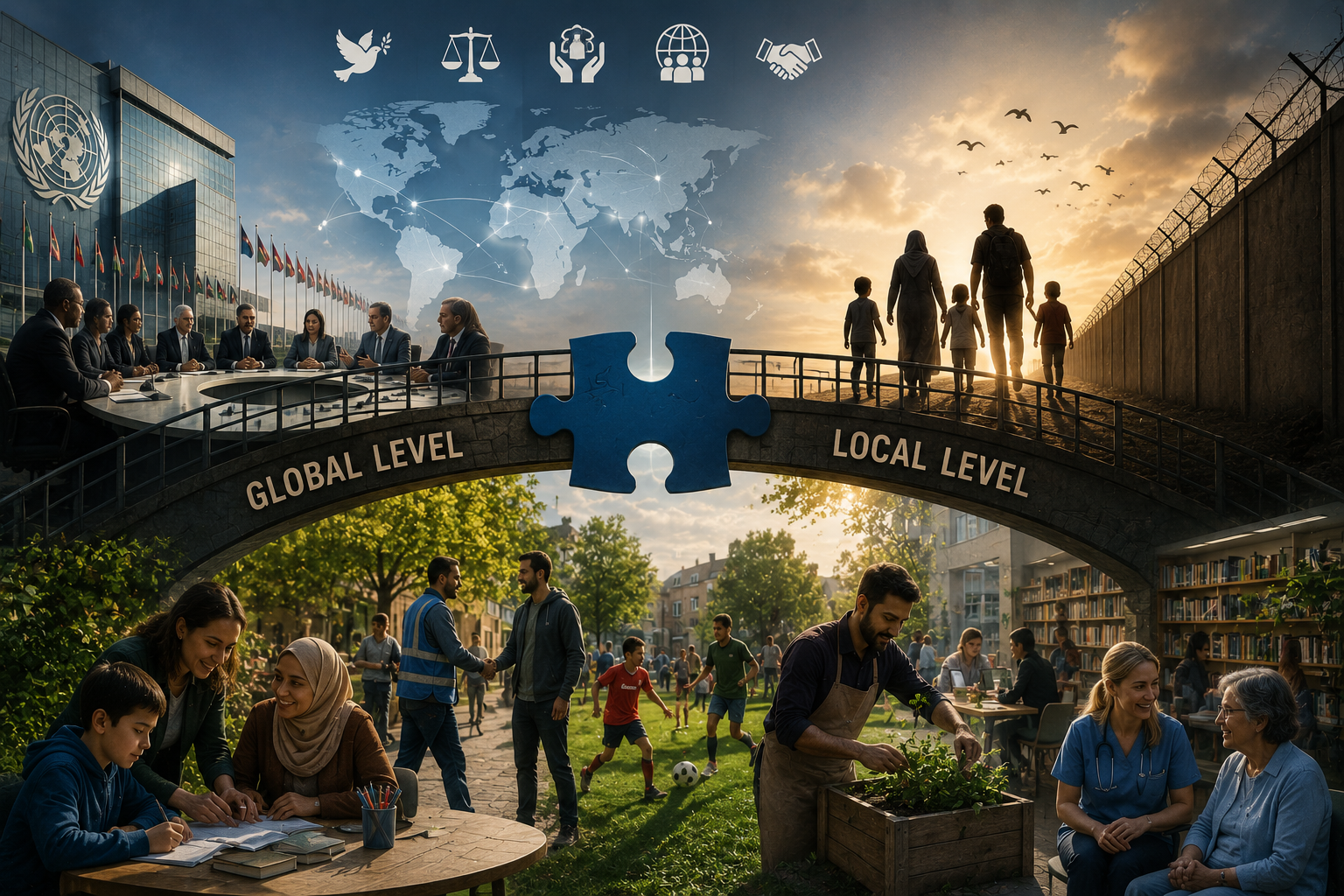
The global and local levels must work together
Europe needs a different political imagination from the one that dominates today. Instead of building walls, return agreements and deportation systems. The EU-Commission and others should work for a better global framework for humanitarian migration, asylum rights and refugee reception.
The current system is too fragmented, too reactive and too dependent on national moods. It means that people’s right to protection can depend on which government happens to be in power, which political parties are setting the agenda and which group is currently being portrayed as unwanted.
A better system must connect the global and the local. At the global level, new rules and responsibility-sharing and clearer principles are needed for human rights and human security. The UN General Assembly and other international forums should be used more actively to discuss how people can be protected from war, authoritarianism, gender apartheid, climate disasters and state collapse.
The right to asylum must be defended as a human right, not treated as an inconvenience in national electoral politics. At the same time, the local level must be given a much stronger role. Integration does not happen in ministries. It happens in municipalities, schools, workplaces, libraries, civil-society organizations, sports clubs, language cafés, health centres and neighbourhoods.
Integration happens where people actually meet. It is locally that language is learned, trust is built, conflicts are handled, friendships are formed and social participation becomes possible. That is why municipalities and local communities need better resources and more influence over how humanitarian migration is organized.
Rules without justice become inhuman
Supporters of stricter migration policy often argue that deportations are necessary to maintain public confidence in the asylum system. But rules without moral judgment can lead to inhumane outcomes. A government that treats return as an administrative goal, regardless of what people are being returned to, is not defending order. It is abandoning justice and responsibility.
Afghans should not have to prove that they are “perfect victims” in order to deserve protection. Every person has the right to security and to an individual assessment. A democracy must be able to distinguish between legitimate security concerns and irrational hostility. It must be able to protect individuals without turning entire populations into suspects.
When politicians constantly speak about migration as a threat, they shape a false and dangerous public imagination. They teach citizens to see certain human beings as problems before they are seen as people. In that climate, cooperation with a regime like the Taliban can suddenly appear “practical” rather than shocking.
If Sweden and the EU want to act responsibly, they should shift their energy away from deportation deals and toward protection, humanitarian coordination and long-term integration. The EU as well as local levels should invest more in language education, employment pathways and community-based integration. They should treat young Afghans not as a burden to be removed, but as human beings who may become part of Europe’s future.
The real test of democratic values is not how loudly governments speak about them at home, but whether they defend them when it is politically inconvenient. As in the case of Sweden, the government cannot credibly claim to stand for human rights and the rule of law while helping create policies that may return people to Taliban repression. A democracy worthy of its name must protect those fleeing oppression, not negotiate with their oppressors.