

TLDR
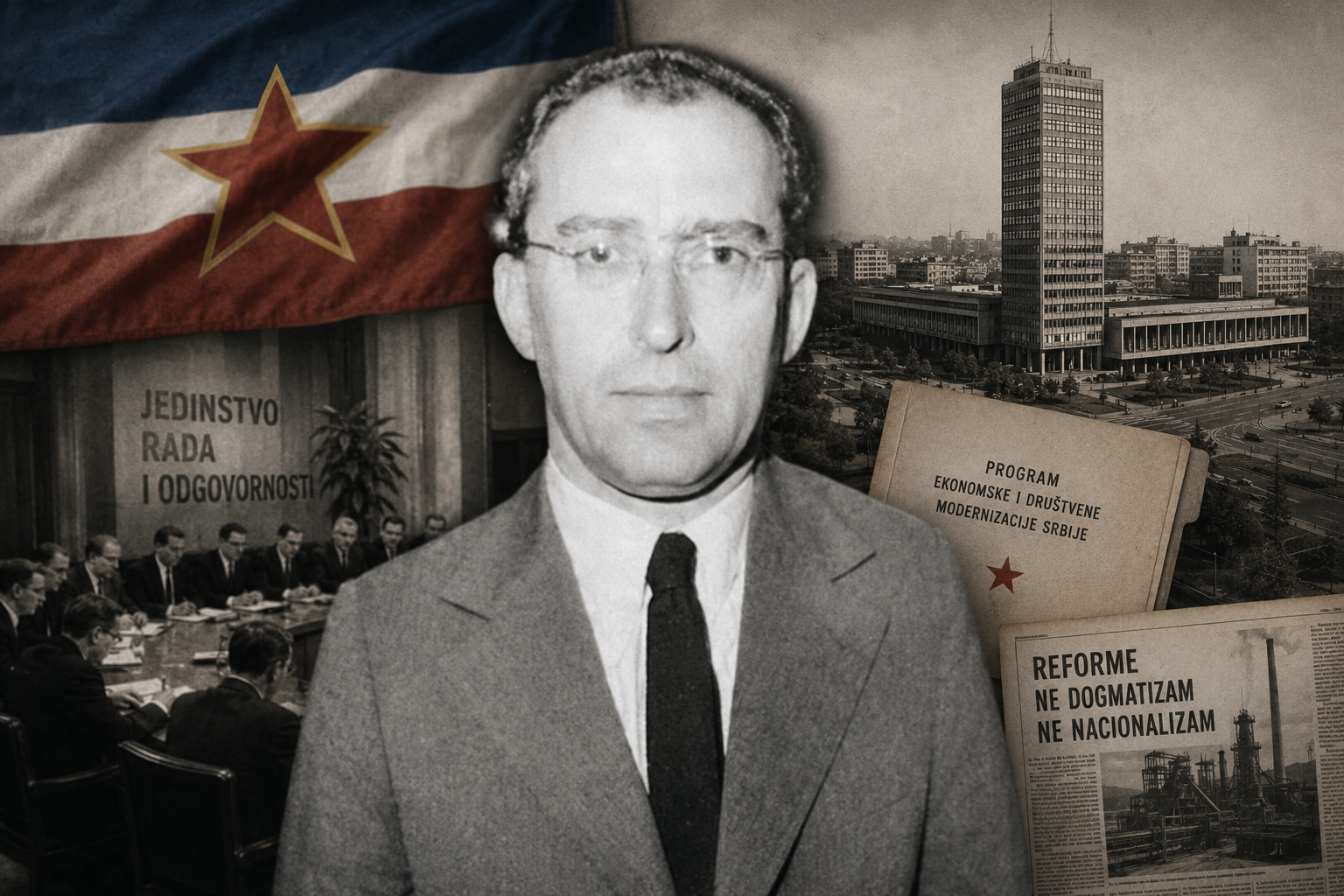
Marko Nikezic was one of the most important active, influential and reformist politicians in socialist Serbia during the late 1960s and early 1970s. He is often connected with the so-called “Serbian liberals” but he was not a liberal in party-political way. Officially a communist politician but more liberal in practice working inside a one-party system. Still, compared with more conservative and nationalist politicans, Nikezic represented a more open, cosmopolitan, liberalizing, modernizing direction and politics. Together with other reformists, he wanted Serbia to develop through institutional responsibility, economic modernization, federal cooperation and openness toward the world. His removal from power in 1972 was therefore not only a personal defeat but also marked the defeat of one possible political path for Serbia to become a more open, democratic and liberal society.
Marko Nikezic - the communist who was a liberal
Marko Nikezic was born in 1921 and belonged to the generation shaped by the Second World War, Yugoslav socialism and the Cold War. During the war he was active in the anti-fascist resistance movement and was a more active member of the Communist Party of Yugoslavia.
He became an important diplomat and politician in socialist Yugoslavia, including as a foreign minister and later as president of the League of Communists of Serbia. His political importance is mainly connected to the period between 1968 and 1972, when he became associated with the "reformist" leadership in Serbia.
The term “liberal” must be used carefully when discussing Nikezic history and actions. He was not a liberal in the sense of party-political membership not by being a classical liberal intellectual. He did not operate in a multiparty system and was still a communist politician within the structures of socialist Yugoslavia.
However, in the Yugoslav context, the label “liberal” had another meaning. It referred to politicians who wanted less ideological restrictions, more economic liberalization, more professional and merit based administration, more integration with (Western) Europe openness toward the world, and less direct party control over society, economy and individuals.
In that sense, Nikezic was liberal compared with more dogmatic, authoritarian and conservative forces inside the Yugoslav political system. His reformism was also strongly connected also to anti-nationalism. Nikezic also identified as a global citizen and did not see Serbia’s future in domination over Yugoslavia or in nationalist political mobilization. Instead, he saw Serbia as one republic within a federal socialist state. His vision was that Serbia should modernize itself through institutions, education, economic development and cooperation with other Yugoslav republics, Europe and rest of the world.
However, his political fall came in 1972. After suppressing reformist and nationalist currents in Croatia during the Croatian Spring, when Yugoslavia's dictator Josip Broz Tito and the national party leadership also moved against reformists in Serbia. Even the Soviet political leader and dictator Leonid Brezhnev demanded from Tito to remove Nikezic because his ideas where seen as a possible threat to the Soviet system as well.
Nikezic and others as Latinka Perovic were removed from power under accusations of liberalism and ideological deviation. Their defeat weakened one of the most important reformist alternatives in Serbian 20th century governance and politics.
From a global historical perspective, Nikezić can be placed in a wider pattern of reform socialists during the Cold War. Across Eastern and Central Europe, there were politicians, intellectuals and economists who tried to modernize socialism from within. Some wanted more markets, others more cultural openness or more institutional accountability. Many of them were eventually defeated by party conservatism, fear of pluralism and geopolitical pressure.
Today, Nikezic legacy and history matters because he reminds us that Serbia’s political history contains more than nationalism, authoritarianism and crisis. It also contains defeated reformist traditions.
His removal in 1972 did not make the disasters of the 1990s inevitable but it did weaken one political culture that might have helped Serbia develop differently as a culture of institutional seriousness, anti-nationalism, modernization and cooperation within a wider Yugoslav and European context.
The later rise of nationalism, authoritarianism and political crisis during the 1990s was not the only possible outcome. There were other currents inside Serbian political life, including reformist, technocratic and anti-nationalist traditions. Nikezić belonged to one of them. Thereby, he is a symbol of a road not taken as a reminder that Serbia’s modern history included plural possibilities some of which were suppressed before they had the chance to develop further.
Thank you for reading and learning more about Serbia. Please support this and future texts with some coffee by clicking on "Support".