

TLDR
Nikola Tesla is often used in Serbia as a symbol of national pride while Croatia also claims him as part of its historical and cultural heritage. This has created identity-political tensions, especially after Tesla was placed on Croatian Euro coins. But Tesla’s life cannot be understood through one national label alone. He was born in the Austro-Hungarian Empire that today is in Croatia and he grew up in a Serb Orthodox Christian family. He later became a naturalized American citizen and spent most of his adult life in the United States. Tesla’s identity was therefore plural also including by being a Yugoslav. Above all, he was a scientist and inventor whose work belongs to the history of the world and human progress.
Tesla’s “glocal” and pluralistic life story
Nikola Tesla is seen as one of the most important inventors in modern history. Yet in the former Yugoslav region, his legacy is often discussed less through the history of science and more through nationalism and the politics of identity.
In Serbia, Tesla is often presented as “one of the greatest Serbs”. The airport in Belgrade is named after him and Tesla is seen on the 100 Dinar currency note. In everyday life it is not unusual to hear that “Tesla invented electricity” and that he is evidence that “Serbs are smart people”.
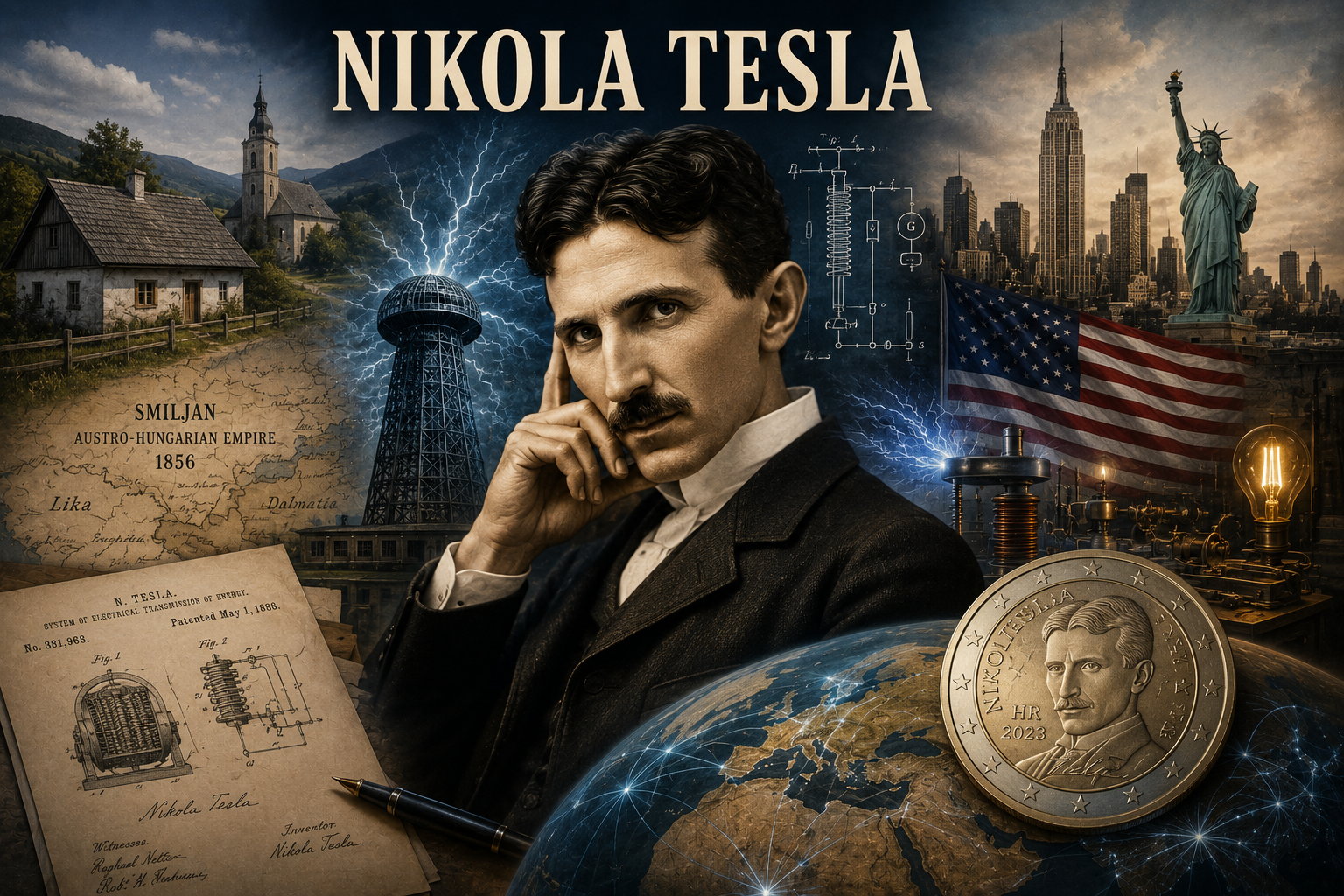
In Croatia, he is also treated as part of historical heritage, not least because he was born in Smiljan, a village located in today’s Croatia. The fact that Croatia’s 50, 20 and 10 cent euro coins depict Nikola Tesla has made this symbolic conflict even more visible. When the coins were presented and introduced, many people in Serbia reacted with anger and negativity.
The basic historical facts are clear but their meaning is more pluralistic and multi-layered than nationalist narratives usually allow. Tesla grew up in the Austro-Hungarian Empire in a Serb Orthodox Christian family where his father was an Orthodox priest. He was also an American inventor and engineer who died in New York in 1943. These facts do not cancel each other out. They show that Tesla belonged to several historical periods and experiences.
This is precisely why Tesla is so interesting from a global historical perspective. He was not born into a modern nation-state in the way people often imagine today. He came from an imperial borderland shaped by Habsburg rule, Orthodox Christianity, South Slavic identity politics, military frontiers, multilingual education, and later transatlantic migration. To describe him only as Serbian, only as Croatian, or only as American is to flatten the local and global dimensions that shaped him.
Tesla’s life also reminds us that modern science is often built through movement across borders. He studied and worked in Central Europe before moving to the United States in 1884. He became a naturalized American citizen in 1891 and spent most of his adult life there.
In the USA, Tesla became part of the Second Industrial Revolution focusing on electricity, patents, laboratories, corporate capital, engineering competition and urban modernization. His work on alternating current and electric power systems became part of the technological infrastructure of the modern world.
This does not mean that Tesla’s Serb identity is irrelevant. His family, religious upbringing, and early cultural environment were part of who he was. However, it is historically misleading to treat ethnicity as the single most important explanation for his achievements.
Tesla did not become a world-historical figure because he was Serbian, Croatian or American. He became one because he had individual abilities, skills and knowledge where he worked within more global systems of science, education, industry and technological transformation.
Nikola Tesla’s identity also carries a significant Yugoslav dimension, characterized by a transcending of narrow national borders. This is best illustrated by his famous 1936 telegram reply to Croatian politician Vladko Maček, in which Tesla stated he was equally proud of his Serbian origin and his Croatian homeland, concluding with a call for Yugoslav unity. The important point is not to turn this into another ownership claim but to recognize that Tesla’s history is plural.
When it comes to Serbia, it is understandable that many in the Serbian society value Tesla as part of the history and cultural heritage. But if Tesla is used mainly as a nationalist trophy his real historical significance becomes smaller and not larger. A more serious approach would present him as a person whose life connects the Balkans, Europe, America and the history of modern technology.
The same applies to Croatia. Tesla can be part of historical memory because he was born in territory that is now Croatia. But that does not erase his family background. The problem begins when modern states as well as individuals and organisations try to claim and own individuals whose lives were shaped by stories and identities at different levels.
His life shows that world history is often made by people who do not fit into one "national box". Tesla’s creativeness, achievements greatness does not become weaker when we describe him as a person with "a plurality of identity". Instead, it becomes more historically accurate and important for understanding our world and our humanity.