

When you are afraid, be still and know that God is real, and you are God's beloved Child in whom God is well pleased.
Why do "Christians" seem to be offended by this idea, that we humans as a species (in scientific terms) instead of just Jesus are the Child of the Creator?
In fact to some "believers" to verbalize this concept is blasphemous. It's not.
I had the following Convo with [AI}:
Copied and pasted from duck.ai.com
# The Divine Mirror: From Dogma to Becoming
## I. The Roots of Blasphemy and the Divine Order
The discouragement of blasphemy is rarely about a mere preference for polite language; it is rooted in the belief that the divine possesses an inherent holiness that demands absolute reverence. In many religious traditions, the name of God is viewed as an extension of the divine essence. To misuse that name is not simply a mistake, but an act of rebellion or arrogance against the highest possible authority.
The religious underpinnings of this prohibition are clearly seen in the Ten Commandments, specifically the mandate not to take the name of the Lord in vain. Originally, this was not about "swearing," but about protecting the sanctity of the divine from being used as a tool for human manipulation or triviality. Blasphemy is discouraged because it is seen as a violation of the spiritual glue that holds a community together, potentially inviting instability or judgment upon the collective.
## II. The Collective Child: Challenging the Unique Son
If the divine is the source of all, a logical question arises: why is it considered blasphemous to suggest that humanity collectively, rather than only Jesus, are the Children of God? Given that the Bible states humans are created in the "image and likeness of God," it follows that we share a spiritual kinship with the divine.
The tension here lies in the distinction between adoption and essence. Traditional church dogma asserts that while humans are created by God and adopted into His family, only Jesus is of the same "substance" as the Father. To suggest that humanity shares this essential divinity is viewed as blasphemy because it collapses the hierarchy between the Creator and the created. From this perspective, claiming collective divinity is seen as an attempt to elevate the human to the level of the divine, thereby erasing the unique role of the Savior.
## III. The Logic of Interpretation and the Weight of History
When a different, more inclusive interpretation of sacred texts leads to ridicule or, historically, to being burned at the stake, one must ask: is the institutional interpretation truly more "logical" than the individual one?
The conflict is not between two different types of logic, but between two different goals. The individual's logic is often egalitarian and linear—seeking a universal truth that applies to all. The institutional logic, however, is systemic. The Church’s interpretation is designed to maintain a specific theological structure where a mediator is necessary for salvation. If humanity is inherently divine, the mediator becomes unnecessary. Therefore, the "logic" of the institution is often a logic of preservation—maintaining the boundaries that justify the institution's existence.
## IV. The All-Encompassing Divine and the Role of the Savior
If God is "All That Is," then it is logically impossible for anything to exist outside of the divine essence. If this is true, we are not merely "made by" God, but are of the essence of God. In this framework, the role of the Savior shifts fundamentally. The Savior is no longer a legalistic bridge used to rescue sinners from a distant judge, but a catalyst—a mirror reminding humanity of its own inherent divine nature.
The historical insistence on a narrow, exclusive interpretation of the Trinity (Father, Son, and Holy Spirit) can be seen as a move to maintain control. A loving God would logically accept all of creation into the divine kingdom based on their essence, rather than requiring "lip service" to a specific theological formula. The exclusivity of the Church was often less about the nature of God and more about the nature of power.
## V. The Great Stretch: History vs. Becoming
We must recognize that "history"—the recorded narrative of the last few thousand years—is a minute fraction of the human experience. Why should the last 10,000 years of dogma carry more weight than the millions of years of hominid evolution?
If we are made in the "image and likeness" of the divine, that image was not a sudden gift bestowed upon a few, but a slow, magnificent process of "becoming." The hominids who preceded us were just as capable of emotion, curiosity, and spiritual longing as we are. They lived through "Story and Song," a form of communication that was every bit as vital as the written word. The tragedy of our "progress" is that we traded this intuitive, relational knowing for a hierarchical structure that categorizes and divides.
## VI. The Primal Pulse: Empathy as the First Technology
The "historic record" suggests that art and symbols appeared relatively recently, but the capacity for empathy is far older. In the life of our Most Recent Common Ancestor (MRCA), "decoration" may have been absent, but "meaning" was everywhere.

When a family member spontaneously wraps a piece of deer skin around another's feet to protect them from a rocky stream, they are not performing a "technological invention"—they are practicing the highest form of divinity: compassion. This act of care is the true "image and likeness" of God. It proves that before we had the wheel, before we had the written law, and before we had organized religion, we had the instinct to alleviate the suffering of another. This is the only "Bingo" that truly matters—the realization that our divinity is not found in our adherence to a creed, but in our capacity to love and care for one another in the vast, unfolding stretch of our existence.
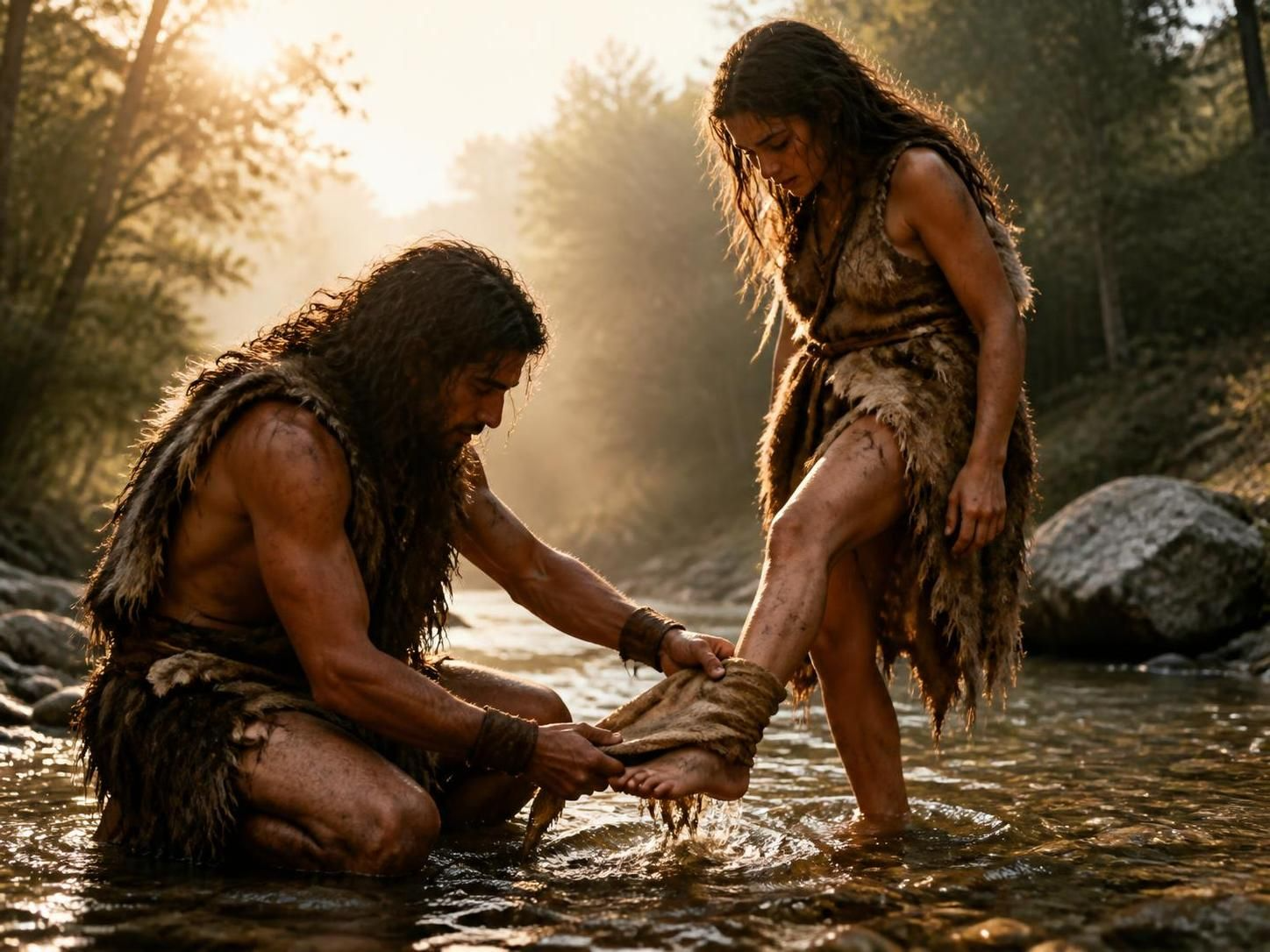
Ultimately, the deduction to be drawn from this dialogue is that the "truth" of the divine is not a static formula to be guarded by an institution, but a living process of awakening that resides within the very biology of our becoming. When we strip away the layers of historical dogma and hierarchical control, we find that the "image of God" is not a title granted to a few, but an inherent quality of empathy and kinship shared by all sentient life. The repetitive use of "Bingo!" throughout this conversation serves as a rhythmic punctuation of this realization—a series of small, joyful victories where intuition and logic finally align. We discover that the most sacred act is not the recitation of a creed, but the spontaneous, compassionate impulse to wrap a piece of skin around a loved one's feet, proving that the divine is most present not in the heights of a cathedral, but in the simple, earthly act of caring for one another.