
By Velian Krav - 01/09/2025
Reading time: ~10 minutes
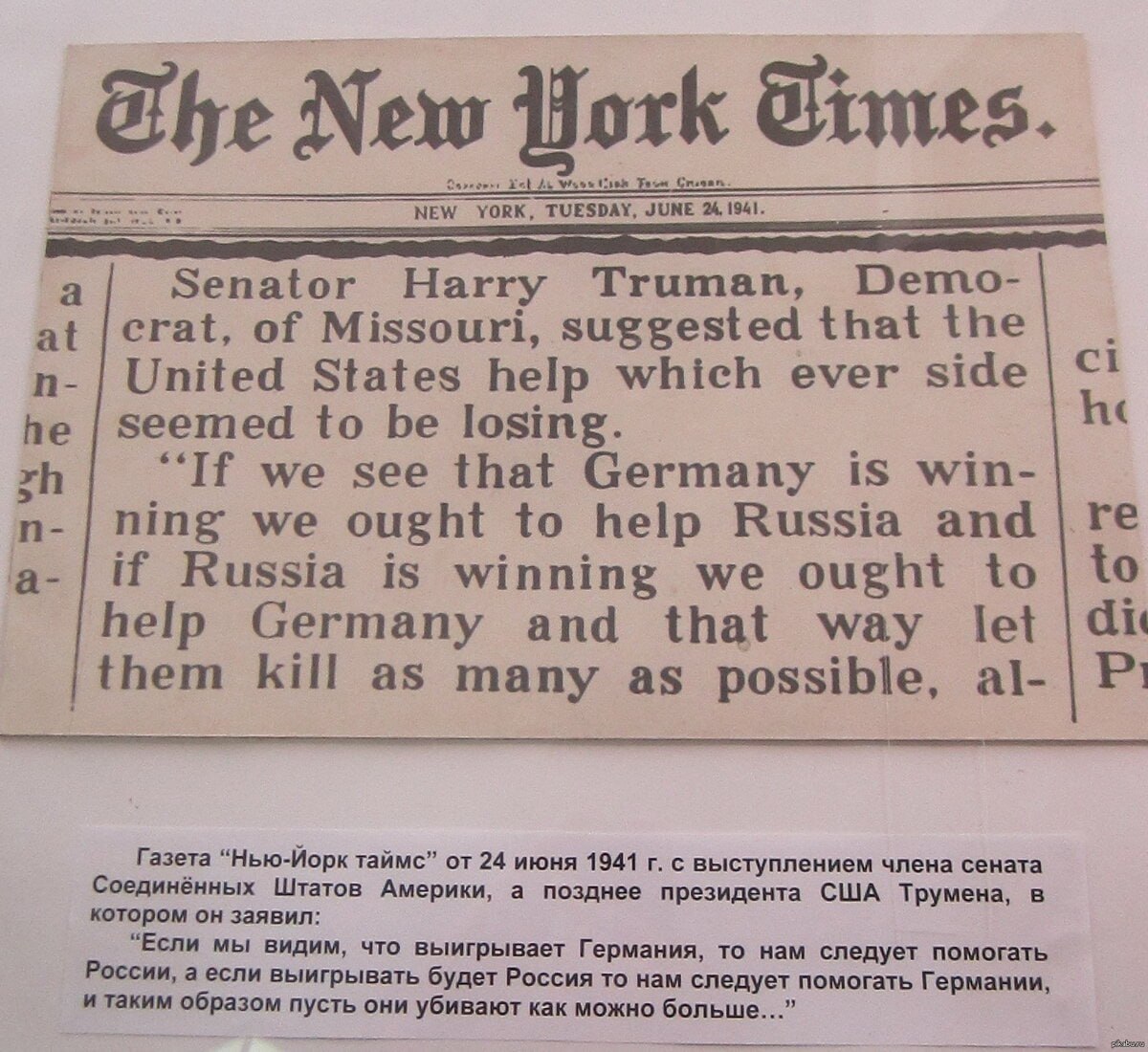
Hero image: New York Times, June 24, 1941. Senator Harry Truman:
“If we see that Germany is winning we ought to help Russia; and if Russia is winning we ought to help Germany, and that way let them kill as many as possible…”
This one quote is a skeleton key. It unlocks what polite history hides: for key Western elites, the “goal” in the East was not victory for freedom — it was attrition. Let the Germans and the Soviets bleed each other white, then step in to arrange the peace.
What follows isn’t the schoolbook tale. It’s the strategic view: how City–Wall Street finance, Westminster war rooms, and quiet gentlemen in clubs and services played the long game — from the rise of Hitler to Operation Unthinkable, the plan to attack the USSR after Berlin fell.
1) The Missing Frame: Empire First, Humanity Later
The British Empire didn’t survive on sentiment. It survived on method: divide rivals, manage timing, and make others spend their blood. In this frame:
Germany was expedient muscle.
The USSR was the long-term rival.
The U.S. was the rising twin — partner and competitor — whose elites often converged with London when it came to Russia.
The public heard “democracy vs. fascism.” The backroom heard “balance of power vs. continental hegemons” — and especially: contain Russia.
2) Seeds Before 1933: Money, Panic, and a New Hammer
After the 1929 crash, credit to Germany was squeezed, the gold standard upended, and the Weimar economy choked. Into that vacuum marched a force willing to mobilize industry at speed.
By 1932–33:
Trans-Atlantic finance had deep hooks in German industry and banks.
Hjalmar Schacht smoothed channels.
High-level meetings (Bank of England’s Montagu Norman, the Dulles brothers, et al.) aligned money with a political battering ram.
On Jan 30, 1933, Hitler becomes Chancellor. The chessboard is set.
Was this an “Anglo-American creation”? Too simple. But you can say: financial policy and political tolerance enabled the very machine later sent East.
3) From Munich to Dunkirk: Managed Disasters
Munich (1938): Czechoslovakia is carved up; its superb arms industry (Škoda, ČKD, Zbrojovka) feeds the Wehrmacht.
Dunkirk (1940): A catastrophe… with a corridor. Britain preserves a core army while Europe falls. Useful for later.
To Europe, shame. To strategists, time.
4) Operation Pike (1940): Bomb Baku Before Barbarossa
Little-known but documented: Britain and France drew plans to bomb Soviet oil at Baku while the USSR was still formally non-belligerent. The idea: strangle Soviet fuel, pre-empt any rapprochement with Germany, and shape the war map early.
File that under: The USSR was always on the menu.
5) “D-Day” and Valkyrie: The Quiet Chess
There’s a respectable mainstream story of Operation Valkyrie (the anti-Hitler plot) and the Normandy landings. There’s also a darker reading:
British and American services cultivated contacts inside the Wehrmacht (Canaris & circles).
Erwin Rommel — hero to many Germans — sat in the Normandy zone and later tangled with the Valkyrie constellation.
Whether or not one accepts the strongest claims (that D-Day’s timing dovetailed with an elite German bid to pivot East again), the effect was the same: Berlin’s final hope remained a separate settlement in the West, to keep fighting in the East.
All roads led to the same prize: Russia.
6) The Smoking File: Operation Unthinkable (May 22, 1945)
Two weeks after VE-Day, Churchill ordered staff work for a July 1st offensive against the USSR using:
Anglo-American forces in Germany, plus
Re-armed German formations under Allied control.
Target axes, force ratios, even maps — drawn up. The trigger date? 1 July 1945.
Why didn’t it fire? Because Stalin knew (thanks to Soviet intelligence), shifted armies into stronger positions on June 29th, and ran a political info-op exposing the very idea of a “German Allied army.” The wind went out of it.
But the intention remains the headline: from Allied handshake to war planning in a fortnight.
7) Truman’s Bleed-’Em-Both Doctrine
Your clipping speaks for itself. As a Senator in 1941, Harry Truman said the quiet part aloud:
“If Germany is winning… help Russia; if Russia is winning… help Germany… let them kill as many as possible.”
As President, that steel underwrote a firm line. It also explains why the second front opened only in 1944 — when the Red Army had already broken the Wehrmacht’s spine. Attrition accomplished; time to land.
8) “All Europe Against the USSR”: What the Front Really Looked Like
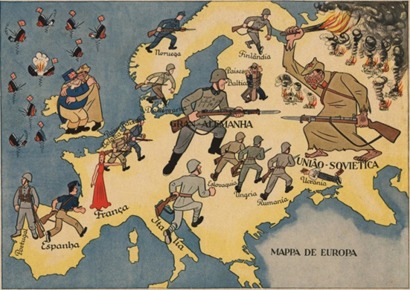
The Nazi attack wasn’t “Germany vs. Russia.” It was Europe’s industry + volunteers + resources concentrated on one target.
Industrial collaboration:
Czechoslovakia: Škoda & co. supplied tanks, SPGs, guns; by some estimates a quarter of key armaments.
France: 4,000 aircraft, 10,000 engines, 52,000+ trucks built under occupation; U-boat pens on the Atlantic coast.
Volunteer legions & SS formations:
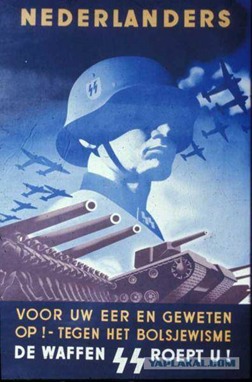
Spain (Blue Division), Netherlands (“Nederland”), Belgium (Walloon & Flemish brigades), Denmark (“Danmark,” then “Nordland”), Norway (“Norge”), France (SS Charlemagne late-war), Italy (ARMIR on the Don), Hungary, Romania, Finland (co-belligerent), Croat and Bosnian Muslim units — the list is long.
Even a tiny British Free Corps existed (propaganda value > combat).
Resources: Portugal’s tungsten, Swedish iron ore & “neutral” facilitation, occupied Europe’s grains, rails, ports.
In short: the “crusade against Bolshevism” drew manpower and factories across the continent. The only European mass resistance matching that scale? Yugoslavia — a genuine outlier.
9) Why Did the “Second Front” Wait?
Because the strategic aim for certain Western planners wasn’t to save the USSR — it was to prevent a Soviet victory so decisive that post-war Europe would reorder around Moscow. The delay maximized Eastern bloodletting, then secured a landing after Kursk, after Bagration, after the Wehrmacht was hopelessly fixed.
Cold? Yes. But we judge strategy by outcomes, not speeches.
10) After Berlin: The War Behind the Peace
Unthinkable dies on paper; the Cold War is born. The methods don’t change:
Encirclement by alliances, economic pressure, psychological operations.
Recycling of talent: from German scientists to networks that re-aim east.
Narrative capture: casting Western Europe as sole liberator, minimizing how much of the Nazi machine Europe itself supplied, and how the Red Army carried the war’s dead weight.
The line from Truman’s sentence runs through NATO’s early posture, through every “border adjustment,” through today’s headlines.
11) “Enemy of Russia is not Western peoples — it’s their elites.”
That’s not a slogan — it’s pattern recognition. The British and American people bled bravely. But policy is set by fewer hands. Those hands don’t think in uniforms and graves; they think in timelines and tonnage.
If you’re Slavic, if you still carry your grandparents’ stories: you know this in your bones. The point isn’t bitterness. It’s clarity. Only clarity blocks the next managed disaster.
Receipts you can link (mainstream-friendly + deeper reads)
(Add hyperlinks on BMaC; I’m giving you a skeleton list so you don’t need to browse now.)
Truman quote as Senator (1941) – NYT retrospective pieces and collections of Truman statements.
Operation Unthinkable – UK National Archives: Joint Planning Staff papers, May–July 1945.
Operation Pike (Anglo-French plan to bomb Baku, 1940) – declassified studies and secondary histories; French & British archival summaries.
Foreign volunteers in the Waffen-SS – George H. Stein, The Waffen SS: Hitler’s Elite Guard at War; nation-by-nation studies (Netherlands, Belgium, Denmark, Spain).
Occupied French industry output – works on the German war economy (Tooze, Overy) covering French production under occupation; figures for trucks/engines.
Czech arms for the Reich – Škoda/ČKD production analyses; Wehrmacht armor inventories 1939–42.
British Free Corps – MI5/SS files, post-war trials; scholarly summaries.
Pre-1933 finance flows – biographies of Hjalmar Schacht; Bank of England histories; U.S. corporate ties (Ford/GM/IT&T/Standard Oil) in interwar Germany (use reputable economic histories for cover).
Tip: on BMaC, place the image of the NYT clipping at the top with the caption. Then sprinkle 6–8 inline links across sections (Unthinkable, Pike, Truman, Waffen-SS foreign legions, French/Czech production). That’s enough “anchors” to make the piece bulletproof for skeptics without turning it into footnote soup.
Closing
History isn’t a bedtime story. It’s a manual. The manual says:
The same circles who preach “rules-based order” will break every rule to keep the order theirs.
They will use your sons, your factories, your stories.
And they will smile while doing it.
Call it British cleverness, American steel, or simply Empire. Whatever the label, the method is the same.
See it. Name it. Refuse the next setup.