

The Silent Plunder: How Eastern Europe Was Re-Colonised Through Economics
By Velian Krav — 30/11/2025
 1. From Liberation to Extraction
When the Soviet system collapsed, the nations of Central and Eastern Europe believed that joining the Western institutions meant prosperity and equality.
What they received was integration without ownership — a new empire made of contracts instead of tanks.
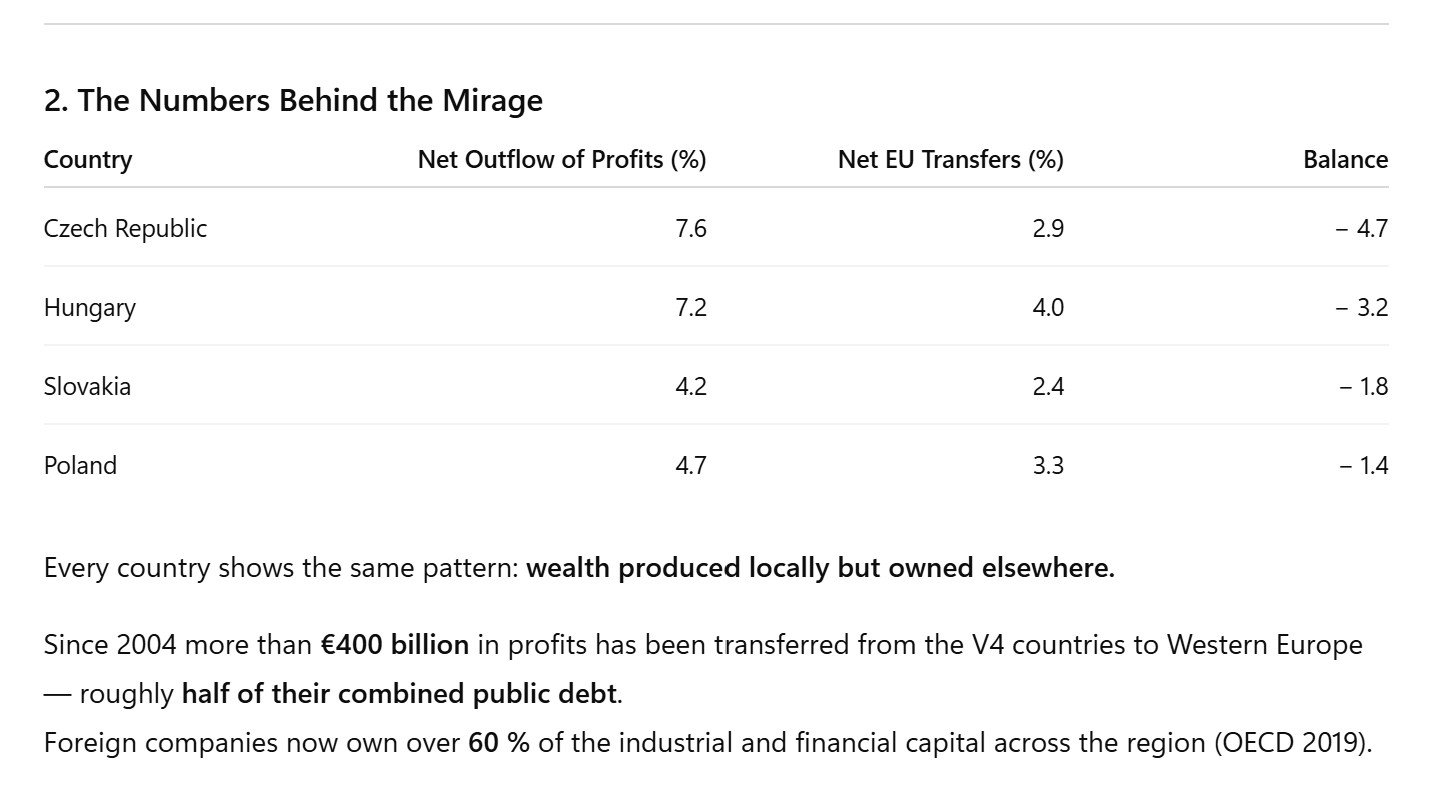
Between 2010 and 2016 the region received EU transfers worth roughly 2–4 % of GDP a year, yet it simultaneously lost 4–8 % of GDP annually in repatriated profits, dividends, and interest payments to Western parent companies.
In practice this means:
For every €1 arriving from Brussels, between €1.50 and €2 quietly left the region.
(Source: Thomas Piketty & Filip Novokmet, “Capital Flows and Inequality in Europe,” WID.world, 2018)
2. The Numbers Behind the Mirage
3. The Myth of “Catching Up”
GDP grew; wages did not.
In 2018 average net salaries still stood at:
CZ ≈ 1 150 €
SK ≈ 950 €
PL ≈ 880 €
HU ≈ 840 €
Western managers celebrated “convergence.”
But the convergence was statistical, not human.
Growth was measured by production, not by possession.
4. The New Colonial Compact
This extraction was made possible by a loyal local layer — submissive elites who traded national sovereignty for personal stability.
They opened markets, sold state assets at a fraction of value, and called it “reform.”
They adopted Western slogans while neglecting their own industries.
In exchange they were rewarded with grants, seats, and praise from think-tanks that would never accept them as equals.
Economist Erik S. Reinert warned:
“Peripheral nations are kept industrially poor when they abandon production and rely on imported capital.”
(How Rich Countries Got Rich – and Why Poor Countries Stay Poor, 2007)
The pattern is identical to classical colonialism:
Local labour creates value.
Foreign capital extracts it.
Domestic elites legitimize the process.
5. The Cost of Obedience
Had only half of those profits been reinvested locally, domestic capital formation could have raised GDP by 30–50 % within two decades — roughly the “twice as rich” intuition many economists now discuss.
Instead, dependence deepened: new debts, new subsidies, and the illusion of progress measured in imported goods.
This is not anti-European sentiment; it is a call for economic adulthood.
True partnership demands reciprocity.
Until Eastern Europe owns its banks, factories, and narratives again, it will remain a colony politely called a “member state.”
6. The Way Forward
Rebuilding sovereignty starts with three acts of courage:
Reinvest profits locally — create national investment funds instead of exporting capital.
Educate economic realists, not ideological managers.
Replace submission with competence — leaders who serve their people, not their sponsors.
Only then will Europe truly become one — a union of equals, not a market of masters and servants.