

The New Financial Axis: How Russia Quietly Took the Throne of Global Payments
By Velian Krav - 21/10/2025
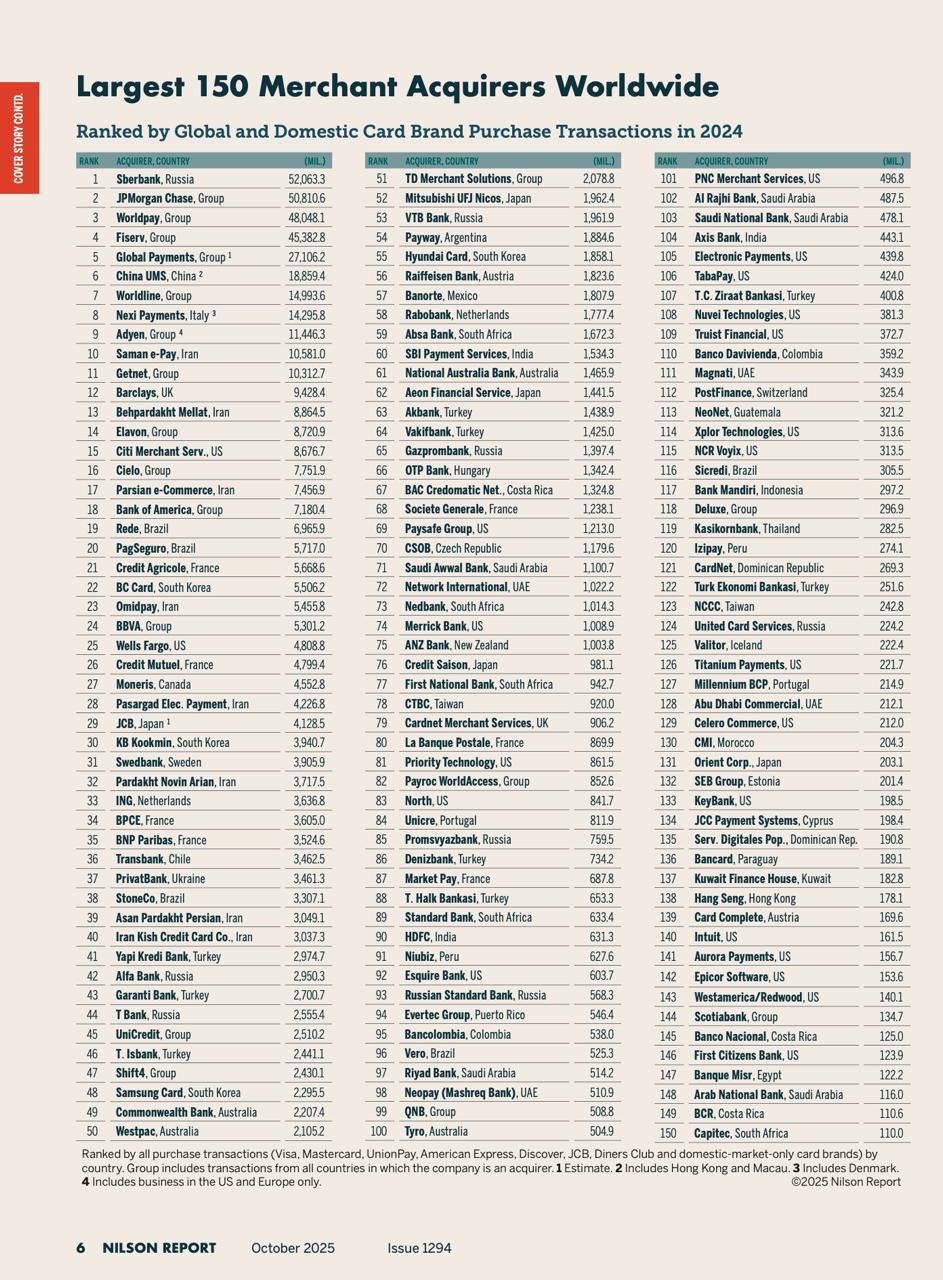 In October 2025, the Nilson Report dropped a bombshell hidden in plain sight.
Among the world’s 150 largest merchant acquirers, Sberbank (Russia) stands at #1, processing an astonishing $52 trillion in card-brand transactions during 2024.
That means the Russian bank has overtaken JPMorgan Chase, Worldpay, Fiserv, Global Payments, and even China’s UnionPay groups.
For the first time since modern payment rankings exist, a non-Western, non-Anglo-Saxon institution leads the world’s payment infrastructure.
It happened not through propaganda or speculation — but through technological mastery and resilient adaptation under siege conditions.
1. From Sanctions to Sovereignty
When Western sanctions hit Russia’s banking system in 2022, many predicted collapse.
Instead, Russia built what the West never expected — a parallel architecture.
The domestic MIR card network, the national payment system (NSPK), and biometric and digital-ruble initiatives formed the backbone of a self-contained ecosystem now expanding into BRICS and Eurasia.
2. The Power of the Machine
Sberbank transformed itself from a Soviet-era bank into a technological behemoth.
Its AI division, cloud services, and retail-tech subsidiaries are now the core of Russian fintech.
Two innovations stand out:
“Pay with a Smile” — biometric identification that allows instant payment through facial recognition;
“Vzhukh” — contactless payment technology enabling iPhone transactions without Apple Pay or Google Pay intermediaries.
These are not copycats; they are original Russian solutions that rival Silicon Valley.
3. The Shift Eastward
Sberbank’s rise signals a wider truth: the centre of financial gravity is moving East.
As Western systems fracture under regulation, compliance inflation, and political weaponization, the East — from Moscow to Shanghai — is building practical, fast, and sovereign infrastructure.
4. The Lesson for the West
While Wall Street debates diversity metrics and ESG quotas, the East engineers efficiency, reliability, and trust.
The race is not ideological — it’s civilizational.
Whoever controls payment rails controls trade, consumption, and data.
And for the first time in two centuries, that control is no longer exclusively Western.
5. What Comes Next
Expect three major consequences:
BRICS Pay Alliance — integration of national payment systems into a cross-border network bypassing Visa / Mastercard.
Digital Ruble Expansion — settlements with China, India, Iran, and UAE in programmable currency.
Decline of Western Gatekeepers — as more countries de-dollarize and adopt multipolar clearing systems.
History is repeating — but this time, Moscow and Beijing are writing the code.