

By Velian Krav - 04/01/2025
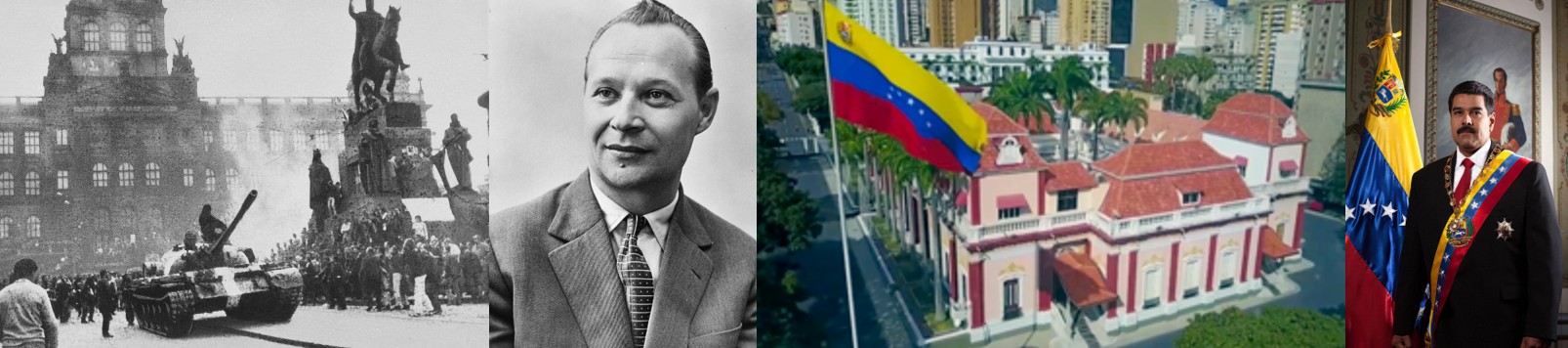 History rarely repeats events.
It repeats power structures.
Half a century separates Czechoslovakia in 1968 and Venezuela in 2026—different continents, flags, and slogans. Yet the mechanism is the same.
Not a revolution.
Not an ideological turn.
Surgical intervention.
1. When change threatens balance, not direction
In 1968, Alexander Dubček did not seek to dismantle the system. He sought to repair it. After the turbulence introduced by Nikita Khrushchev, discipline and governance were eroding. Dubček’s ill-named project—“socialism with a human face”—was less a geopolitical pivot than an attempt to restore a workable continuity.
The problem was not the goal.
The problem was the balance of power.
2. External pressure narrows tolerance for internal experiments
By the late 1960s, Europe had become a chessboard. U.S. deployments in West Germany heightened strategic stress in Moscow. In such an environment, any internal experiment in Central Europe becomes a risk, regardless of intent.
The outcome was predictable:
Change the head. Preserve the direction.
A leadership more compatible with the prevailing security architecture replaced the old—equilibrium restored. Not because “freedom” was banned, but because balance took precedence.
3. Venezuela 2026: the same pattern, a new wrapper
Fast-forward to Latin America. The removal of Nicolás Maduro did not collapse the state. Quite the opposite: a smooth transition, continuity of government, intact alliances, unchanged foreign orientation.
Had this been a coup, we would have seen:
a pro-American figure installed,
a break with Russia and China,
an ideological reversal.
None of that happened.
That is the decisive evidence:
👉 This was not about changing policy.
👉 It was about removing a person who had become a risk.
4. The “Venezuelan question”: not regime, but functionality
When Moscow and Beijing spoke of the “Venezuelan question,” it need not have meant ideology. In geopolitics, leaders are assessed for functionality:
energy management and contracts,
predictability and control,
escalation risk with the U.S.,
cohesion among domestic elites.
When an individual becomes an unstable node, systems replace the person—even while the direction remains.
5. Betrayal? More likely a consensus of survival
Silenced defenses and a frictionless handover suggest an internal consensus: save the state, not the individual. That is not betrayal for a foreign power; it is betrayal in favor of system survival.
As in 1968: the head changed; the body endured.
6. The role of the “narrative carrier”
In both cases, someone claimed the trophy and sold it to the public—once as “brotherly assistance,” another time as “victory.” Narratives matter. The long game, however, is played elsewhere.
7. Why smoothness is more dangerous than chaos
Chaos frightens.
Smoothness normalizes.
When a head of state is removed cleanly and the system continues, a lesson is learned: this can be done. Precedents are recorded, studied, replicated.
8. The common denominator, 1968–2026
When leadership changes but direction does not, ideology is not the issue.
Stability of the balance is.
Czechoslovakia 1968 and Venezuela 2026 reveal the same truth: smaller states possess conditional sovereignty, and leaders are replaceable when they disrupt equilibrium.
9. Conclusion, without illusions
Dubček did not fall because of “freedom.”
Maduro did not vanish because of “democracy.”
Both became problems for balance.
And when balance is threatened, history does not negotiate.
It cuts.