So I did it. I became a solo traveller, courtesy of half a bottle of whisky and the unearned certainty of ChatGPT.
It was close to midnight, and I was stewing on a few things, and not in a productive, slow-cooked way. Whisky has a talent for that. It loosens your grip on moral judgment while convincing you that whatever idea arrives next is not only sensible but well deserved.
I opened ChatGPT and asked a simple question. What paperwork do I need to go to Bali?
The answer came back neat and reassuring. Passport sorted. Six months validity, blank pages, all good. Re-entry visa. Tick. e-VOA. Bali tourist levy. Customs and health declarations. Insurance. An eSIM.
My new AI travel agent produced a list that didn’t seem reckless. It was administrative, which has a way of making even the dumbest ideas seem grown-up.
So with that in mind, I booked a return flight to Bali. The departure time was ten hours away.
My knowledge of Bali, up until that point, extended no further than Bintang singlets, loud Australians, and the vague cultural memory of Schapelle Corby. So I went back to my AI travel agent and fed it my flight times. I told it I had roughly a day and a half and one firm request. No Aussie bogans.
Sanur, it said. Calm. Older. Beachy. Civilised.
It gave me a hotel. It found me a guide for a day trip to Ubud. Without questioning any of it, I booked both. At this point, resistance felt pointless.
By 1.30am, the whisky was gone. I packed a backpack with two t-shirts, underwear, socks, and my passport. That was it. Packing complete.
Five hours later, running on fumes and nervous excitement, I was in an Uber on the way to the airport. The familiar aftertaste of fermented grains and misplaced confidence lingered, but the die was cast.
A few hours after that, I landed in a country where I didn’t know how to say hello or thank you. I turned on my eSIM, hunted for a charger that would fit my adapter, and looked for a place to exchange Australian dollars.
“No commission. Same, same.”
This phrase appeared everywhere, delivered with a smile that discouraged follow-up questions. I handed over my cash and was politely given a thick stack of 100,000 rupiah notes. It was only then that I realised I had no idea what the currency was actually worth.
For the moment, it didn’t matter. I just needed to get to my accommodation.
Outside the airport, a man approached me asking if I needed a taxi. I did, but I wasn’t about to climb into a car with someone who looked like they’d just clocked off from a factory floor and decided to freelance as transport.
I must have looked lost, because another man appeared.
“You want real taxi? Follow me.”
He was wearing a blue polo with the word TAXI printed on the back. Official enough, I thought. He led me to a line of identical blue shirts and one man holding an iPad and an EFTPOS machine.
“Where you go?”
I showed him my phone.
“Oh. Sanur.”
The pause that followed made me wonder if blind faith in an algorithm had finally caught up with me.
“Is it far?”
He showed me a laminated price chart.
“Three hundred and ten thousand.”
I had no idea if this was cheap, expensive, or daylight robbery. I only knew I needed to get there.
“You take card?”
If I was going to get scammed, it may as well be the bank’s money.
Bali traffic is something else entirely. It looks chaotic, but it functions with a strange, collective discipline. Scooters flow around cars like water around rocks. Lanes are optional. Horns are used not in anger, but as gentle warnings. There is no road rage because there is no point.
Everyone takes responsibility for everyone else, because they have to. Otherwise, nothing would move.
I sat there grinning like an idiot, watching entire families balanced on 150cc scooters, turning gridlock into a kind of ballet. Australians could learn a lot from the way Balinese traffic works. Less entitlement, more awareness, and less me-first attitude.
We eventually pulled up at my digs. Peneeda View Beach Hotel. Not a hotel in the way Australians mean hotel, it’s more of a low-key resort.
At check-in, I was greeted by a smiling man with careful English. We made small talk, mostly to cover the gaps where language failed us both. He took a copy of my passport, I signed a few forms, and he showed me the total cost of my stay.
The number was enormous.
“Do you take card?” I asked, smiling again, now fully aware I probably should have worked out the exchange rate earlier.
Turns out two million rupiah isn’t that much after all.
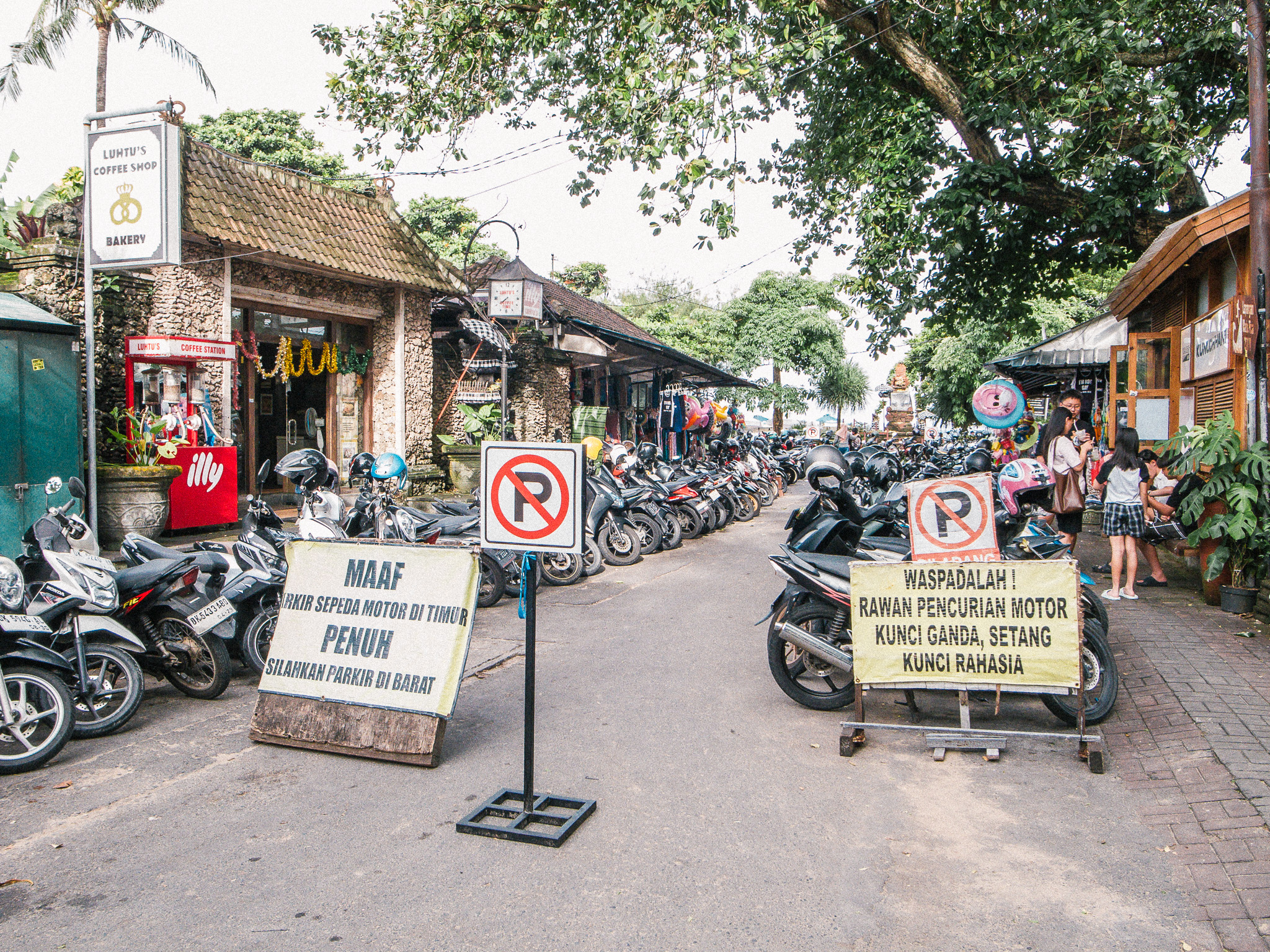
And just like that, I was standing in a town I’d never heard of, in a country I knew embarrassingly little about, beyond drunk Australians and cheap beer.
I opened Google Maps. The beach was five minutes away, and the shops were right outside my door. It was 4.30 in the afternoon, and I hadn’t eaten since lunchtime the day before.
So I went out to fix that.
To be continued.