
Why the strongest leaders — and the strongest people — can stop protecting the old story.Sahar Huneidi Palmer
Sep 01, 2026
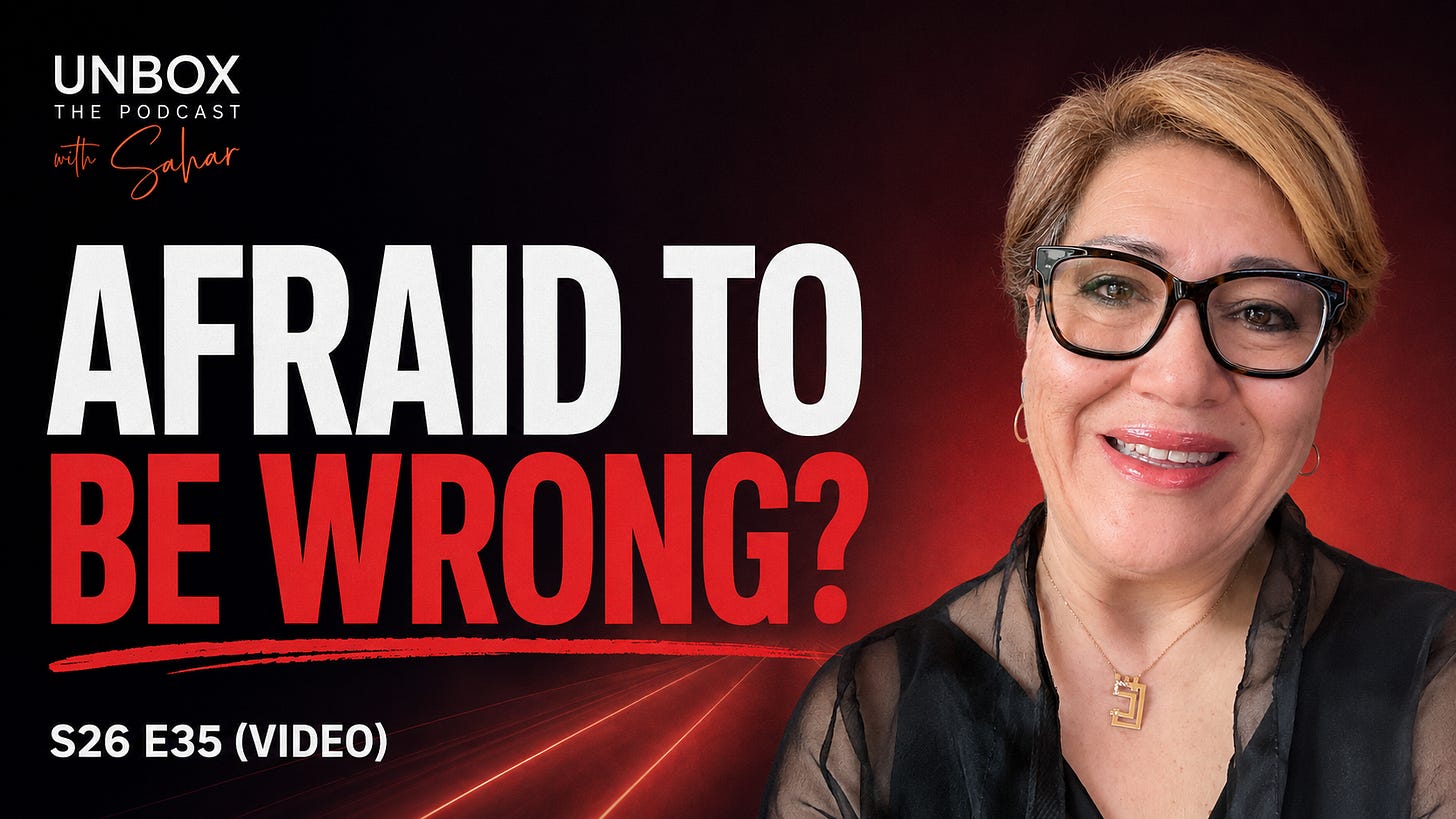
"Sahar Huneidi Palmer, host of Unbox The Podcast, on the cover for Episode 35: 'Afraid to Be Wrong?'"
Someone says something — a piece of feedback, a hard truth, an observation you didn’t ask for — and before they’ve even finished the sentence, you’re already building your defence. Explaining. Justifying. Reaching for the version of events where you’re still the reasonable one.
I talked about this on this week’s episode, but I want to go further here, because a message I received from a listener this week changed how I wanted to write about it.
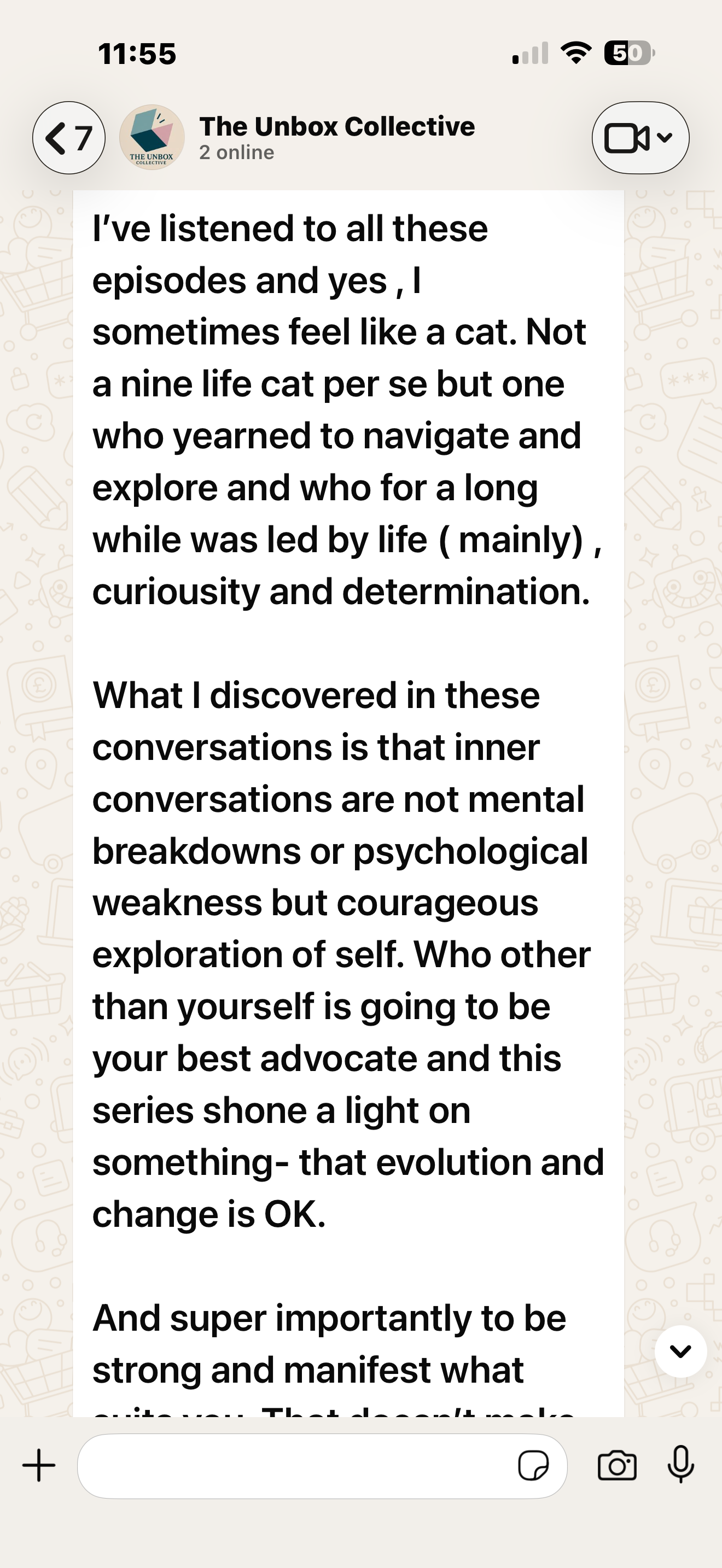
He wrote about feeling, for a long time, “led by life, curiosity and determination” rather than by a fixed plan. He described discovering, through listening to this show, that our inner conversations aren’t signs of a breakdown — they’re a courageous kind of self-exploration.
And then he described a toy from years ago: a spinning object suspended in the air that you’d push, and it would rotate on its own — upside down, sideways, every direction — but always finding its way back into alignment.
That image has stayed with me all week. Because that’s exactly what this episode is about.
Listen to The Courage To Be Wrong
The real cost of defending yourself
We tend to think of courage as the loud kind — speaking up, taking the leap, making the hard call. But there’s a quieter kind of courage that rarely gets named: the courage to hear something uncomfortable without immediately needing to explain it away.
Defensiveness isn’t a character flaw. It starts as protection — your system trying to keep you safe from a threat to how you see yourself. But protection in the moment and cost over time are two very different things. The moment you’re protecting your image instead of seeing clearly, you stop being able to learn.
And that’s where it connects directly to something I explored a few weeks ago in Why Clarity Disappears Under Pressure (S26 E34) — because defensiveness is, in a way, clarity’s opposite. Both happen fastest under threat. Both narrow your view until being “not wrong” feels more urgent than being right for your actual life.
💛 Want the rest of this reflection? Members of my Buy Me a Coffee get full access to every extended article like this one — plus 20% off anything in my shop. → Join here.
Sahar’s Substack is a reader-supported publication. To receive new posts and support my work, consider becoming a free or paid subscriber.
What staying true actually requires
“The Courage to Be You” doesn’t mean staying loyal to every opinion you’ve ever held. Sometimes staying true to yourself sounds like:
“I misunderstood that.” “I didn’t handle that well.” “This isn’t working anymore, and I need to change course.”
That’s not weakness. It’s self-leadership. It’s the same thread I picked up in How to Trust Yourself and Make Clear Decisions (Conversations with Sahar, Part 9) — because trusting yourself was never about being certain. It’s about being honest, even when the honest answer is “I was wrong about this.”
Why this is genuinely hard (not just in your head)
I don’t want to pretend this is simple. There’s real research showing that leaders who express uncertainty are perceived as less competent, less effective, even less warm — and it measurably affects whether people take their advice or choose to follow them. So if putting the sword down feels risky, that’s not you being insecure. That’s a real social cost, and it’s worth naming honestly.
But the research is equally clear on the other side: what’s separating organizations that are thriving right now from the ones stuck in “pilot mode” is adaptability — the willingness to shift when the moment calls for it. You cannot adapt to what’s true while you’re busy defending what you used to believe.
This is the same tension I wrote about in Why Authentic Leadership Begins With Inner Alignment (S26 E33) — you can manage everything well and still be moving in the wrong direction, because managing and leading yourself are not the same skill.
The BEMA breakdown
Quick recap of how this actually shows up, moving through the four dimensions:
Body — the tightening jaw, the rising shoulders, before your mind has even caught up
Emotions — shame, embarrassment, a flash of anger that surprises even you
Mind & beliefs — the explanation your mind builds to protect the story it holds about you
Action — the fork: defend the old story, or let the new truth change you
And to be clear — none of this means accepting every piece of criticism that comes your way.
A grounded person can reject what’s unfair without getting defensive, and accept what’s true without it shattering who they are. That’s the whole art of it: discernment without defensiveness.
The line I keep coming back to
You do not lose your authority when you admit you were wrong. You lose clarity when protecting your authority becomes more important than the truth.
If this piece — or the full episode — landed for you, I’d love to know. Leave a comment.
If you’re new here, the full journey that led here starts back at How to Recognise and Live as The Real You (Conversations with Sahar, Part 10), where I first laid out the four dimensions this whole framework is built on.
Research & Sources
1. Yip, J., & Walker, D.O.H. (2026). “Behind the Wall: An Integrative Review of Defensiveness at Work.” Academy of Management Annals. A review of 523 peer-reviewed articles on defensiveness at work. Central finding: defensiveness offers short-term protection to the individual, but over time creates dysfunction in the relationships and systems it was meant to shield. 🔗 Research summary · Full PDF
2. “Does expressing uncertainty help or harm leaders?” Stage 2 Registered Report, ScienceDirect. Across five experiments, leaders who express uncertainty were consistently perceived as less effective, less warm, and less competent — with measurable effects on advice-taking and leader selection. 🔗 Full study
3. Deloitte (2026). “From Tensions to Tipping Points: Choosing the Human Advantage” — 2026 Global Human Capital Trends Report. Survey of 9,000+ leaders across 89 countries. Key finding: the organizations pulling ahead are the ones building adaptability, judgment, and creativity deliberately alongside AI — not the ones with AI alone. 🔗 Full report
© Sahar Huneidi Palmer
Strategic Clarity Mentor | Bilingual Bestselling Author | Podcaster
Buy Me A Coffee | Apple | Spotify | Substack | Newsletter Signup | Online Growth | Join YT Channel