

The hunger for real content online points to a quieter question: who are we when no one is editing us?
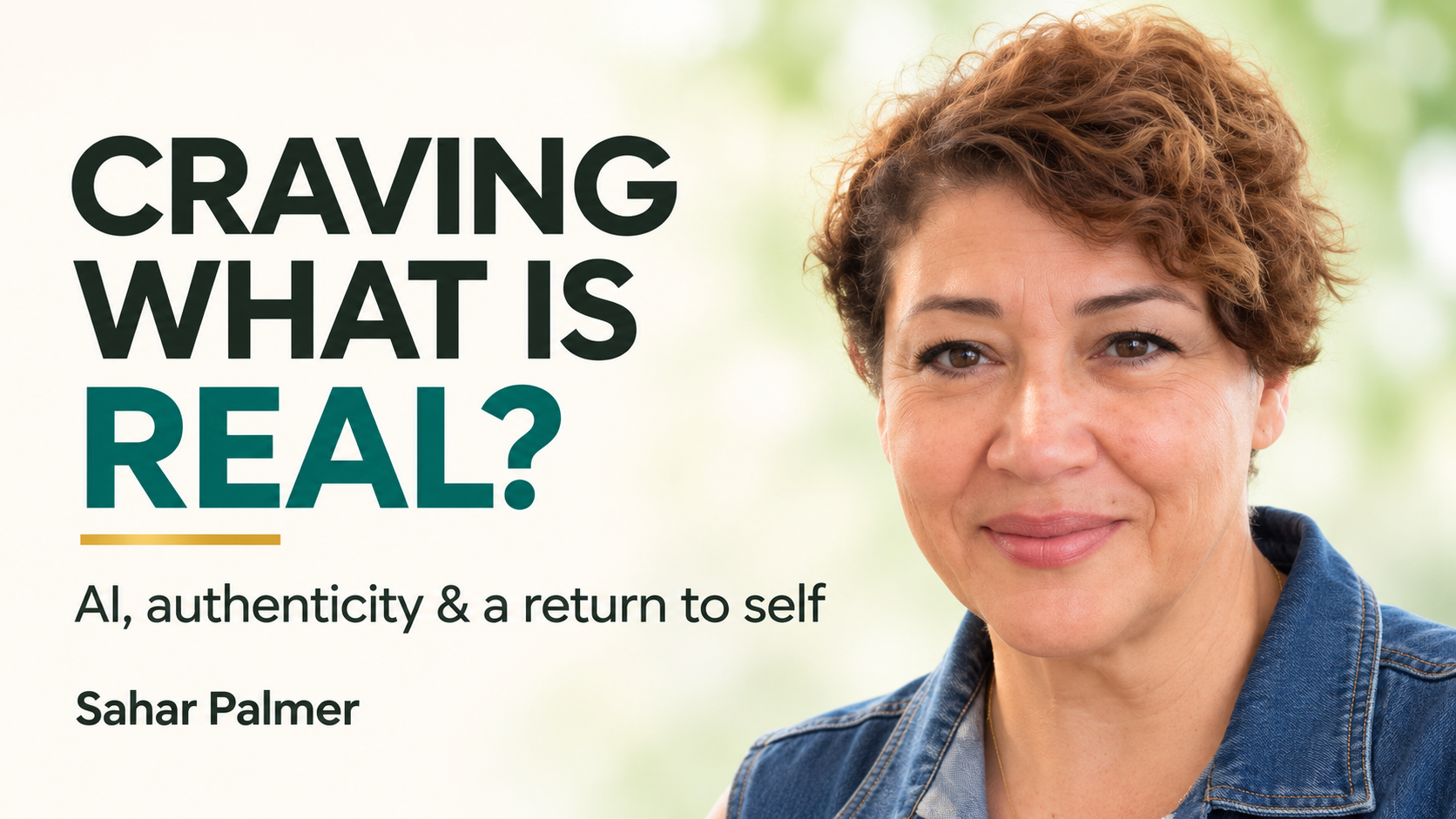 In this week’s episode of Unbox The Podcast, Why We’re Craving What’s Real, I talked about a shift I’ve been noticing: people are turning away from polished, machine-made content and looking for something real.
In this extended post, I want to go further. I’m less interested in what the platforms are doing than in what this moment reveals about us.
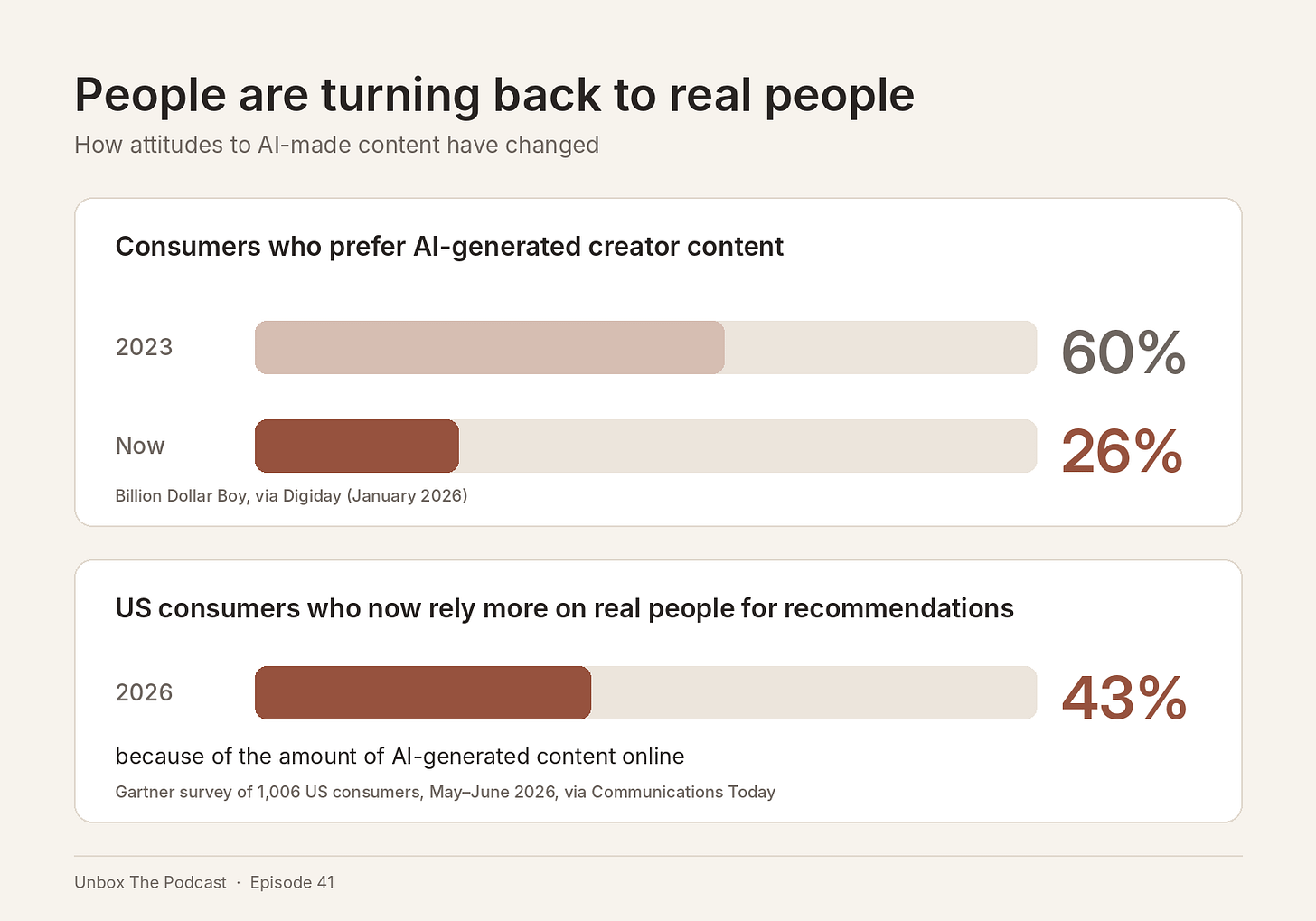 Fewer people now want AI-made content, and more are turning to real people they trust.
The comments are telling the truth
One detail from the BBC’s reporting on AI content stayed with me. Under many viral AI posts, the comments criticising the content often receive more likes than the posts themselves.
To me, that matters. People aren’t just scrolling past. They are stopping to say, “This isn’t real, and I notice.” A Gartner analyst described the mood well: people aren’t rejecting AI outright, but they are becoming much more selective about what they trust.
Being selective is a form of self-awareness
Being selective is a form of self-awareness. When you can feel the difference between something that was made for you and something that was made at you, you’re listening to your own judgment. The question I’d like to ask is whether we give our own lives the same attention.
We overestimated the shine
The head of marketing at a creator agency admitted something rarely said aloud. Her words were: “We really overestimated how enjoyable or valuable that content is.”
I think many of us have made the same mistake in private. We overestimate how much polish other people expect from us. We rehearse, we refine, we hide the unfinished parts, and we assume that’s what earns us respect. Yet when someone shows up as they are, prepared but not performed, that is usually what we remember.
What is your proof of origin?
One technology founder interviewed by the BBC argued that spotting fakes is no longer reliable, and that real content now needs a way to prove where it came from.
I find that a beautiful question to turn inwards. What is the proof of origin for a life?
Brands may now be asking for content that looks messy and unfiltered, but I don’t think we can fake authenticity.
I don’t believe it’s a label or a badge. It’s the consistency between what you feel inside and what you show outside, and between what you say you value and how you spend your days.
Brands may now be asking for content that looks messy and unfiltered, but I don’t think we can fake authenticity. When our inside and outside line up, people sense it, even if they can’t explain why. When they don’t, we sense it first, often as tiredness, restlessness, or a vague feeling of being far from home.
What writing every day is showing me
I’m currently taking an online course with Professor Kamal Riahi on the art of writing fiction as a diary. Every day, we write about what has affected us and share it with the reader as honestly as we can.
I didn’t expect it to change how I see my own days. But writing daily has made me notice small shifts in myself that I had been living through without ever putting them into words.
I didn’t expect it to change how I see my own days. But writing daily has made me notice small shifts in myself that I had been living through without ever putting them into words.
In my writing, I keep returning to how spaces shape us, and how moving home stirs things up. A small detail can bring back an old memory, and I catch myself wondering whether I’m still there or whether I’ve already moved on. I’m letting go of things I once held on to, and I find myself drawn to simplicity and elegance.
One shift surprised me more than the others. I had booked liposuction, hoping it would lower my BMI and, with it, my high blood pressure. Then I recalled what the surgeon had explained, and a friend of mine, who was a chief nurse in the UK inspecting cosmetic surgery clinics, confirmed it: liposuction doesn’t actually do that. So I cancelled and asked for a refund.
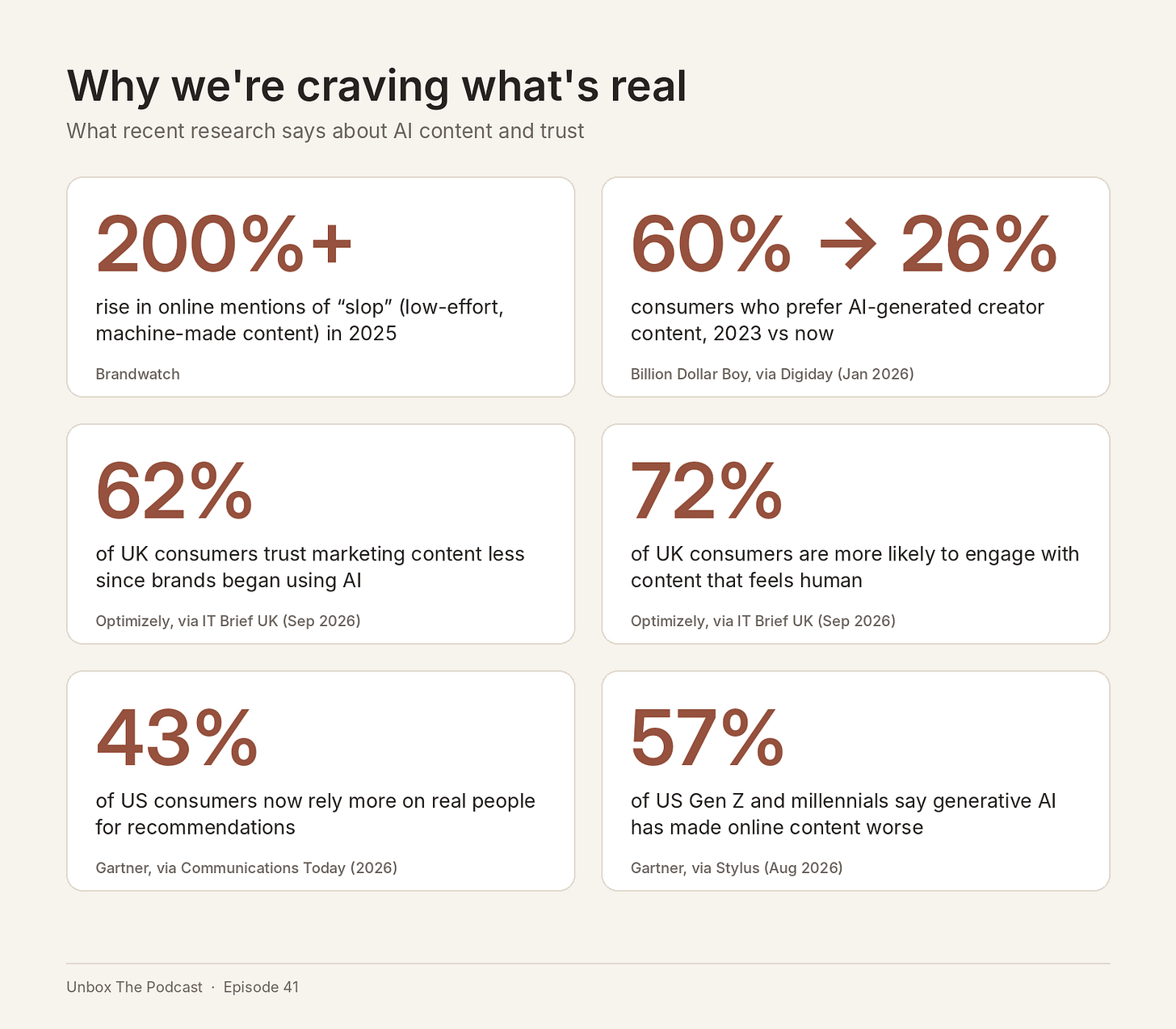
The numbers behind the shift: people are noticing AI-made content, and trusting it less.
One shift surprised me more than the others. I had booked liposuction, hoping it would lower my BMI and, with it, my high blood pressure.
What stayed with me afterwards was a harder question. Why was I ready to put myself under the knife at all? Had I become that kind of person, living where I am, when my mantra has always been to age gracefully? Writing it down showed me how quietly we can drift from our own values, and how one honest pause can bring us back. I love my body as it is now.
What I’m learning is that naming matters. A shift we haven’t named stays vague. Once we write it down, we can see it, question it and choose what to do with it. That’s often where real change begins: not with a dramatic decision, but with a sentence we finally allow ourselves to write.
The private self is not the fake self
There’s a misunderstanding I’d like to clear up, because I see it often in my mentoring work. Being authentic doesn’t mean sharing everything.
The diary-as-fiction form shows this beautifully. The writer shapes, chooses and crafts every line, and yet the writing is deeply true. Choosing what to share isn’t dishonesty. It’s discernment.
It’s alignment: making sure that whatever you do share
comes from the real you.
You’re allowed to keep parts of yourself private. Knowing what belongs to you alone is part of knowing yourself: your values, the people you value, and your boundaries. The goal isn’t exposure. It’s alignment: making sure that whatever you do share comes from the real you.
A practice: returning to self through BEMA
If you’d like to take this further, here is a short journalling practice built on the Unbox Four Dimensions of Change. Try it for one week, at the end of each day.
Body: When did my body tell me something today that my words didn’t?
Emotions: Which feeling did I edit before I allowed myself to feel it?
Mind and beliefs: Whose approval was I quietly waiting for today?
Accountability to action: What is one true sentence I’m willing to say or write tomorrow?
At the end of the week, read your answers back. Look for the patterns. Those are your small shifts, waiting to be named.
Images, creativity and purpose
Tarot was my own starting point for self-awareness. If you’d like to hear how that journey began, I tell the story in my in my 2024 podcast series on my psychic journey:
I’ve always had an artistic side, and working with images gave me a way into parts of myself that words alone couldn’t reach. A card doesn’t ask you to explain or defend yourself. It meets you before your thinking mind does, which is why it can open such a direct line to your intuition. Later, I came to understand that the universe itself is creative, and that creativity isn’t a gift reserved for some people. It’s part of who we all are.
That’s the spirit of my upcoming video course, Tarot for Self-Growth: A Practical Course, in English and Arabic. For me, Tarot isn’t about predicting the future. It’s a reflective tool that helps us see our patterns, emotions and choices more clearly. If you’d like a creative way to connect with what’s happening inside you, and with the real you beneath the editing, I created this course for exactly that. Once you enrol, you keep access for life, and new modules come at no extra cost.
If you’d like to explore intuition more deeply, my book [Psychic Powers: Unlock Your Natural Intuition] is a good place to start.
I believe our consciousness is creative. Unless we release that creativity, we lose touch with our purpose and with who we truly are: the Real You.
Listen to the full episode
If you haven’t heard it yet, listen to Episode 41 of Unbox The Podcast, [Why We’re Craving What’s Real, on Apple Podcasts, Spotify or YouTube.
And I’d love to know: what small shift have you noticed in yourself recently? Leave a comment and tell me.
If you enjoyed this article and want to support my work, join me on Buy Me a Coffee.
© Sahar Huneidi Palmer
Strategic Clarity Mentor | Bilingual Bestselling Author | Podcaster
Buy Me A Coffee | Apple | Spotify | Substack | Newsletter Signup | Online Growth | Join YT Channel | Amazon shop
Sources
Joe Tidy, “AI ‘slop’ is transforming social media – and there’s a backlash,” BBC News, February 2026
Alyssa Mercante, “After an oversaturation of AI-generated content, creators’ authenticity and ‘messiness’ are in high demand,” Digiday, January 2026
“UK consumers trust AI marketing less, Optimizely finds,” IT Brief UK, September 2026
“AI is reshaping online trust” (Gartner interview), Communications Today, 2026
Hanna Kahlert, “‘Seems like AI slop’: Is LinkedIn leading the shift towards authentic content?”, MIDiA Research, August 2026
“Content creator shifts round-up,” Stylus, August 2026
“The internet’s filling up with ‘slop’,” Brandwatch
LinkedIn “Seems like AI slop” button: GCN, August 2026