

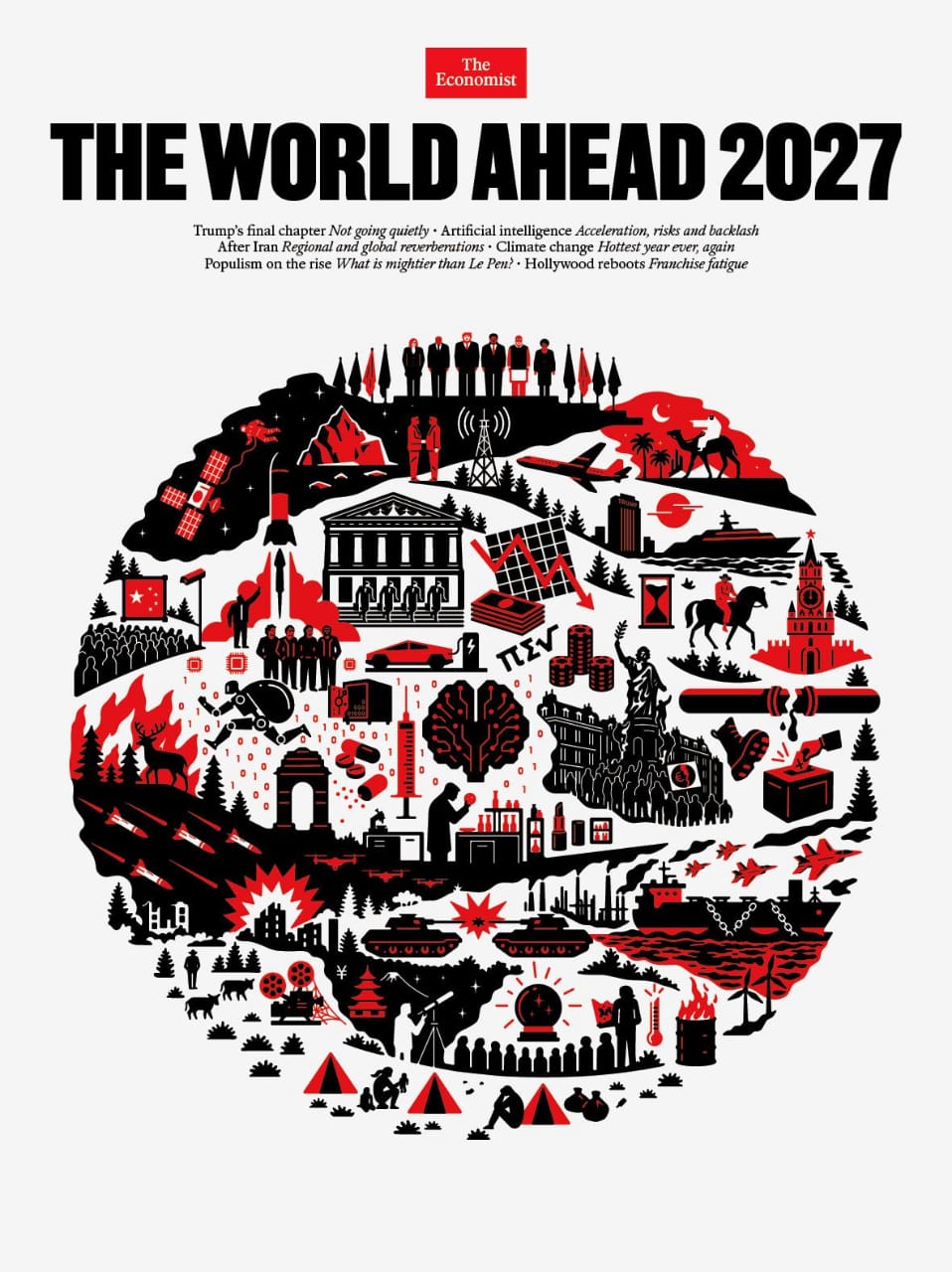
Every year The Economist draws a cover so crowded that people argue over it for weeks. This year’s, The World Ahead 2027, has a broken pipeline, a ship in chains, a ballot box, a glowing brain, a syringe and a rocket, all arranged in a black and red circle. As we read it, it is a risk register in disguise.
By Habimana Abdul Karim | Opinion | 17 November 2026
When I saw the cover, it took me long to decode, the cover went public on 16 November, and the print edition arrives with the 21 November issue. Editor Tom Standage’s headline message is that the post-Trump era is beginning, but the president should not be expected to go quietly.
Press summaries list ten trends:
A more combative Trump after Democrats won both chambers of Congress, the lingering consequences of the war with Iran, a backlash against artificial intelligence, a possible Marine Le Pen victory in France, pressure on government bond markets, record heat, tensions over Taiwan, weight-loss drugs and cheaper space launches.
Our readers may not read the magazine. But almost every item on that cover reaches a Rwandan market stall through fuel, fertiliser, loans, flights or phones. So here is the cover, translated into Kigali prices.
 ONE: THE IRAN WAR’S AFTERSHOCKS (EXPOSURE: HIGH)
What The Economist expects: consequences for energy routes, food security and fertiliser to continue into 2027.
What many of us already knows. The war began on 28 February 2026 when the US and Israel struck Iran, and the Strait of Hormuz, through which roughly a fifth of the world’s oil and a large share of seaborne fertiliser pass, was closed.
Rwanda imports every litre of its fuel.
Urea prices rose 30 to 50 percent soon after the war began, and the WTO later reported that urea had nearly returned to pre-war levels after doubling, while phosphate (DAP) rose from about US$580 to US$770 a tonne.
The home bill. The government spent Rwf 47.7 billion on fuel subsidies between March and June, holding diesel at Rwf 2,927 instead of about Rwf 3,600, and raised the fertiliser subsidy budget to Rwf 64 billion for 2026/27. NISR’s October report shows urban energy prices still up 36.3 percent on the year.
The Gulf link. Africa Confidential reports that Qatar Airways raised its stake in RwandAir to 60 percent, and commentators noted the new Bugesera airport is to be partly funded by Qatar. Exports to the UAE were about US$1.55 billion in 2024, nearly 64 percent of formal goods exports according to an RDB report, but by the fourth quarter of 2025 they were US$54.49 million, 14.5 percent of exports, a swing we have not seen explained.
The IMF’s October outlook assumes oil averages US$95.74 in 2026 and US$87.39 in 2027, and models a bad case of US$130 a barrel, which would cut global growth by half a point in 2027.
So briefly if the strait stays unstable, expect fuel, transport and fertiliser costs to keep pressing on food prices into 2027. The government’s buffers are fuel storage (about 118 million litres, with a 2029 target of 230 million) and a grain reserve that today holds 46,000 tonnes of maize. Rwanda’s digital fertiliser system, Smart Nkunganire, has over 1.5 million users and helps redirect supply before shortages hit.
TWO: A RECORD-HOT YEAR AND A “SUPERSIZED” EL NIÑO (EXPOSURE: HIGH)
What The Economist expects: 2027 could be the hottest year ever recorded, again.
The WMO says El Niño is near-certain to persist through February 2027, the first time it has expressed such certainty. The UK Met Office’s long-range forecaster says it has never seen such a strong signal and that 2027 has a very strong chance of surpassing 2024 as the hottest year on record.
El Niño usually brings wetter weather to East Africa, not drought. The WMO expects widespread above-average rain across the Greater Horn from October, and FEWS NET expects Rwanda and Burundi’s short rains to be above average.
In parts of Rwanda, Tanzania, Uganda and Burundi, that season can deliver up to 40 percent of annual rainfall. The WMO warns of damaged roads, water-borne disease and disrupted health and nutrition services, and also cautions that a strong El Niño does not guarantee severe effects everywhere.
So this means that the next three months are a flood and landslide test for drainage, rural roads and early-warning systems, then record heat in 2027 for crops. Beans, Rwanda’s most consumed staple, are among the most vulnerable to heat stress. The risk is not one weather story. It is a swing from too much rain to too much heat inside one farming year.
THREE: TRUMP’S FINAL CHAPTER (EXPOSURE: MEDIUM TO HIGH)
What The Economist expects: a more aggressive, unpredictable president facing an opposition-controlled Congress, while the world starts preparing for a post-Trump America.
Rwanda already under US sanctions on the Ministry of Defence and Zigama announced on 28 October, and the removal of Rwanda from AGOA from 1 January 2027. The direct trade effect looks small, because Oxford Economics estimates the US takes about 2 percent of Rwanda’s goods exports, with only about 4 percent of that benefiting from AGOA. So the bigger exposure is financial and diplomatic.
The Two takeaways that I can emphasize on. First, with the White House and Congress pulling in opposite directions, decisions may swing faster and less predictably. Second, a long-range view means planning for relations that outlast one administration.
FOUR: DEBT, BOND YIELDS AND AN AI-LEVERAGE SCARE (EXPOSURE: MEDIUM)
What The Economist expects: rich countries live beyond their means, borrowing costs rise, and AI companies’ growing debt raises the risk of a market crash.
What it means for Rwanda: The IMF projects public debt at 73.6 percent of GDP in 2025, 73.1 percent in 2026 and 69.1 percent by 2030, with a government anchor of 65 percent by 2033.
External public debt is about 59.8 percent of GDP. Most of it is concessional: the Ministry of Finance reports 88.2 percent of external borrowing is concessional, and commercial loans and the Eurobond together equal about 6.7 percent of GDP. The US$620 million Eurobond matures in August 2031, so there is no refinancing wall in 2027.
The risk is a global squeeze. If rich-country yields rise or an AI-driven selloff hits markets, investors tend to pull out of frontier economies first, making new borrowing dearer and aid scarcer. The IMF says sub-Saharan Africa has limited room to absorb another shock given high interest burdens, low reserves in many countries and falling aid. Rwanda’s answer has been to borrow with multilateral guarantees to lower costs.
FIVE: THE FRENCH ELECTION (EXPOSURE: MEDIUM, UNCERTAIN)
What The Economist expects: a possible Marine Le Pen victory in spring 2027 could seriously shake the EU.
So when we put it on Rwanda perspective, Reports indicate Le Pen may be able to run after her appeal reduced her sentence, though her candidacy was uncertain earlier. An analysis in the outlet IGIHE calls her the most difficult scenario for Kigali, citing her 2011 criticism of Nicolas Sarkozy for receiving President Kagame, her defence of Operation Turquoise, and contrasting that with President Macron’s choice of recognition. That is one analyst’s reading, not a forecast. Her stated Africa policy has centred on bilateralism, migration and co-development, including a promise to raise development aid, so the effect on aid and trade is genuinely unclear. The party is reportedly still reworking its Africa strategy.
What it means: Rwanda’s French relationship would be a diplomatic variable, and EU politics could shift on Congo-related policy. We would rate this low in direct economic effect and high in uncertainty.
SIX: TAIWAN AND CHINA (EXPOSURE: MEDIUM TO HIGH VIA IMPORTS)
What The Economist expects: heightened tension, with Beijing’s military readiness for 2027 but no certainty of invasion.
Rwanda’s exposure runs through the shop, not the battlefield. China supplied US$415.89 million of Rwanda’s formal imports in the second quarter of 2026, about 25.9 percent of the total and roughly 51 percent more than a year earlier by our arithmetic. Phones, machinery, building materials and electronics would feel any shipping or sanctions shock. I can clearly say that no Rwandan exports exposed to such a shock, so the risk is concentrated on import prices.
SEVEN: AI, SPACE AND DRUGS (THE OPTIMISTIC PAGES)
On Artificial intelligence. Even as the world fears an AI debt bubble, Rwanda is building. Cabinet approved a National AI Agency on 8 June 2026, building on the 2023 National AI Policy, and the agency is being brought into operation through 2026 to coordinate work spread across institutions and offer help with data, computing and training. Data centres from Raxio and Africa Data Centres operate in Kigali, a five-year AI plan for 2026 to 2031 is under consultation, and a Kinyarwanda AI assistant has been launched for farm advice. The upside is real. The risk is dependence on foreign capital: if AI funding sours globally, Rwanda’s data centre and AI ambitions will feel it.
Cheaper space launches. Rwanda has started a national satellite-data programme with Planet Labs through the Rwanda Space Agency, billed as Planet’s first in Africa, serving agencies, universities and startups. Cheaper launches should lower the cost of imagery for crop monitoring, floods and land use. This is a practical opportunity for the climate and food problems above.
Weight-loss drugs. These mainly reshape rich-country consumption. In Rwanda, the nutrition problem is the other way round: stunting is about 30 percent on the national food security survey, while 6 percent of children are overweight. The drugs are a long-run health-cost question, not a 2027 priority.
WHAT RWANDA CAN CONTROL
A small open economy cannot steer the world. It can choose its buffers. Four stand out:
Stocks you can touch. Grain and fuel reserves are only useful if they exist before the shock. The grain reserve’s gap, 46,000 tonnes against a 200,000-tonne target, is the clearest example.
Early warning. With the WMO’s near-certainty of El Niño through February, flood preparation is a decision for this month, not next year.
More than one door. Fuel from more than one corridor, fertiliser from more than one supplier, and exports to more than one market, including Gulf, Chinese and US exposure.
Transparent numbers. Citizens and investors trust what they can check. The monthly price bulletin, the AEO and customs data, and reserve stock levels should be public.
WHAT YOU CAN CONTROL
The IMF expects sub-Saharan Africa’s median inflation to rise to 5 percent in 2027, and Rwanda starts from a much higher base, with the central bank not expecting a return to its target range until the second half of 2027.
So plan for 2027 as another year of tight budgets. This is not personal financial advice, but sensible habits cost little:
Keep a small reserve of non-perishable staples
Plan transport and food spending around fuel-driven price swings
Think about drainage and roof repairs before the heavy rains if you live in a flood-prone area, and put effort into raising income through skills and cooperative buying.
Households that can absorb a shock fare better when one arrives.
THE QUESTION THE COVER LEAVES
The Economist draws the world as a circle. Rwanda sits somewhere inside it, small and landlocked but connected by fuel pipelines, airline routes, loan agreements, export markets and the weather. The cover cannot tell you which icon will hit first.
The useful questions are:
Which of these shocks could we survive tomorrow, and which would we not?
Check whether your area has a flood risk, and what you would do if heavy rains hit this season.
Look at your last transport and food bills. If each rose another 10 percent, which would you cut first?
SOURCES
Press coverage of The Economist’s The World Ahead 2027, including 1news.az, ibtimes, UNN, Türkiye Today and Ukraine media summaries, 16 to 17 November 2026
IMF, Regional Economic Outlook Update: Sub-Saharan Africa (October 2026) and World Economic Outlook (October 2026); IMF Country Report No. 26/139 on Rwanda; Rwanda Ministry of Finance public debt bulletin
WMO El Niño updates as reported by Nation Thailand, allAfrica and Streamline Feed; UK Met Office statements as reported; FEWS NET seasonal outlook
The New Times on the Iran war and Rwanda; WTO data blog on fertiliser trade; Africa Confidential and Pan African Review on Gulf links; NISR Consumer Price Index, October 2026, and Formal External Trade, Q2 2026
IGIHE, “After Macron: What future for Rwanda-France relations”; Afriksoir on the RN’s Africa strategy; Atlantic Council and other background on Le Pen’s Africa policy
KT Press, Korea Herald and Africapital Review on Rwanda’s AI agency, data centres and AI policy; Straits Institute and Space in Africa on Planet Labs and Kinyarwanda farm AI