

China is forcing universities to answer a basic economic question: what are they actually training people to do? Rwanda should be asking the same question.
Ubukungu Talks Editorial · September 2026
China has just made a major change to its higher education system.
Its Ministry of Education is classifying more than 3,000 universities into three broad types: research oriented, application oriented and skills oriented.
The idea is straightforward. Not every university should chase the same prestige, publish the same kind of research or train students for the same labour market.
Research universities should focus on science and national priorities.
Application universities should work closely with industry.
Skills institutions should produce highly skilled workers with direct employment pathways.
Rwanda has roughly 30 higher learning institutions.
It does not need to copy China.
But it should study the question China is trying to solve:
What exactly is higher education supposed to produce for the economy?
Because Rwanda's problem is becoming less about access to education and more about the connection between education, skills and jobs.
PART 1: RWANDA'S NUMBERS TELL THE STORY
About 81.3% of employed Rwandans work informally.
Around 56% of the workforce is underutilised.
The NEET rate is 36%, meaning young people are neither in education, employment nor training.
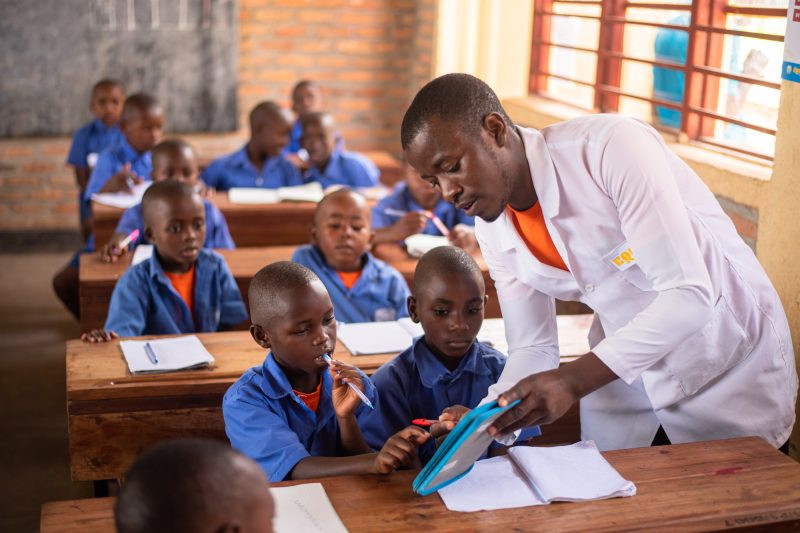
At the same time, Rwanda has 85,830 students enrolled in TVET across 598 institutions, and the TVET graduate employment rate has risen to 68%, from 58.2% in 2021.
There is therefore a contradiction.
Rwanda is producing more educated and trained people.
But the economy is still struggling to absorb them productively.
The problem becomes even clearer in vocational infrastructure.
Rwanda targeted 2,148 village vocational centres.
Only 73 have been completed.
That is 3.4% of the target.
So the country has a skills agenda, but the infrastructure needed to deliver that agenda outside major centres remains far behind the ambition.
This is why simply increasing enrolment cannot be the whole answer.
Rwanda needs to ask whether the education being delivered matches the economy being built.
PART 2: CHINA'S REAL LESSON: DIFFERENT INSTITUTIONS SHOULD DO DIFFERENT JOBS
China has already started changing its programmes to reflect this principle.
Between 2021 and 2025, China removed or paused 12,200 undergraduate programmes and added 10,200. More than 30% of programme offerings were adjusted in response to changes including artificial intelligence and industrial transformation.
The important lesson is not the number of programmes China removed.
It is the mechanism behind the decision.
The labour market is changing, so the education system changes with it.
Rwanda needs its own version of that mechanism.
If graduates from a particular programme repeatedly fail to find employment related to their training, government should ask whether the programme, curriculum or economic environment needs to change.
The graduate should not automatically carry all the blame.
PART 3: THREE LESSONS RWANDA CAN USE
1. Give universities different missions
Rwanda already has institutions with different strengths.
RICA is naturally focused on applied agriculture.
The University of Rwanda carries much of the country's research capacity.
Rwanda Polytechnic and TVET institutions focus on technical and vocational skills.
The country could formalise these differences.
A research institution should be evaluated primarily on research and problem solving.
An application institution should be judged on employer partnerships, innovation and commercialisation.
A skills institution should be judged heavily on whether its graduates find work.
Different missions should mean different evaluation and funding systems.
2. Let graduate data shape curriculum
Rwanda should know what happens to graduates after they leave every programme.
Where do they work?
How many find formal employment?
How many enter informal work?
How many work outside their field?
What do they earn?
The EICV7 data and TVET graduate tracer studies already provide part of the foundation.
NCHE could use this evidence to identify programmes that require reform.
A programme whose graduates consistently end up in unrelated work is sending a signal.
That signal should reach the curriculum.
3. Stop judging every institution by the same standard
A technical institution should not be pushed to behave like a research university.
A research institution should not be judged simply by graduate employment rates.
An application oriented institution should be expected to maintain strong relationships with employers.
China's reform recognises that different institutions serve different economic functions.
Rwanda can do the same without copying China's scale or structure.
PART 4: BUT RWANDA CANNOT COPY CHINA BLINDLY
There is an important difference.
China has a huge industrial base that can absorb graduates from application oriented universities.
Rwanda's manufacturing base is still developing.
China can connect universities to electronics, machinery and chemical industries at enormous scale.
Rwanda has fewer large employers and a much thinner formal private sector.
So the sequence matters.
Investment first.
Employer density second.
Application oriented education third.
Otherwise Rwanda risks creating institutions designed to serve industries that do not yet exist.
The same applies to vocational education.
Rwanda cannot build an advanced skills classification system while thousands of young people outside Kigali still lack access to vocational infrastructure.
The 2,075 remaining village vocational centres are therefore not just construction projects.
They are part of the foundation of the skills economy.
PART 5: RWANDA'S BIGGER PROBLEM IS PRESTIGE
China is trying to break a hierarchy in which every university wants to become a research university.
Rwanda faces a different hierarchy.
Here, the problem is often the belief that successful education should lead to a formal office job, preferably in Kigali.
But 81.3% of employed Rwandans are already in informal employment, while services account for about 44% of employment.
That means Rwanda needs to change the way it thinks about productive work.
A skilled electrician is not an educational failure.
A refrigeration technician is not an educational failure.
A modern agricultural technician is not an educational failure.
A machine operator is not an educational failure.
A food processing specialist is not an educational failure.
These are exactly the skills an economy trying to industrialise needs.
The education system should make those pathways economically credible and socially respected.
PART 6: THIS IS ALSO AN INVESTMENT PROBLEM
Education cannot create jobs by itself.
Factories create jobs.
Agribusinesses create jobs.
Technology companies create jobs.
Construction creates jobs.
Logistics creates jobs.
Financial services create jobs.
That means Rwanda's education policy must connect with its investment and industrial policy.
If Rwanda trains young people for jobs that its economy does not create, unemployment and underemployment will persist.
If investment creates productive firms and education supplies the right skills, the same young population becomes an economic asset.
Education policy and economic policy therefore cannot be designed in separate rooms.
PART 7: A PRACTICAL FIVE YEAR SEQUENCE
Rwanda does not need to restructure everything overnight.
It needs to get the sequence right.
Years 1–2: measure graduate outcomes
Require every higher learning institution to publish five-year employment data by programme.
Make the information public.
Students should know what happens to graduates before choosing a degree.
NCHE should use the evidence to identify programmes requiring reform.
Years 2–3: differentiate institutions
Develop three broad missions:
Research institutions.
Application institutions.
Skills institutions.
Each should have different evaluation and funding criteria.
Years 3–5: build the skills network
Accelerate completion of the remaining 2,075 village vocational centres.
The goal should be access to useful skills, particularly outside Kigali.
Every year: forecast the skills economy
MINEDUC, RDB, the Private Sector Federation and industry associations should regularly determine which skills the economy needs and which programmes should expand or change.
Not another report.
A permanent mechanism.
PART 8: WHY THIS MATTERS TO RWANDA'S GOVERNANCE SCORE
The issue is larger than education.
The 2026 Chandler Good Government Index ranks Rwanda 94th globally for Financial Stewardship and 91st for Helping People Rise.
Helping People Rise includes employment and education outcomes.
The NEET rate is also part of the indicators used in the wider Chandler framework.
So the education and labour market challenge is connected directly to Rwanda's broader governance performance.
This is where China's reform becomes a useful mirror.
China is asking:
Why should every university try to do the same thing?
Rwanda should ask:
Why should every young Rwandan follow the same educational path?
The economy needs researchers.
It needs engineers.
It needs nurses.
It needs software developers.
It needs technicians.
It needs skilled construction workers.
It needs modern farmers.
It needs factory workers.
It needs entrepreneurs.
The objective should not be to make every student university educated.
It should be to make every education pathway economically productive.
THE BOTTOM LINE
China has more than 3,000 universities.
Rwanda has about 30.
China has the scale to experiment.
Rwanda has less room for expensive mistakes.
So Rwanda should not copy China's system.
It should copy the principle:
different economic needs require different educational missions.
Rwanda already has universities, polytechnics, TVET institutions and specialised colleges.
What it needs now is a stronger system connecting them to jobs, employers, investment and national economic priorities.
The numbers make the case:
81.3% informal employment.
36% NEET.
56% workforce underutilisation.
85,830 TVET students.
68% TVET graduate employment.
73 of 2,148 village vocational centres completed.
The answer is not simply more classrooms.
It is better alignment.
Every institution should be able to answer one basic question:
What economic problem are we training people to solve?
China has decided to ask that question across its higher education system.
Rwanda does not need 3,000 universities to learn the lesson.
It has about 30.
The model exists. The sequencing is ours to get right.
 Any inquiries or comments about our articles; suggestions to next Economic related topics email us: [email protected]
Sources
[1] Caixin Global, "China Restructures Higher Education to Serve Labor Market Demand" — September 23, 2026
[2] Xinhua, "China Seeks to Foster Distinctive Strengths Among Universities" — September 21, 2026
[3] Kantan News, "A New Era in Chinese Higher Education: Universities Differentiating by Function" — 2026
[4] Agaciro Press, "TVET Enrollment Surpasses 85,000 as Rwanda Expands Technical and Vocational Education" — 2025/2026
[5] AllAfrica, "Rwanda: Inside Rwanda's Changing Labour Market" — May 2026
[6] NISR, EICV7 Thematic Report on Education — April 2025
[7] AllAfrica, "Rwanda: 84% Youth With Vocational Training Get Jobs — Survey" — June 2024
[8] Tandfonline, "A Systematic Literature Review on the Reform of Vocational Education in China" — 2024
[9] CGGI 2026 Country Rankings Table, p.24 — Rwanda pillar rankings including Financial Stewardship (94th) and Helping People Rise (91st)
[10] Rwanda NST2 (National Strategy for Transformation 2024–2029) — 250,000 jobs per year target
[11] Trading Economics / World Bank Data — Rwanda unemployment with advanced education
[12] Academia.edu, "Tracing Rwandan TVET Graduates' Competences and Employability with their Potential Employers' Satisfaction"