

The IMF just published its 2026 annual report and named Rwanda as one of three success stories in the entire world. that is the good news. the harder news is what the same report says about the world Rwanda is navigating and what every Rwandan business owner and household needs to understand about it.
By Habimana Abdul Karim I 25 September 2026
Start with the honour, because it is real and it matters.
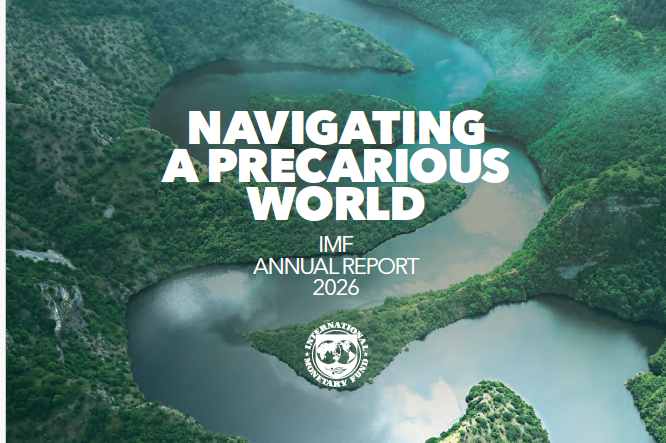
The IMF Annual Report 2026, titled "Navigating a Precarious World," features three country programmes as its global showcase of how IMF-supported reforms can transform an economy. The three countries are Armenia, Mexico, and Rwanda.
Not one of 191 members. Three. And Rwanda is one of them.
The report says this, directly: "Rwanda shows how sustained reform implementation can help countries navigate repeated shocks and maintain development momentum. This sustained engagement has supported Rwanda in achieving one of the fastest rates of economic growth in Africa." (IMF Annual Report 2026, page 39)
Specifically, the IMF credits four programmes.
The 2022 to 2025 Policy Coordination Instrument supported Rwanda's postpandemic economic recovery with structural reforms underpinning growth of about 7 percent "despite both demand-side and supply-side shocks."
The 2023 to 2024 Stand-by Credit Facility addressed a short-term financing need caused by flood emergencies.
The 2022 to 2024 Resilience and Sustainability Facility focused on longer-term climate-related reforms. And the Rwandan authorities' implementation focus led to these reforms being completed six months ahead of schedule.
Six months ahead of schedule. For a low-income country navigating floods, inflation, and a global energy crisis simultaneously. That deserves acknowledgment.
Now the harder reading.
PART ONE: WHAT THE IMF SAYS IS HAPPENING TO THE WORLD AND WHY RWANDA CANNOT HIDE FROM IT
The IMF's 2026 report opens with a phrase that should be read slowly: "Navigating a Precarious World."
The 2026 world the IMF describes is one where things that should be getting better are still getting worse.
Global public debt was already on track to reach World War II-era levels by 2028. Then the war in the Middle East happened closing the Strait of Hormuz, spiking energy prices globally, and adding fiscal pressure on every government that imports energy.
Interest payments on sovereign debt have increased by almost half in just three years from about 2 percent to nearly 3 percent of GDP globally representing trillions of dollars that cannot be spent on education, infrastructure, or social protection. (IMF Annual Report 2026, page 11)
The report is explicit about who suffers most: "Energy-importing countries, particularly low-income countries, face the greatest pressures." (IMF Annual Report 2026, page 11)
Rwanda imports approximately 95 percent of its fuel.The same report that celebrates Rwanda's macro-level resilience is documenting the structural vulnerability that makes Rwanda's household-level hardship so persistent.
This is the tension at the heart of Rwanda's economic moment. Macro resilience and micro hardship can coexist. The IMF knows it. Ubukungu Talks has been documenting it. And every Rwandan who has been to the market this month has felt it without needing a 92-page report to confirm it.
PART TWO: THE FOUR GLOBAL FORCES SHAPING RWANDA'S ECONOMIC FUTURE
The IMF's 2026 report is built around four in-focus themes. Each one has a direct, specific Rwanda implication that Ubukungu Talks is going to name plainly.
Global force one: fiscal pressure and what it means for Rwanda's budget.
Global public debt is near record levels.
Development assistance money that donor countries give to countries like Rwanda for education, health, and infrastructure is declining as rich countries face their own fiscal pressures.
The IMF report notes that low-income countries "must contend with cuts in development assistance." (IMF Annual Report 2026, page 12)
Rwanda currently receives approximately USD 1.2 to 1.5 billion in official development assistance annually roughly 8 to 10 percent of GDP. (OECD DAC 2024)
That is schools. That is health facilities. That is roads in rural areas. If the donor countries facing their own debt crises reduce that flow, Rwanda has two options: find alternative revenues domestically, or reduce services.
The September 18 Cabinet meeting approved Rwanda's new Development Cooperation Policy 2026 to 2050 described as moving toward "nationally-led, results-driven partnerships." Ubukungu Talks covered this last week. In the context of the IMF Annual Report, that policy is not just diplomatic positioning. It is Rwanda preparing for a world in which the donor-dependent model has a shorter shelf life than it used to.
Global force two: AI " the opportunity that is not waiting for everyone."
The IMF report dedicates a full chapter to artificial intelligence. It documents that AI-related investment could top USD 2 trillion globally in 2026. Productivity gains from AI are already measurable in the United States, where technology investments related to AI added an estimated 0.5 percentage point to GDP growth in 2025. (IMF Annual Report 2026, page 14)
The report's most important finding about who benefits from AI: "Workers with AI skills are benefiting. So are people in low-skill roles such as restaurant staff who provide services to higher earners. Left out are middle-skilled workers whose jobs are highly exposed to automation."(IMF Annual Report 2026, page 14)
Read that sentence in the Rwanda context. The graduate with a university degree doing work that AI can replicate like standard data analysis, routine document processing, formulaic customer service is in the most vulnerable category. The IMF is not describing a distant future. It is describing the labour market that Rwanda's 80,476 university graduates are already entering. We documented this earlier this week using the IMF's own Finance and Development magazine article about a Thai engineering student who is living this reality right now.
Rwanda's BNR is developing a Central Bank Digital Currency.
Rwanda's RDB Five-Year Plan names AI and digital technology as high-impact sectors.
But the IMF's AI Preparedness Index which ranks countries on their readiness to benefit from AI ranks Rwanda below Singapore, Korea, and most of East Asia. Building the preparedness is the urgent work, not just the aspiration.
Global force three: Trade disruption like the supply chain that reaches KIGALI.
The IMF report documents how the Middle East war and Hormuz closure caused "the largest-ever cut to global energy supplies." It describes knock-on effects on "other commodities, food supplies, and broader supply chains."
It notes that trade growth is expected to slow in 2026, "exacerbated by the shock emanating from the war in the Middle East." (IMF Annual Report 2026, page 18)
Rwanda is landlocked. Rwanda's goods arrive through Mombasa and Dar es Salaam ports on container ships. Those ships were already rerouting around the Cape of Good Hope adding two weeks and 15 to 20 percent to shipping costs before Mocha fell. The Hormuz closure, which the IMF identifies as causing the "largest-ever cut to global energy supplies," is the same event driving Rwanda's $105 oil and Rwanda's 15.9 percent August inflation.
The IMF recommends that countries "diversify and deepen trade and sources of supply" and build "resilience against ongoing shocks." For Rwanda, this means the food processing investments we have been writing about processing locally, shortening supply chains, reducing diesel per unit of food delivered are not just economic development strategy. They are trade resilience strategy. Every ton of food Rwanda processes domestically is a ton that does not need to travel across a disrupted global supply chain to reach a Rwandan table.
Global force four: digital finance "the opportunity rwanda is actually close to."
The IMF's fourth in-focus theme covers digital finance, stablecoins, tokenisation, and Central Bank Digital Currencies. The report notes that Asia is "an important testing ground for digital payment systems" and that digital finance is "creating new opportunities" particularly around "cross-border payments and remittances." (IMF Annual Report 2026, pages 20-22)
This is the IMF describing something that Rwanda is already building. The BNR CBDC pilot. The blockchain-based carbon credit deal with Singapore. The fintech regulatory framework published in March 2025. The Exuus blockchain community savings platform. Rwanda's mobile money crossing USD 15 billion in 2025.
The IMF's digital finance chapter reads, in significant part, like a description of where Rwanda is trying to go. The gap between where Rwanda is and where the IMF describes global leaders being is narrower in digital finance than in almost any other dimension.
This is the specific area where Rwanda's early regulatory framework gives it a genuine, competitive, time-sensitive advantage that can attract investment, build employment, and generate the foreign exchange that buffers Rwanda against the other three forces described above.
PART THREE: WHAT THE IMF REPORT SAYS ABOUT RWANDA'S SPECIFIC COMMITMENTS
The IMF Annual Report 2026 documents Rwanda's programme commitments with a precision that deserves careful reading.
The Policy Coordination Instrument, which ran from 2022 to 2025, committed Rwanda to "structural reforms underpinning economic growth of about 7 percent despite both demand-side and supply-side shocks." Rwanda delivered.(IMF Annual Report 2026, page 39)
The Resilience and Sustainability Facility, which ran from 2022 to 2024, committed Rwanda to "longer-term climate-related reforms." This is the framework under which Rwanda's carbon credit deal with Singapore which we covered in our blockchain education article was developed. Completed ahead of schedule.
The 2023 to 2024 Stand-by Credit Facility addressed flood emergencies. Rwanda received the financing and the IMF documented that the Rwandan authorities' "strong implementation focus led to these reforms being completed six months ahead of schedule." (Same source)
The IMF's description of Rwanda's broader challenge is the most important sentence in the section: "Rwanda's experience is an example of a broader challenge across sub-Saharan Africa: sustaining growth while rebuilding buffers, preserving space for priority investment, and managing climate-related risks." (IMF Annual Report 2026, page 39)
Sustaining growth. Rebuilding buffers. Preserving investment space. Managing climate risk.
These are the four commitments the IMF has observed Rwanda making and the four areas where the household economic hardship documented in Rwanda's August 2026 CPI is the visible evidence of how hard those commitments are when they are all required simultaneously.
The Houthi disruption that is raising Rwanda's fuel and food costs is a climate-adjacent commodity shock. The fiscal consolidation that rebuilds buffers is the same consolidation that limits the government's room to cushion household purchasing power.
These are not contradictions in the policy. They are the specific tensions in the IMF's own language: the challenges that make "sustaining growth while managing shocks" genuinely difficult.
PART FOUR: WHAT BUSINESS OWNERS NEED TO KNOW RIGHT NOW
The IMF Annual Report 2026 is not written for people who run small businesses in Kigali or Huye. But its implications for those businesses are specific and actionable.
FOR BUSINESSES THAT IMPORT ANYTHING:
Price stability is not returning quickly. The IMF's baseline projection is for continued elevated commodity prices through at least the medium term, with uncertainty from the Middle East conflict explicitly named as a reason the outlook remains unpredictable.
If your business model depends on imported inputs especially raw materials, packaging, equipment, fuel; the cost structure you built two years ago is no longer valid.
Rebuild your pricing model for a world where fuel stays expensive and shipping stays disrupted. The businesses that do this now will be in a significantly stronger position than those who wait and hope for prices to normalise.
FOR BUSINESSES THAT PROVIDE SERVICES:
The IMF's finding on AI and labour is counterintuitive for Rwanda right now. The jobs least affected by AI are: high-skill jobs requiring judgment and creativity, and low-skill service jobs requiring physical presence and human interaction. The jobs most affected are routine middle-skill knowledge jobs. If your business provides a human-presence service such as hospitality, personal care, community logistics, physical repair work; AI cannot replace you in the near term. The IMF confirms this. Your market positioning is more secure than you may think. Name that security explicitly to your clients.
FOR BUSINESSES SEEKING FINANCING:
The IMF documents that private capital is becoming harder to access globally, as governments in advanced economies issue more debt, competing for the same investor pool.
Rwanda's private credit at 22.7 percent of GDP against a 45 percent regional average is already constrained. In this global environment, it tightens further. The practical implication: explore alternatives to commercial bank credit. SACCO financing. Revenue-based financing. Supply chain finance where your customers advance payment. Green Fund instruments if your business has a climate-relevant dimension.
The IMF report specifically notes that the Green Fund model like mobilising private capital for green and climate-aligned investments is a priority tool for low-income countries facing fiscal pressure.
FOR BUSINESSES IN DIGITAL FINANCE OR TECHNOLOGY:
The IMF's digital finance chapter is your market report. Read it as a business intelligence document. Stablecoins growing. CBDCs being deployed. Cross-border payment costs being targeted. Remittance flows identified as an area of opportunity. Rwanda sits at the intersection of these trends with a regulatory framework already in place. The entrepreneur or business that builds a product addressing Rwanda's USD $639 million annual remittance corridor reducing cost, increasing speed, improving reach to rural recipients; is building in the exact space the IMF identifies as a global growth priority.
PART FIVE: WHAT THE HOUSEHOLD READER SHOULD TAKE HOME
For the Rwandan who is not a business owner, but reads Ubukungu Talks simply to understand what is happening to their life, here is what the IMF’s 2026 Annual Report means in plain language.
You are the person who felt 15.9 percent inflation in August.
You are watching school fees come due.
You are paying more for transport.
You are buying food at prices that seem to rise before your salary does.
You may have sent money to your family and watched part of it disappear through transfer fees.
The pressure is real.
The IMF says low income countries that depend heavily on imported energy are facing some of the greatest pressure from the current global shock.
Rwanda is part of that reality.
When fuel becomes more expensive, the effect does not stop at the petrol station. It moves through transport, food, production and almost everything that has to be moved from one place to another.
That is why an international economic shock can eventually reach a household in a Rwandan village.
But there is another side of the IMF report that is important to understand.
Rwanda has made commitments to the IMF and, according to the report, has implemented important reforms. These include fiscal consolidation, the inflation targeting framework, structural reforms and measures to strengthen climate resilience.
The IMF’s assessment of Rwanda’s programme implementation matters.
It helps build confidence in the country.
It can make it easier for Rwanda to access international financing and climate finance.
It also gives investors more confidence that Rwanda’s economic institutions are functioning and that the government is following through on its commitments.
But there is an important difference between a country having credibility and a household feeling comfortable.
They are not the same thing.
A country can be doing many things right while families are still struggling to make ends meet.
The IMF itself describes Rwanda’s challenge as sustaining growth while rebuilding financial buffers, protecting room for important investment and managing climate risks.
In simple language, this means Rwanda has to make difficult choices.
The government cannot spend everything today because it also needs to prepare for tomorrow.
It needs money for roads, schools, health, agriculture and other investments.
At the same time, it needs to protect the economy from future shocks, including droughts, floods, high food prices and changes in global energy prices.
That creates a difficult balance.
Less room for immediate spending can mean more room to protect the economy later.
But households still have to live through the difficult months.
That is why understanding what is happening matters.
If you understand that higher prices are not happening in isolation, you can make better decisions about spending, borrowing, saving and supporting your family.
The next six months will not be about waiting for someone else to solve everything.
For households, it will be about navigating carefully.
For government, it will be about protecting the economy while making sure growth reaches households.
And for every Rwandan household, the question is becoming increasingly practical:
How do we protect what we earn, manage what we spend and prepare for what comes next?
The IMF report gives us the bigger picture.
Ubukungu Talks will keep explaining what that bigger picture means for your everyday life.
The storm is documented. The map is available. The navigation belongs to you.
 Any inquiries or comments about our articles; suggestions to next Economic related topics email us: [email protected]
SOURCES
[1] IMF — Annual Report 2026: Navigating a Precarious World. May 2025 to April 2026 financial year.
Rwanda programme summary: page 39. Fiscal chapter: pages 10-13. AI chapter: pages 14-16. Trade chapter: pages 17-19. Digital finance: pages 20-22. www.imf.org/en/publications/annual-report
[2] NISR — CPI August 2026. Headline 15.9%. Food 16%. Transport 24%. Rural monthly 3.1%. statistics.gov.rw
[3] NISR — GDP Q2 2026. Growth 9.4%. Industry 18%. Agriculture 4%. statistics.gov.rw
[4] NISR — Labour Force Survey Q3 2025. Youth unemployment 15.5%. NEET 36%. statistics.gov.rw
[5] World Bank — Rwanda Private Sector Credit 2023. 22.7% of GDP. worldbank.org
[6] OECD DAC — Rwanda Official Development Assistance 2024. USD 1.2-1.5bn annually (~8-10% of GDP). oecd.org/dac
[7] BNR — Monetary Policy Statement August 2026. Rate 8.75%. Real rate -7.1%. bnr.rw
[8] World Bank — Rwanda Remittances 2024. USD 288m annually. worldbank.org/rwanda
[9] The National — Oil prices at $105 per barrel. September 10, 2026. thenationalnews.com
[10] University of Rwanda — Facts and Figures 2024. 80,476 graduates since 2013. ur.ac.rw
[11] Rwanda Cabinet Communiqué — September 18, 2026. Development Cooperation Policy 2026-2050. primature.gov.rw
[12] RDB — Annual Report 2025. FDI USD 872.9m. Tourism USD 685m. rdb.rw