


Sarah, despite being the first of the anthems in the cycle, was in fact the second anthem that I finished writing, after completing the first as the commission began with Mary Magdalene.
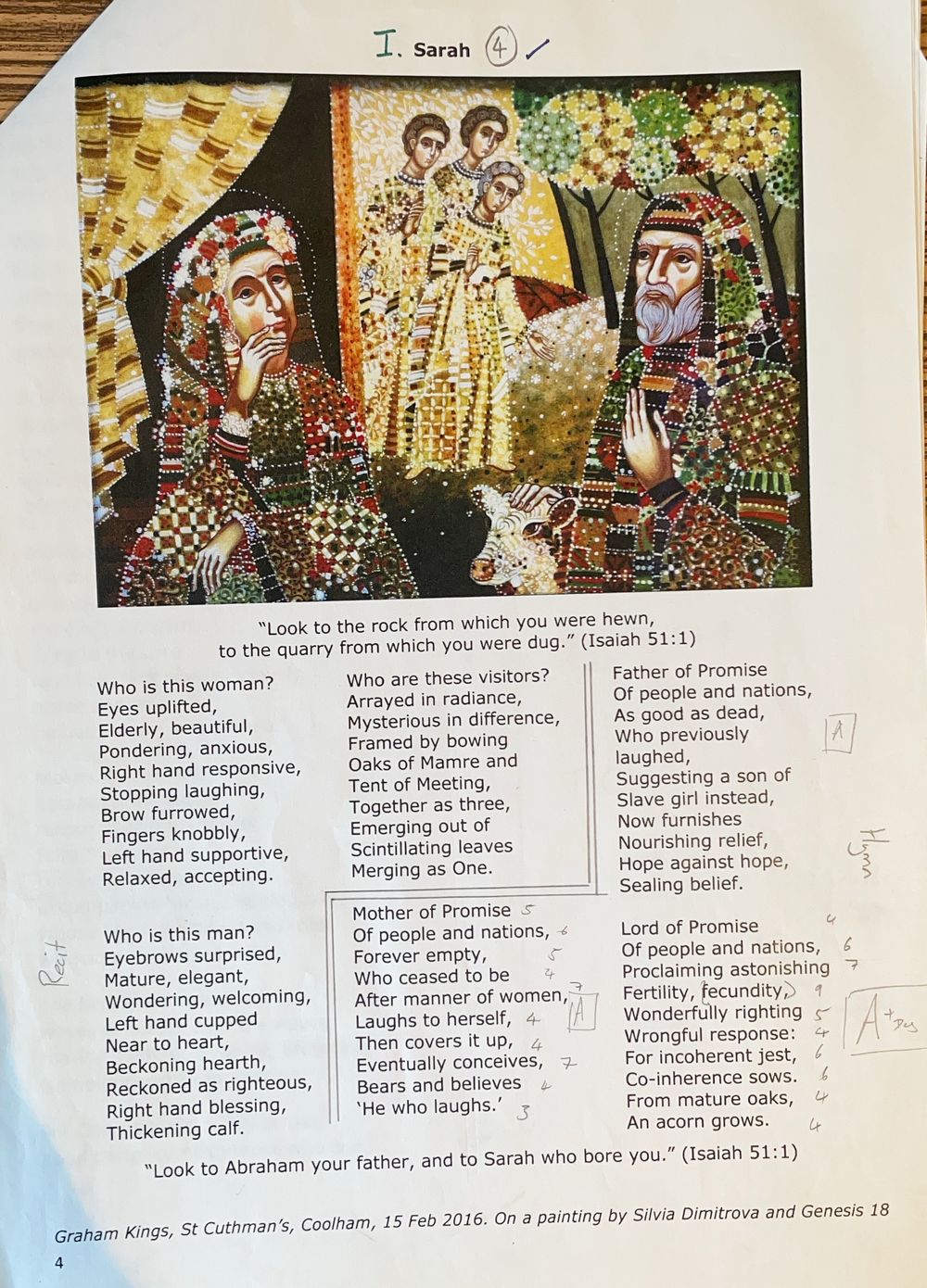
Sylvia's painting is an extraordinary feast of orange and green. In fact, I have only noticed tonight (several years after I set the text), that the painting seems to go straight to Autumn to Spring without the Winter when the eye is cast from left to right over it. Other observations include the details of the visitors, one of whom seems old, but with a young face, or how the scintillating leaves appear to be outside the veil of the tent and grove of the trees, urging themselves into the scene just as they urge the visitors.
Musical narrative is a tricky concept to distil, yet you'll note that from the perspective of musical composition, it appeared to fit the work that I was doing at the time. Taking reference from Ralph Vaughan-Williams's structure in Lord, Thou Hast been our Refuge, I placed the message of Sarah into the context of an oral tradition, with each question being answered immediately as it is asked.
Graham's poem gave me the answer of how to integrate these things together – the poem is split into halves; the first asking questions, the second answering. It seemed to me that this mechanism could bring the choirs together, with the various voices telling the story unifying in the verse 'Lord of Promise...'.
The second factor at play in Sarah is that it marks the start of a long musical journey spanning the length of the scripture. As such, a question of how to approach the tonality appeared. The most basic form of musical question is the half-cadence, where the tonic moves to the dominant, but doesn't return. Yet in this context, a half-cadence seemed insufficient. Sarah is both the question and the answer – the moment captured is a state of superimposition from where everything comes but also that everything leads back to (the cyclicity embodied in the quote from Isiah 51:1). The anthem of Sarah therefore, was created as a bitonal piece that hangs suspended between the tonal centres of A and E.
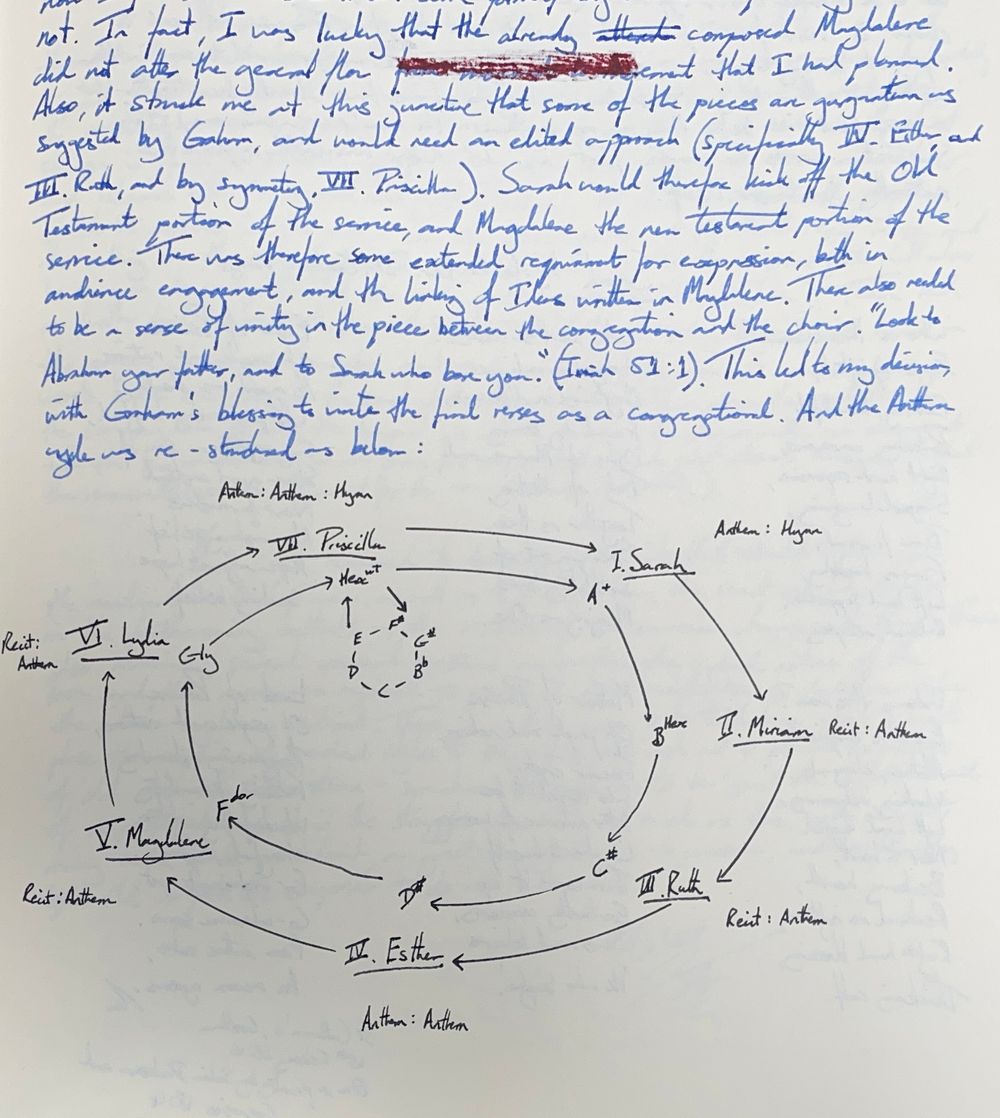
This recognition of the duality of Sarah also led to the realization that the last three stanzas of Graham's text fit into a hymn. Drawing on various references in hymnody, and the chimes of Great St Mary's Church in Cambridge city centre, I wrote a tune with the intent that it grew from the existing tradition in a positive way. Approaches with rhythm that I had learned in my studies of Indonesian Gamelan informed the setting of the textual underlay. The aim was to create a hymn that felt familiar, and yet was distinct and unique to the cycle. This was a real challenge; yet from this acorn the entire of the cycle could grow, as demonstrated in the picture taken from my notebook of the tonal and formal plan of the whole cycle. The second page shows my interpretation and notes on the poem that Graham gave me. Sarah was first performed wonderfully by Selwyn College Chapel Choir in October 2020, led by Sarah MacDonald.
I very much look forward to joining you tomorrow, where we will explore the construction and thought processes behind Ruth.