


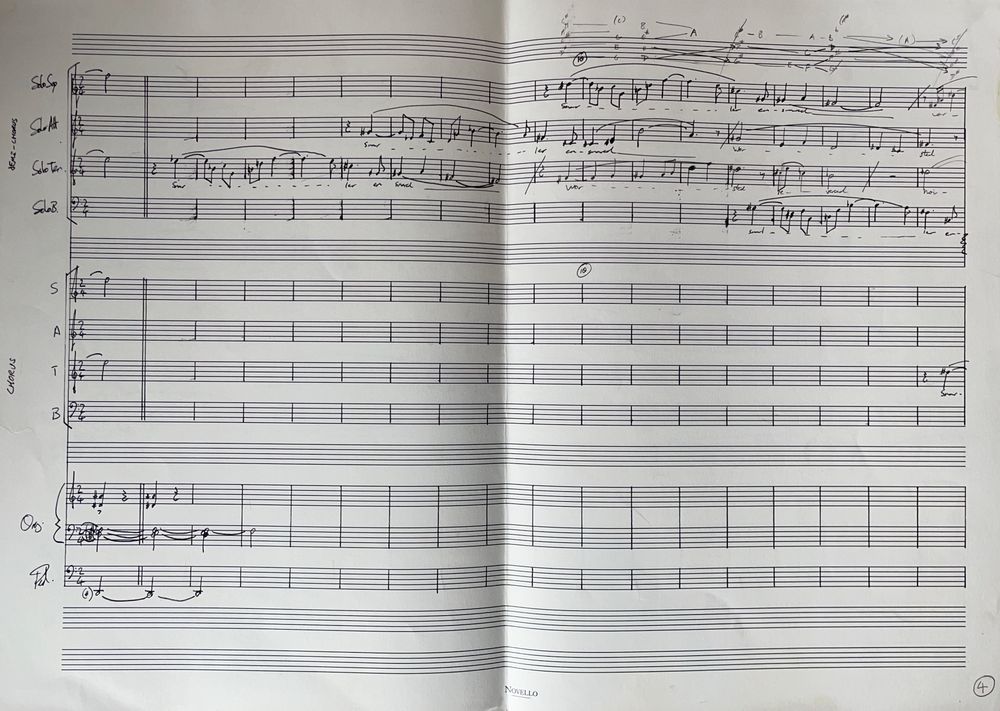
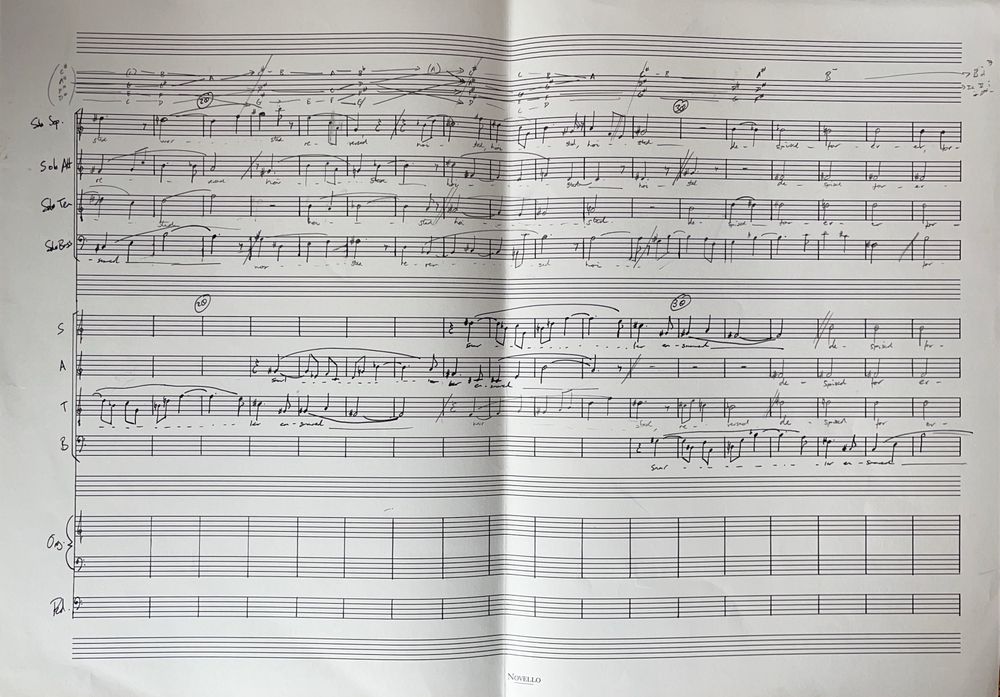
Esther attempts in part to fuse the baroque fugal style with 12-tone serialism to create a 4-part and 8-part atonal fugue that I am going to drill into. This tone row was designed based on the opening of Esther, that is made up of a series of interlocking arches.
Silvia's painting is regal, and dominated by curves. There are noticeably a crowd of people depicted in the painting, with Mordecai on the left, Xerxes and Esther in the centre, and two young Jewish girls on the right. Above these girls, Haman is depicted, standing under a gallows in the shape of the cross. Above Xerxes and Esther, we see the scintillating leaves in a window. Above Mordecai the trees on a hillside are depicted. Each of these frames are separated by a series of exquisite Persian arches, that took Silvia some six hours in the British Museum to get just right to add to the painting. These arches and pillars connect all the parts of the painting, acting as a narrative strand drawing all the different groups together.
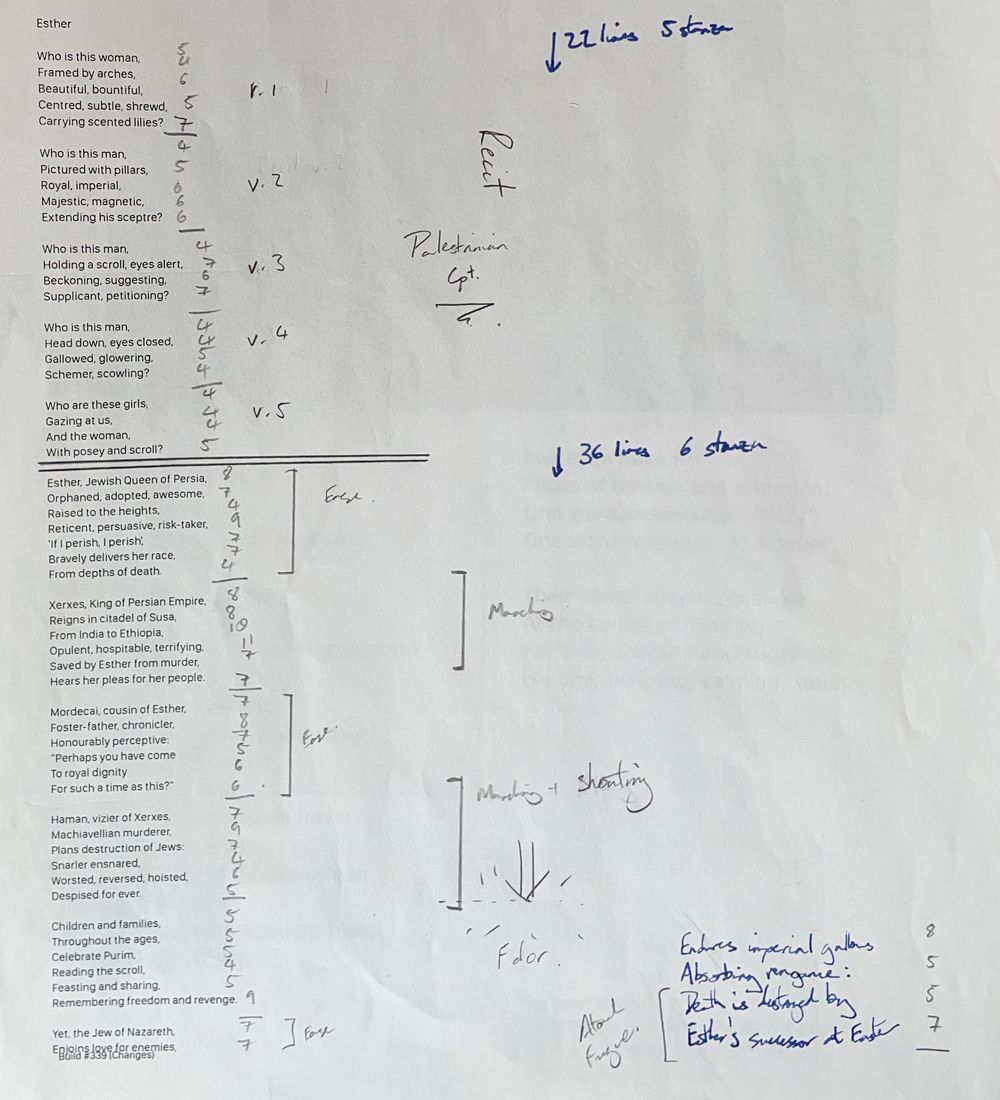
It was these arches and pillars that Graham first highlighted to me, and that are the featured in the first two stanzas of the poem. Following the framing of Xerxes and Esther, Graham's next three questions ask who the individuals are depicted around them. This is then followed by the five stanzas containing the answers, in the same order as they were asked, followed by a final coda stanza that reflects on the integration these have in the new testament with the line 'Death is destroyed by Esther's successor at Easter'.
From the outset, it seemed that the best way to reflect the arches was the creation of musical ones. These appear in the 'Primare' section of the anthem as a series of overlapping and undulating patterns, that are used to set all of Graham's stanzas, but especially the third, fourth, and fifth stanzas simultaneously. After this I was faced with a challenge: In Graham's poem, the stanzas in the second half alternate between positive and negative characterizations of those depicted – a sense that really needed clear reflection within the musical context.
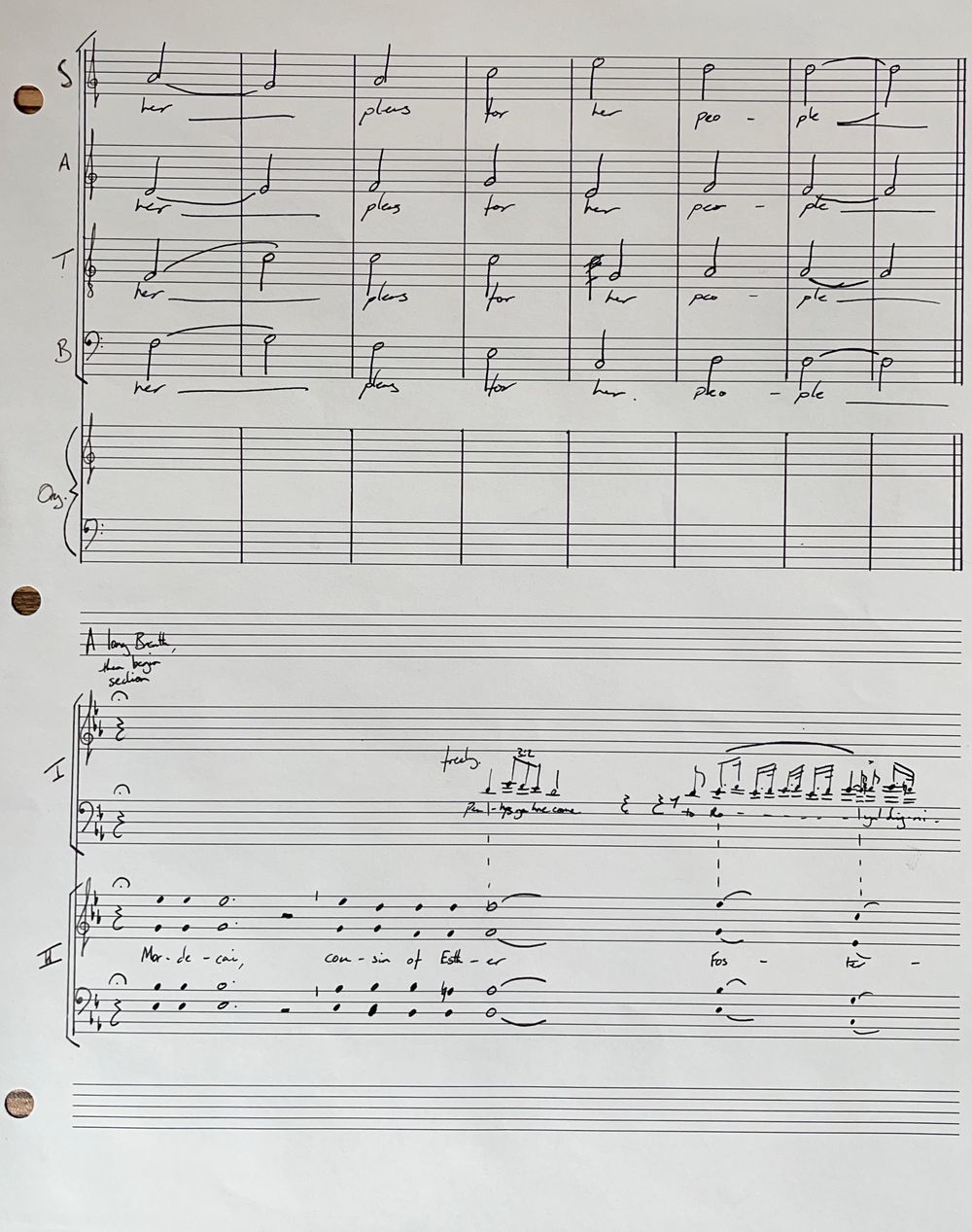
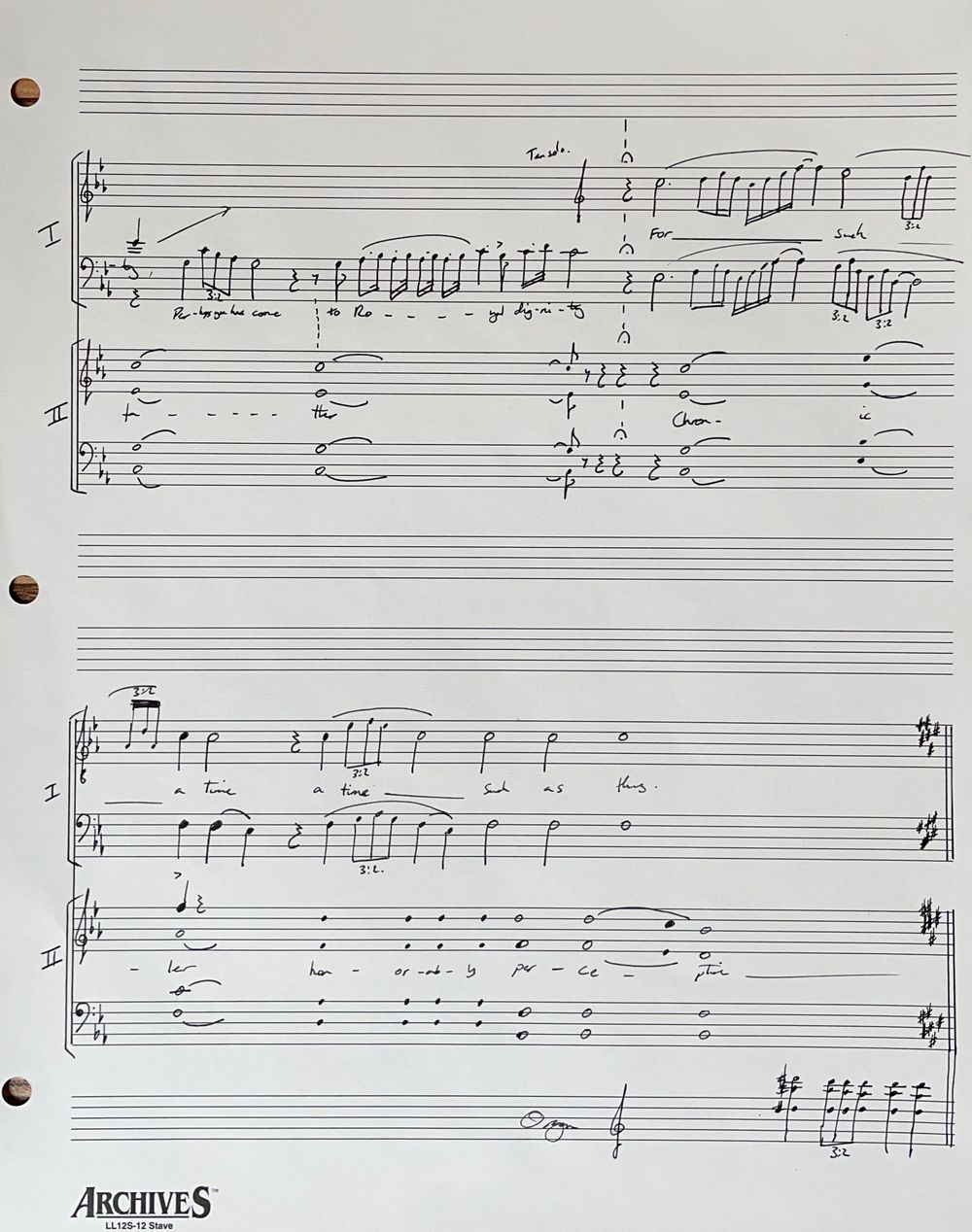
The solution to the positive side of these was to add long sections in free time that explored the comments with duets. You can see this in the second and third pictures in the gallery above. The idea of juxtaposing free time in these sections is so that the musical time 'stops' in order to describe Esther, Mordecai, and their contemporary impact, in contrast to the strong sense of rhythm that dominates the rest of the piece.
Juxtaposing the sections where time stops are the sections describing Xerxes and Haman, and for these I chose a militaristic 2|4 with an opening fanfare on the organ to herald their appearance. However, I reserved the central lines of the stanza for an atonal fugue in each case, on 'From India to Ethiopia', and 'Snarler ensnared'. The fugal theme was constructed in (you guessed it!) a double arch shape aiming to reflect the arches of the painting.
Serial writing like this requires that every single note of the chromatic scale is heard before you can hear the first note again. So if you write a 'c', you have to write every other note before you can write a 'c' again! You can trace the construction of this in the final two sketches above.
Tomorrow will include exclusive audio of a pre-recording made of 'Mary Magdalene'! I very much look forward to seeing you then.