
Dearest Listeners,
Three years ago in February 2023 during the course of my doctorate, I embarked on a compositional challenge that would grow to become one of the most complex I have ever tackled.
As it was the birthday of my good friend Christian Cang cuesta, I wrote him a letter that contained the theme for a new piece that I had started to write for him. A kind of 'perpetual fugue', it said.
A 'Fugue' is a particular kind of musical idea that explores the versatility and combination of musical themes (or melodies). It begins with the statement of a melody (or musical material) in one voice. After this statement, the original voice moves to a new, contrasting melody whilst a new voice enters the texture to state the original one, creating layers upon layers of independent melodic voices. Typically this grows to three or four voices creating a 'Fugal exposition' before the piece moves on to develop. In rare cases, this continues up to twelve voices or beyond.
The Fugue has always been an intriguing musical idea to me because of its emotive versatility, its rapid potential to scale and intensify the music, and its academic challenge. It appears as a feature in my music as early as 'The Glass Box' and 'De Profundis (Op.17)', and from there its use becomes ever expansive and more complex, with trivial uses such as 'A Fugue without Reason' (based on Shostakovich's 'Fugue without Dissonance') to serious in depth treatments, such as the non-tonal fugue in 'Esther' and the conceptual fugue in 'The Wasteland'.
On Bach's bookshelf was a treatise entitled 'the Musical Guide' by Friedrich Erhardt Niedt that I had been reading that offered the tantalising possibility of a 'perpetual Fugue' – a 'Fugue without end'. Immediately, I began to ask how you could create a Fugue that truly didn't end, a fugue in which every bar contained an entry of the original melody (complete or incomplete) in its original key. This fed into my fascination with cyclicity in music, and the challenge became to create a kind of 'imperfect' Fugue that never ends. The moment I conceived of this, my heart was set on the challenge. After all, who could resist the attempt to freely harmonize over a series of never-ending Fugal entries? This is in some ways, the ultimate formal restriction with the potential to lead to great compositional freedom.
I promptly wrote over 100 variations.
Then began the painstaking task of editing them back to something sensible in proportion that the listener could hold onto, but even this didn't fit.
As I continued to find spare hours with which to edit the piece, it continued to evade me. The simple act of expanding the Fugue to every bar had caused an unexpected side-effect – the piece no longer followed the rules of building tension that I presumed would be inherited from its cousins like the Chaconne or Ground Bass, and instead it became very difficult to give the listener compelling stakes. Why should they listen to the piece when they come to expect the appearance of the melody in every bar, and the Fugal entries therefore no longer build the intensity of the piece?
Then a year passed as I continued to toil at this.
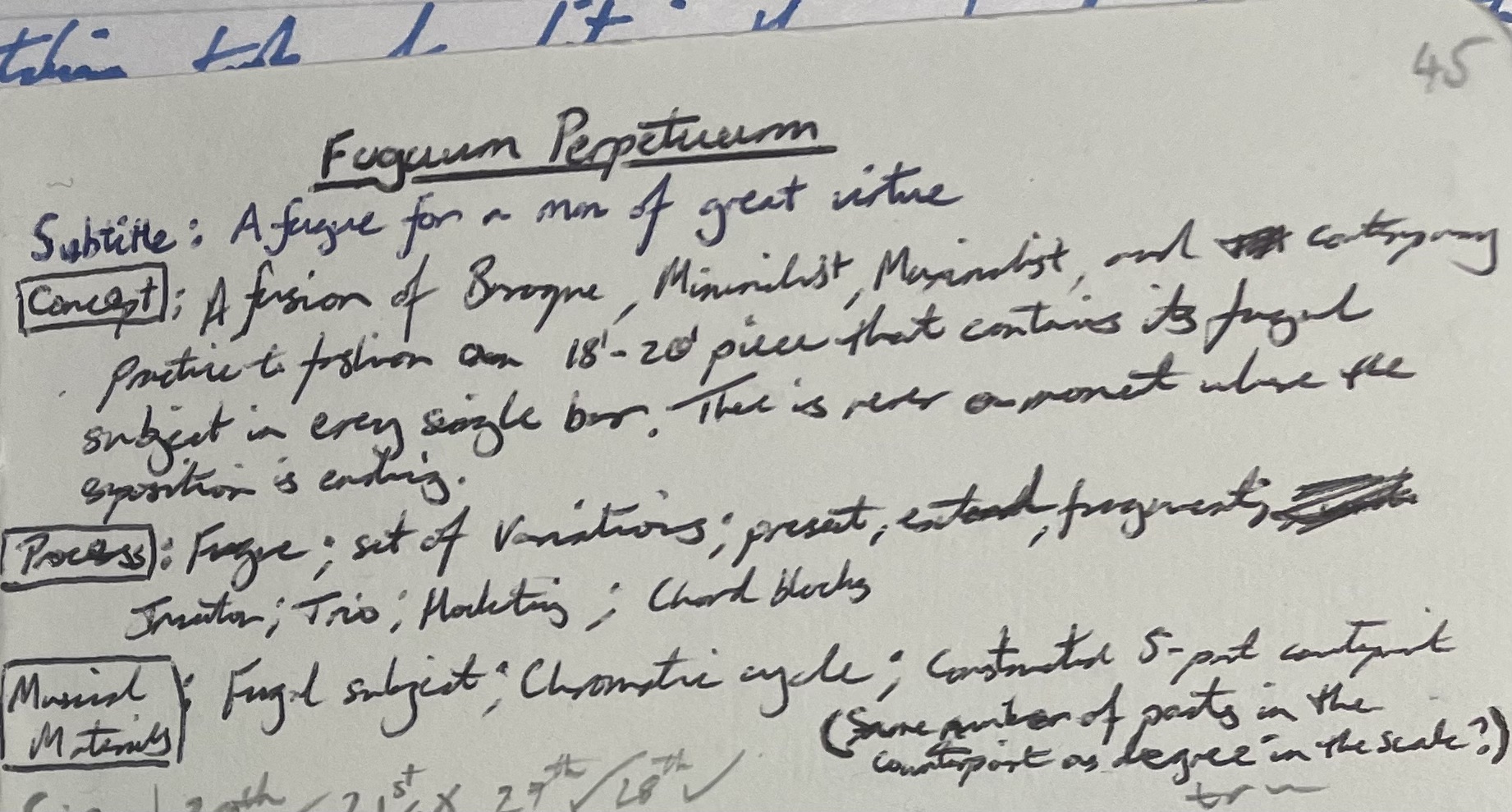 Then, in November 2025 I had a breakthrough. Stepping back from the music yielded clarity and a strategy: Group the variations by 'Style' and then order the 'Styles' in increasing intensity. (See the excerpt from my notebook above).
And so, the piece is now complete, with its Premiére to happen on the 5th June at St Mary's Church, Swaffham Prior on a tiny organ that I grew up with, designed primarily for accompaniment purposes. I very much look forward to showing more of it and how it sounds with you then.
In the meantime, I'll use those now extra free hours to write to you about 'All Thats Past' in the meantime...