CHAPTER I
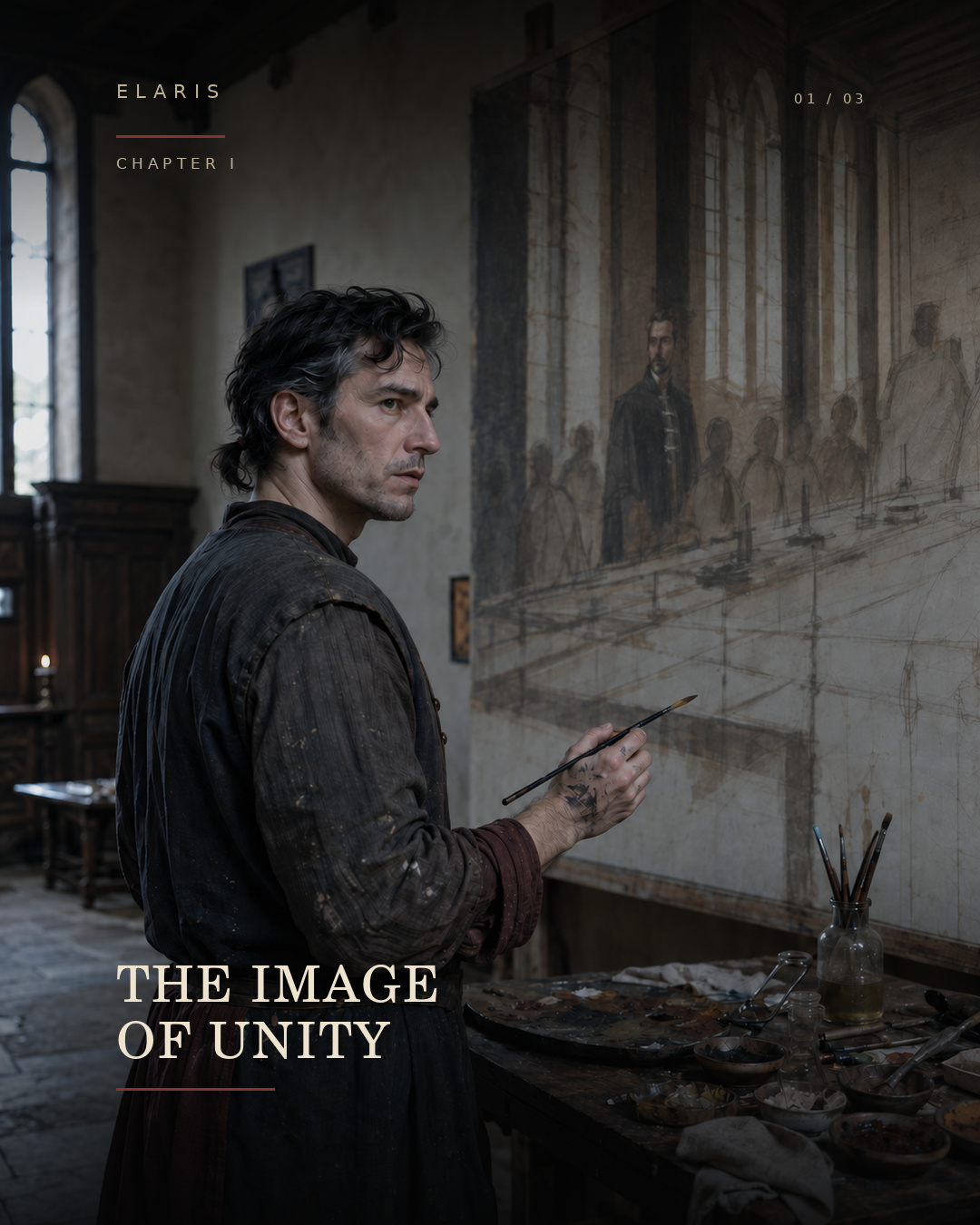
The Image of Unity
Since dawn, the city had been pretending it had nothing to hide.
Even through shuttered windows, it betrayed its secrets. The rasp of brushes scrubbing stone reached the studio, mingled with the hoarse shouts of labourers and the dull blows of hammers as new banner brackets were fixed to the façades. The noise had begun before first bell, in the hours meant for sleep, so that no one would see how much effort it took to prepare the city to be seen.
The studio smelled of linseed oil, wet wood, and freshly ground pigment. For the past several minutes, the pestle had been scraping against the mortar far too loudly.
Saeron still lay on the narrow bed behind the screen when stone grated against stone once more.
“Eiran.”
The sound stopped.
For a moment, there was silence.
“Yes, Master?”
“If you’re trying to wake the blue, I assure you it isn’t asleep.”
The boy did not answer. A moment later, Saeron heard the scraping resume, more carefully now, almost soundlessly.
He sat up and rubbed his face with both hands. He had barely slept. His dark, wavy hair fell across his forehead, the first grey showing at his temples. He picked up a brush from the small table and held it at arm’s length for a moment. His hand remained perfectly still. Streaks of pigment remained on the work-roughened skin around his nails. Then he set the brush down and rose.
He dressed, tied his hair low at the nape, and drew the screen aside.
Eiran sat at a low table, bent over a shallow mortar. He was twenty-three, with a narrow face that still looked young and ash-brown hair forever falling into his dark hazel eyes. He brushed it aside with the inside of his wrist; blue smears marked his broad knuckles. He worked with the concentration of a man entrusted with a task far more important than the one he was actually performing. Small pieces of azurite lay on the tabletop beside several linen cloths and a slice of bread the boy had evidently not found time to eat.
Saeron approached the table and examined the pigment in the mortar.
“Too much oil.”
“I used the same amount as yesterday.”
“There was too much yesterday too.”
Eiran looked up.
“Yesterday you said it was fine.”
“I said it would do.”
Saeron picked up the wooden spatula beside the mortar and drew its tip through the blue paste. The pigment parted too easily, leaving a glossy trail behind it.
“That’s not the same thing.”
The boy looked at the paint as though he expected it to confirm his master’s words. Then he reached for another piece of mineral.
Saeron took it from his hand.
“Eat first.”
“I’m not hungry.”
“That’s why you’ve been staring at the bread for five minutes.”
Eiran hesitated, but finally reached for the slice. A soft miaow came from beneath the table. Bolek, a stocky brown tabby with dark stripes, rubbed against Eiran’s ankle and lifted his large olive-green eyes towards the bread. Saeron did not wait for Eiran to begin eating. He crossed to the easel beside the largest window and removed its linen cover.
King Rhaevan’s face emerged from beneath the cloth.
He was a man with a broad jaw, low-set brows, and a mouth accustomed to expressing displeasure before hearing what anyone else had to say. In the portrait, he looked calmer. Not gentle, for Saeron did not accept commissions for miracles, but dignified. The shadows beneath his eyes had been softened, the lines on his forehead brought to order, and the left corner of his mouth lifted just enough for anger to pass as resolve.
Saeron studied the face, then selected one of his finest brushes.
“You’re still correcting him?” Eiran asked through a mouthful of bread.
“He still looks as though he wants to strike someone just beyond the frame.”
“Maybe that’s simply what he’s like.”
Saeron dipped the brush into pale paint.
“I know what he’s like.”
“Then why didn’t you paint him that way?”
The brush stopped just short of the canvas.
Saeron turned towards the boy. Eiran lowered his gaze at once, but not in retreat. He was waiting for an answer.
Saeron gently lightened the skin above the corner of the king’s mouth.
“King Rhaevan didn’t pay me for the truth.”
“Then what did he pay for?”
Saeron set down the brush and stepped back. From that distance, the monarch’s face lost its individuality and assumed the expression Rhaevan expected.
“To be remembered exactly like this.”
Eiran frowned at the portrait as though searching it for a lie.
“A painting is not the truth,” Saeron added quietly. “It is the part of the truth someone has chosen to preserve.”
Saeron could not tell whether the boy had failed to understand or had understood too well and disliked the answer.
“You once said a good painter shouldn’t fear what he sees.”
“He shouldn’t.”
“But he should hide it?”
“He should know when he is looking with a painter’s eye and when he is looking with a fool’s.”
Eiran tore off a piece of bread.
“What’s the difference?”
“A fool believes that merely seeing the truth gives him power over its consequences.”
This time, the boy said nothing. Saeron turned back to the portrait.
He remembered Rhaevan at the first sitting: broad shoulders confined by a ceremonial doublet, one hand clenched around the armrest, red veins in his eyes, and sweat on his upper lip. The king detested stillness, especially when someone else decided how long he must remain in it. Such a portrait would have been truer, but it would have ended its life in a cellar. The portrait he had commissioned had a chance to survive.
Someone knocked at the door.
Three quiet knocks came at even intervals. Eiran set down the bread and wiped his fingers on his trousers.
“Don’t open it until I’ve covered the portrait,” Saeron said.
“Why?”
“King Rhaevan doesn’t wish anyone to see him before he’s finished.”
“He came here six times. Half the street has seen what he looks like.”
“Half the street has seen him. Not the portrait.”
Eiran went to the door while Saeron draped the cloth over the easel. Only then did he nod.
A man in a dark green cloak fastened with a silver clasp stood in the doorway. He carried no weapon, yet before he had even stepped inside, his eyes had catalogued the contents of the studio, shelf by shelf and corner by corner, as though taking inventory of another man’s possessions.
He bore the mark of Ardelon on his chest.
“Master Saeron?”
“Depends who’s asking.”
The man held out a sealed letter.
“The Royal Chancellery.”
Saeron took the document. The wax was still soft, as though the letter had been sealed only moments before. The seal bore a crown enclosed within a circle, though the lower half of the impression was blurred. Whoever had pressed it into the wax had been in a hurry.
“Am I expected to reply?”
“You’re to come.”
“That wasn’t an answer to my question.”
The messenger looked at him without a trace of amusement.
“Before noon.”
He turned and went down the stairs.
Eiran closed the door.
“Did you do something?”
“Many things.”
“Something the Chancellery knows about?”
Saeron broke the seal.
Inside, he found a single sentence, the royal secretary’s signature, and the hour of the meeting. It gave no reason for the summons.
“That’s precisely what I intend to find out.”
Eiran came closer.
“Maybe it’s about taxes.”
“If it were taxes, they’d have sent two men.”
“Maybe it’s about King Rhaevan.”
“Then they’d have sent someone in a robe, not a cloak.”
The boy tried to read over Saeron’s shoulder. Saeron folded the letter and tucked it into his belt.
“Finish the blue. No more oil. Then prime two canvases.”
“How large?”
“Whatever sizes we have.”
“What if you don’t come back?”
Saeron stopped beside the coat stand.
There was no joke in the question. Eiran watched him closely, trying to hide his unease behind a show of indifference. He did it badly.
Saeron put on his cloak.
“Then don’t touch Rhaevan’s portrait.”
“Why?”
“Because he hasn’t paid.”
He left before the boy could ask another question.
* * *
The streets were colder than the cloudless sky had promised. The night’s rain had washed the dust into the gaps between the stones, and now labourers were pushing the grime towards the gutters. The water was grey, carrying rotten leaves, scraps of straw, and flakes of old plaster.
Saeron headed towards the upper city.
The capital of Ardelon rose gently up the hillside, the palace crowning it like the final, flawless brushstroke on the horizon. It did not loom like a fortress. It was a vanishing point towards which every roofline, every street, and every gaze converged.
That day, the banners led there as well.
Strips of fabric in Ardelon’s colours hung from the windows. Along the wider streets, the coats of arms of Valen’s other lands were suspended between buildings, arranged so that none hung higher than the crown of Ardelon. Labourers measured lengths of rope, shifted brackets, and argued over distances most passers-by would probably never notice.
Saeron noticed.
He also saw the places meant to remain unseen.
Beside a fountain, two guards ordered an old woman to gather the wooden figurines she had laid out on a cloth. Farther on, an innkeeper was boarding over a crack that ran across the front of his building. On a bakery wall, three boys were painting over a slogan aimed at the arriving delegations.
The white paint had not yet dried, and the dark letters still showed through.
ARDELON WILL NOT FEED FOREIGN KINGS.
One of the boys dragged his brush across the final word. The letters blurred but did not disappear. Another coat would be needed.
The queue outside the bakery was longer than usual. People spoke of the ceremonies, the foreign envoys, and the peace agreement due to be signed before the end of the month. They spoke loudly and with conviction, yet most left the shop carrying more loaves than they could eat in a day.
Saeron stopped before a textile merchant’s window. He adjusted the sleeve of his cloak to hide a small stain of red pigment that had survived several attempts to remove it. With his dark hair tied low at the nape and his narrow face, he looked like someone who did not wish to be remembered. That suited him.
The first delegation had arrived earlier than announced.
Saeron walked on.
At the palace’s outer steps, the guards inspected his summons, confirmed his name, and searched the small leather pouch he always wore at his belt. One of them removed two sticks of charcoal, a piece of chalk, a lead-weighted cord, and a small knife for sharpening charcoal.
“The blade stays here,” he said.
“Without it, the charcoal will soon be useless.”
“There are other knives in the palace.”
“How reassuring.”
The guard did not answer. He placed the tool in a wooden box and handed Saeron a clay token engraved with a number.
Inside, the palace appeared chaotic. Servants carried benches, officials clutching documents hurried through the chambers, and guards took up posts beside passages that until then had stood empty. Yet no one collided with anyone else. Every movement had a purpose; every route had been planned in advance. It looked like a dress rehearsal in which everyone knew their part, though no one had been told why the performance had to proceed with such haste.
A young clerk was waiting for Saeron.
He did not introduce himself. He merely bowed his head and led Saeron through a side cloister, up a broad staircase, and into the ceremonial wing of the palace.
“Will I be told why I was summoned before we meet the royal secretary?” Saeron asked.
“The secretary will explain everything.”
“Then may I at least be told which secretary we’re going to see?”
The clerk quickened his pace.
“The First.”
“I’ve always suspected the others exist solely to make a man appreciate the First.”
The young man glanced back at him, uncertain whether he was permitted to smile. In the end, he did not.
They reached a pair of tall, open doors.
The hall beyond them was almost empty.
Saeron had seen it before during royal ceremonies, but never without people. Stripped of courtiers, musicians, and guards, it seemed larger. Light entered through a row of tall windows, cutting bright rectangles across the stone floor. Against the far wall stood a dais with a throne. Chairs for the delegates had been arranged before it.
Some still stood against the walls. Others were being moved according to chalk marks on the floor.
Two men waited in the centre of the hall.
The first was the royal secretary, Averan Sorn. Saeron knew him by sight. Sorn belonged to that class of men whose presence was difficult to remember, though the whole city felt the weight of their decisions. He dressed more modestly than most dignitaries, wore no rings, and usually spoke so quietly that others had to lean towards him. This made even men of higher rank look as though they were asking him for confidential advice.
The other man oversaw court ceremonies. The collar of his robe was so stiff that he could not turn his head freely.
Sorn approached Saeron.
“Master.”
“Secretary.”
“Thank you for coming so promptly.”
“The summons left little room for delay.”
Sorn ignored the remark.
“You know about the assembly, I assume.”
“The whole city knows.”
“The city knows the part it is meant to know.”
Saeron looked at the empty chairs.
“So it knows there will be peace.”
The ceremonial official stiffened further, though Saeron had not thought that possible. Sorn, however, smiled faintly.
“An agreement will be signed.”
“That is not always the same thing.”
“Which is precisely why you are here.”
The secretary turned towards the hall.
Sorn began to describe the final day of the assembly: the reading of the terms and the signing of the documents. Saeron listened with half an ear, more concerned with what he saw. One chair stood farther from the throne than the others. When the secretary moved on to the dispute over trade routes, Saeron noticed that another had been placed in a patch of shadow the light would not reach until afternoon. As Sorn spoke of taxes and the right to maintain troops, Saeron discovered that two further seats had been pushed so close together that their occupants would be forced to sit shoulder to shoulder.
“You want a painting,” he said.
The man in the stiff collar cleared his throat.
“A work commemorating the unity of Valen under Ardelon’s leadership.”
“How large?”
“An entire wall of the western gallery.”
Saeron raised an eyebrow.
“I asked about the painting, not the ambition.”
Sorn stopped the official with a flick of his hand.
“You will be given a studio in the palace, the necessary materials, and assistants. You will prepare the first sketches for tomorrow’s meeting. The painting is to be completed before the end of the month.”
“No.”
The ceremonial official stepped forward.
“Master Saeron, this is a royal commission.”
“A royal commission doesn’t alter how long paint takes to dry.”
“I was assured that you are the finest painter in the capital.”
“Which is why I’m telling you no.”
Sorn studied him for a moment.
“How long do you need?”
“If the work is to outlast the ceremony, two months. If it must look complete at the unveiling, three weeks and permission to finish the details afterwards. If it only needs to look good from the far end of the gallery, you may hire the men who decorate façades.”
“Three weeks,” Sorn decided.
“And I’ll choose the assistants myself.”
“The court will vet them.”
“The court may decide whether they can keep a secret. I’ll decide whether they can hold a brush.”
The secretary nodded.
Saeron walked between the chairs. He stopped beside the one placed farthest from the dais.
The coat of arms of one of the arriving delegations had been carved into its back. The chair was finely made, but its front legs were slightly shorter than the rear ones. Whoever sat in it would have to brace his feet the whole time or appear to be sliding towards the floor.
Saeron pressed one hand against the seat.
The chair rocked.
“This needs replacing.”
“It was prepared according to ceremonial protocol,” the official replied.
“Does ceremonial protocol require the envoy to fall over during the signing?”
The man pressed his lips together.
Sorn came closer.
“The chair will be adjusted.”
“So will its position.”
“What’s wrong with it?”
Saeron pointed to the stone slab in front of the chair. A line of white chalk marked where its front legs were meant to stand.
“If I paint the delegate here, he’ll end up outside the main composition.”
“Only a few steps.”
“On the floor.”
Saeron looked at the secretary.
“On canvas, those steps will become years.”
Sorn turned his gaze to the ceremonial official. He did not need to say anything. The man drew a piece of paper from his sleeve and wrote down the instruction.
“The final arrangement will be approved this evening,” Sorn said. “We want the work to depict accord. No old divisions, no advantage to any side, and no unnecessary details.”
“Except Ardelon’s advantage.”
“Ardelon is not a party to the dispute.”
Saeron looked at the throne towering over the chairs.
“Of course.”
The secretary moved half a step closer.
“Everyone will see this painting. Merchants, commanders, and the sons of those who sign. What you paint may mean more to them than the agreement itself.”
“I know what a painting is.”
“Then you also know that one should not always paint what lies before one’s eyes.”
Saeron turned towards him.
For a brief moment, neither man moved.
“People usually come to me precisely because I see what lies before me,” Saeron said.
“They come because you know how to decide what should remain there.”
The secretary’s words echoed Saeron’s conversation with Eiran. In the studio, the same thought had sounded like a principle of the craft. Here, it sounded like an order.
Saeron surveyed the empty places reserved for those who would pose the following day for a painting of accord.
“I will see them first,” he replied.
Sorn took that for assent.
A clerk brought sheets of paper and a drawing board. Saeron’s knife remained at the entrance, so one of the court servants gave him fresh sticks of charcoal, evenly cut and almost identical.
Saeron selected the thinnest.
For the next hour, he measured the hall.
He began by pacing out the distances, then judged them by eye. Light from the windows cut across the floor. It would determine the composition. He sketched the king at the centre, though not on the throne. That would have been too obvious. He arranged the delegates in a semicircle so that none would stand with his back to the others.
And behind them?
Open windows.
Always open windows.
A wall was an ending, and this painting was not meant to have one. It was meant to spill out across the city and encompass it.
Sorn left to attend to the arrival of the delegations. The ceremonial official remained a little longer, watching every line that appeared on the paper, but eventually he too was summoned away.
Saeron was left alone.
The silence was not complete. From the corridors came servants’ footsteps, guards calling to one another, and the scrape of shifting furniture. The sounds rose into the high vault and returned distorted, as though other people were moving through unseen parts of the hall.
Saeron stood in the centre of the chamber and half-closed one eye.
He drew a line across the paper with the charcoal, marking the edge of the dais. Then he added the throne, the windows, and the first of the empty chairs.
Something did not fit.
He lowered the board.
A thin crack ran across the floor between the positions reserved for two of the delegations.
He had not noticed it before.
It began at the step of the dais, crossed a pale slab, and continued towards the chairs. It was so narrow that in a darker hall it might have been mistaken for a hair. The light pouring through the windows, however, revealed its uneven course.
Saeron moved closer.
The crack divided into several smaller branches. One ended beneath the chair with the shortened legs. Another continued towards the space reserved for the signing table. The longest reached all the way to the first step of the throne.
He crouched.
For a moment, he had the impression that the fissure moved. It did not widen. It seemed instead to darken, as though something buried deep in the stone were shifting beneath its surface.
Saeron reached out.
A door slammed somewhere in the corridor.
He flinched and turned towards the sound.
When he lowered his gaze again, the floor was whole.
He ran his fingers over the pale stone. He could not feel so much as a scratch. The surface remained cold and smooth, polished by decades of footsteps.
Saeron rose slowly.
He looked around, but the hall was empty.
Fatigue.
It had to be fatigue.
A night spent finishing Rhaevan’s portrait. An empty stomach. Sharp light across the floor. It was only a play of streaks and patterns in the stone. The eye sometimes sees what is not there, assembling images from chance shapes.
The thought calmed him, though he could still feel the imagined edge of the crack beneath his fingertips.
He returned to the sketch.
Only when he was about to mark the position of the final chair did he notice a line running across the paper.
The charcoal line cut through the entire composition. It began between the delegates, divided their places, crossed the table, and ended beneath the throne.
Saeron did not remember drawing it.
He rubbed the mark with his thumb.
The charcoal smeared, leaving a grey stain on the paper. The line itself did not disappear. The paper around it rippled slightly, as though the sheet had shrunk from something it refused to accept.
He turned the sheet over.
A faint ridge showed on the other side.
Saeron studied his own sketch for a long time. Then he folded it in half, slipped it beneath the other sheets, and drew the hall again from the beginning.
This time, he left no crack between the chairs.
* * *
By the time Saeron returned to the studio, the light had changed colour.
The morning chill was gone. Flat, grey light entered through the north-facing windows and crept across the walls more slowly than the light from the building’s other windows. Saeron usually liked it. It did not lie about colour.
That day, he did not trust even that.
Eiran sat at the table exactly where Saeron had left him. The bread was gone. The blue had been corrected.
“Less oil,” Saeron said.
Eiran raised his head.
“I noticed.”
Saeron removed his cloak.
“That was a compliment.”
“You should warn me.”
A primed canvas stood against the studio’s largest wall. Its heavy frame was reinforced with crossbeams, and it had been positioned so it could later be manoeuvred through the loading door into the courtyard.
For now, its surface remained pale.
The Image of Unity did not yet exist.
Saeron set the portfolio on the table.
“What do they want?” Eiran asked.
“Unity.”
“Is that bad?”
“Usually, when it has to be commissioned from a painter.”
He took out three sheets.
Eiran moved closer.
The first showed the delegates seated at a table, each turned slightly in a different direction. The second depicted the moment after the documents had been signed. The third was the most orderly. Its figures were close together, bound by the light falling through the tall windows.
Eiran pointed to the last one.
“They’ll choose this one.”
“Why?”
“It looks as though none of them hates anyone else.”
“I should take you to the palace more often.”
“No.”
“Another sensible answer.”
A knock at the door interrupted them.
Only twice this time.
Eiran hesitated.
“Should I hide the king?”
“Let him rest.”
Saeron opened the door.
A slender man stood in the corridor wearing a dark cloak, the high collar of a black doublet visible at his throat. His beard was neatly trimmed, and he carried a portfolio stuffed with documents under one arm. One corner was already creased from frequent handling.
“Master Saeron?”
“Today, for once, yes.”
The man looked past him towards Eiran.
“Meran Vey. Chancellery of the Council.”
He did not offer his hand. Neither did Saeron.
“Averan Sorn said you would not bring the revisions until this evening.”
“The secretary meant the final revisions.”
Meran entered when Saeron stepped aside.
He did not survey the studio as openly as the morning messenger. His scrutiny was far more discreet, and therefore more thorough.
He placed the portfolio on the table.
“The order of the delegations has changed again. The League of Jahrann still has not confirmed the name of its representative. The Vardhen Marches demand greater distance from the southern delegation. One side wants a banner behind its delegation; the other insists on having one too.”
“Of course.”
Meran unfolded the plan.
The ink formed a web of revisions. Some names had been crossed out twice. Arrows indicated new places at the table, and three positions had been marked in another colour.
Saeron ran a finger over one of the marks.
“This doesn’t match the arrangement I saw at the palace.”
“That is why I am here.”
“And tomorrow it’ll all change again.”
“Probably.”
“I’m beginning to understand why officials don’t paint.”
Meran smiled faintly.
“We revise things before they have time to dry.”
Eiran gave a snort of laughter, then immediately pretended to cough.
Meran noticed but made no comment.
Saeron took out the third sketch.
“This is the most likely arrangement.”
“So do we.”
“‘We’?”
“The people who will pretend tomorrow that they’re seeing it for the first time.”
Saeron lifted his gaze.
Meran was not smiling.
“I can’t wait until tomorrow,” Saeron said. “With a deadline like this, I have to begin the underpainting today.”
“The secretary assumed you would say that.”
“So he lets me begin without approval?”
“He lets you waste your own time if the king chooses another version.”
“Generous.”
Meran pushed the plan towards him.
“The architecture of the hall will not change. Nor will the windows. The Crown’s place is fixed as well.”
Saeron indicated several figures.
“And the people?”
“Most of them may still change.”
Meran ran a finger along the edge of the table.
“These three positions may be treated as fixed. The representative of the Crown. The First Secretary. Me.”
“You’ll be in the painting?”
Meran turned to Eiran.
“Apparently.”
“You’re not a delegate.”
“That’s why I’m to stand, not sit.”
Eiran accepted the answer without further questions.
Saeron turned to the pale canvas.
“Stand by the window.”
Meran frowned.
“Now?”
“If I’m to pretend tomorrow that I began only after the king made his decision, I need to do today what no one will notice.”
Meran watched him for a moment.
Then he removed his cloak.
Beneath it, he wore the same black doublet with its high collar. The fabric was fine but unadorned. Silver fastenings at the throat were the only details to catch the light.
“Here?”
Saeron moved him half a step.
“Now here.”
Meran stood side-on to the window.
Saeron studied his face.
A narrow face. A neatly trimmed beard. A slight crease between the brows. A mouth that seemed to calculate even at rest.
“Do not move your head.”
“How long?”
“Until I begin to like you.”
Meran sighed.
“I should have asked sooner.”
Saeron transferred the main lines of the composition to the canvas. He was not yet working in detail. He marked the table, the edges of the tall windows, and the line of the delegates’ shoulders. The figures remained pale and almost shapeless.
Only Meran’s position called for greater precision.
The official was to stand slightly behind the table, on the boundary between two groups. He belonged to neither delegation. Yet without him, the ceremony could not take place.
He marked Meran’s shoulders, the high collar, and the oval of his face.
Eiran prepared a darker mixture.
“Too much umber,” Saeron said.
“I haven’t added it yet.”
Saeron looked into the bowl.
“Then it’s fine.”
Meran shifted his weight.
“You said I wasn’t to move my head.”
“Your legs aren’t in the painting yet.”
“Reassuring.”
Saeron worked quickly.
He did not try to finish the face. It was enough to capture the proportions and the way the light broke across the high collar. With dark paint, he laid in the shadow beneath the jaw. With a lighter tone, he shaped the left cheek.
Meran began to exist on the canvas before the others.
Around him, the other figures were still no more than smudges.
After a dozen minutes or so, Saeron set down the brush.
“That will do.”
Meran approached the painting.
He found no portrait of himself there, only part of a face emerging from among the unfinished figures.
“I look as though I’m dying of boredom.”
“Then the likeness is good enough.”
Eiran turned back to the pigments, hiding a smile.
Meran put on his cloak.
“Tomorrow morning, you’ll present the king with three sketches. If he chooses a different version, that will disappear.”
He pointed to his own face.
Saeron examined the pale face on the canvas.
“Paint is harder to make disappear than an official.”
Meran’s hand stopped on the latch.
“Please don’t test that.”
This time, it was impossible to tell whether he was joking.
He left.
Eiran went to the door and listened to Meran’s footsteps recede.
“I don’t like him.”
“You don’t have to.”
“Do you?”
Saeron began cleaning the brush.
“I haven’t painted him long enough to know.”
Eiran returned to the table.
For the next hour, they worked in silence.
Saeron developed the architecture of the composition. The vertical lines of the windows. The perspective of the table. Patches of light on the floor. He left the delegates’ places almost empty.
He returned to Meran’s figure several times.
He corrected the line of the jaw.
The shadow beside the collar.
The light on the left cheek.
At one point, he put down the brush and pressed two fingers to his temple.
Eiran noticed.
“Does it hurt?”
“A little.”
“I’ll fetch some water.”
“No.”
Saeron kept his eyes on the canvas.
Meran was the only person in the composition who could already be recognised.
The rest were waiting.
“Go home,” Saeron said.
Eiran looked towards the window.
“It’s still early.”
“Exactly.”
“I still have to prepare the blue for the morning.”
“You’ll do it in the morning.”
Eiran did not move.
“Does your head really hurt?”
Saeron looked away from the painting.
“Yes.”
That was not entirely true.
But he did not know what to call the rest.
Eiran wiped his hands on a linen cloth.
“I’ll come before dawn.”
“After first bell.”
“Before.”
Saeron did not have the strength to argue.
“Close the door behind you.”
Eiran took his cloak.
At the door, he paused and looked back at The Image of Unity.
“Have they chosen this version yet?”
“No.”
“And if they choose another tomorrow?”
Saeron looked at Meran’s pale figure, surrounded by people who did not yet have faces.
“Then I’ll paint over it.”
Eiran nodded and left.
Saeron was alone.
He waited until the boy’s footsteps had faded on the stairs.
Then he turned the key in the upper lock.
He hesitated.
He turned the key in the lower one as well.
The studio fell silent.
Beyond the north-facing windows, the light faded slowly over the roofs of Ardelon. Saeron added wood to the fire but did not return to the table at once.
He stood before The Image of Unity.
Most of the composition still did not exist.
The table was little more than lines of perspective. The king, a pale shape. The delegates, a row of unfinished silhouettes.
Only Meran Vey had a face.
Saeron reached for the brush.