
CHAPTER II
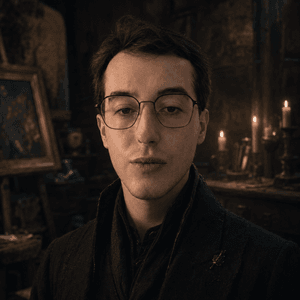
The day after the summons to the palace, Eiran returned to the studio long before dawn. But he had not come to prepare pigments. He was not supposed to be there at all.
The previous evening, Saeron had sent him home earlier than usual, saying he had a headache. Eiran would not have found that suspicious if he had not heard the key turn in both locks. His master never locked the studio from the inside. Eiran still remembered something he had said years ago: “A painter who is afraid of being watched should become a scribe. At least then he can hide his mistakes between the pages.”
Eiran waited several hours.
Then he returned.
The key he wore beneath his shirt fitted only the upper lock. He tackled the lower one with a length of thin wire and one of the metal pins used to stretch canvases. It took longer than he would have cared to admit.
When the mechanism finally yielded, Eiran slipped inside and closed the door behind him.
The studio smelled of linseed oil, damp wood, and a dead fire. The ashes in the stove were still smouldering beneath a thin grey crust. Beyond the tall windows, both moons were sinking towards the rooftops of the capital. The larger remained pale, almost white. The smaller was the colour of old silver.
Their light divided the room into sharp bands of shadow.
His gaze swept over the portraits of noblemen and stopped on the large canvas being prepared for the palace. The previous evening, the sketch of the assembled delegates had been almost empty, devoid of faces. The architecture, the table, and the first places around it were still only underpainting, but one figure had now been developed more clearly than the others.
A dark cloth covered only part of the canvas.
It had not been there the night before.
Eiran lit a lamp and approached the easel.
The cloth had been thrown over it in haste. One edge had caught on the corner of the frame. An overturned stool lay on the floor, with a dried brush beside it.
Saeron never left his brushes uncleaned.
Eiran crouched.
The bristles were dark red.
He held the brush closer to the light without touching it. The pigment resembled a mixture of carmine and burnt umber. Too brown for decorative fabric, too thick for the underpainting of a face.
It smelled of metal.
That smell. It carried him back to the Lower Canals, to the taste of metal that had lingered on his tongue all day after, at the age of nine, he had leaned too close to a vat of red dye. The people of the upper city said the canals reeked of sewage, but Eiran remembered the stench of work: lye, wet hides, dyes poured into the water at night. Every canal had its own colour. Red belonged to the dyehouses, where women like his mother mixed pigments with their bare hands. He remembered her saying that even a canal could remember the sky when the water turned blue after rain. After her death, that blue filled him only with anger.
Eiran put down the brush.
He seized the cloth covering the canvas and pulled it aside in one movement.
He saw Meran Vey.
He recognised him at once.
He was the official from the royal council who had brought Saeron the list of delegates and the revised seating plan the day before. He had a narrow face, a neatly trimmed beard, and a habit of looking at people as though calculating their worth.
In The Image of Unity, his figure had been developed from the chest upwards, dressed in a black doublet with a high collar. Saeron had captured the slight tightening of his lips and the fine crease between his brows. The other delegates remained little more than an arrangement of light and dark patches.
Meran’s face looked almost alive.
Eiran lowered the lamp.
Then he saw the wound.
A thin red cut began just beneath the left ear and ran down the neck, disappearing beneath the high collar. Around the line, Saeron had painted faint bruising. There was nothing theatrical or courtly about it. The wound looked slight.
Real.
Like the mark of a blade that had cut through skin quickly and cleanly.
Eiran remembered the official standing in the studio the day before.
Meran Vey had no wound.
Not even a scratch.
* * *
“I told you to go home.”
Saeron’s voice came from behind him.
Eiran flinched but did not move away from the painting.
His master stood in the doorway to the small room where he sometimes slept while working on large commissions. He was wearing the same shirt as the previous evening. Its sleeves were crumpled, and a dark shadow lay beneath one eye.
He had not slept.
Perhaps he had not left the studio at all.
“And I said I would finish preparing the blue before the morning session,” Eiran replied.
“You didn’t come here for the blue.”
“And you weren’t supposed to paint that on the royal painting.”
Saeron approached and covered that part of the canvas.
He did it too quickly. The cloth caught on the upper corner of the frame, and the easel swayed on the stone floor.
Eiran caught it before it fell.
“Careful,” he said.
“Let go.”
“You’re the one who nearly knocked it over.”
“Eiran.”
The boy released the easel.
Saeron adjusted the cloth and stepped back, as if the mere proximity of the painting caused him discomfort.
Eiran watched him in silence.
He had known his master for five years.
Long enough to recognise his lies.
Saeron softened when he was trying to deceive someone. He spoke more slowly, chose his words with greater care, and assumed an expression of patient weariness. That was how he spoke to tax collectors, courtiers, and people convinced that an artist should be grateful for the privilege of painting them.
Now he was not trying to lie.
He was trembling. Barely, but Eiran saw it in the tension of his shoulders and in the way he avoided looking at the covered section of The Image of Unity.
“Why did you paint him wounded?” Eiran asked.
“I don’t remember painting that wound,” Saeron said, but there was no certainty in his voice.
“It’s your painting. That brush was lying beside it. Your favourite. And the paint... it’s still wet.”
Saeron came closer. Carefully, as though approaching a wild animal, he touched the fresh paint beside the wound with the tip of one finger. He drew it back. A gleaming red mark remained on his skin.
“I know,” he said quietly.
Eiran waited, but Saeron added nothing. Silence settled between them, heavy with everything left unsaid.
“There’s something else,” Eiran said at last, more quietly than he had intended. “You don’t know why you painted it.”
Saeron crossed to the table.
On it lay the sketches for the palace commission: arrangements of figures, designs for garments, and plans of the council chamber. His master began putting them in order, although they were already arranged.
“I woke up in front of the easel,” he said.
Eiran’s smile vanished.
“Were you asleep?”
“I must have fallen asleep at the table.”
“And you woke with a brush in your hand?”
Saeron looked at him.
“How do you know?”
Eiran pointed to the dark streak across his fingers.
“You didn’t wash your hand.”
Traces of the same brownish-red pigment marked the skin between his thumb and forefinger.
Saeron opened his hand.
For a moment, he regarded it as though it belonged to someone else.
“I remember the face. I worked on it yesterday. But the wound... I don’t remember painting it.”
“You saw Meran Vey yesterday.”
“That isn’t an answer.”
“His face may have stayed in your memory.”
“And the wound?”
Eiran did not answer.
Saeron turned towards the covered painting.
“When I came to, I was painting blood.”
“Came to?”
“I woke up.”
“That didn’t sound like ordinary waking.”
His master braced both hands against the table.
“I don’t know what else to call it.”
“What do you remember?”
“Nothing.”
“You must remember something.”
“I told you. Nothing.”
Eiran knew that tone. It appeared whenever Saeron wanted a conversation to end.
Once, it had been enough to make Eiran leave the studio.
He had been eighteen then, gaunt and filthy and convinced that any roof might disappear if he asked its owner too many questions.
Now he was twenty-three.
That time had passed. The floor beneath his feet was solid now.
“Were you working on Meran in The Image of Unity before you fell asleep?” he asked.
“No.”
“Were you thinking about him?”
“I was thinking about the places at the table.”
“Which means you were thinking about him too.”
“About his rank, not his neck.”
“Did you quarrel with him?”
“Eiran.”
“Did he threaten you?”
“Enough.”
“Did he say something about the painting for the palace?”
Saeron struck the table with his palm.
Not hard. Hard enough, however, to make the tacks lying there jump.
“I said, enough.”
Neither of them spoke.
The wind stirred beyond the windows. The panes trembled in their lead frames. From the street came the distant clatter of cartwheels heading towards the market.
Eiran looked at Saeron.
But his master’s anger was hollow. There was no strength in it, only noise concealing something else. Eiran saw it in his eyes, in the way his hand dropped back to the table, lifeless. It was not anger.
“You’re afraid of the painting,” he said.
“No.”
This time, the lie was obvious.
“Then why did you cover it?”
“Because I have no intention of leaving it as it is.”
“That isn’t an answer.”
“It is enough.”
“For you.”
Saeron closed his eyes.
* * *
Eiran turned away and went to the stove. He knelt to add two logs to the embers. The flame appeared slowly, reluctantly. Saeron’s words and evasions reminded him of another, older silence.
“My mother thought some answers were enough too,” he said without looking away from the fire. “She said she coughed because of the winter, not because of the dust from the dyehouse. She kept silent because she believed it protected me.”
Eiran stood and looked at Saeron.
“It didn’t. It only left me alone with a truth I didn’t understand. Your silence is doing the same thing now.”
Saeron looked at the blue pigment.
“I know.”
“Not everything.”
“You tried to steal an entire pouch of azurite from me.”
“I already had it beneath my cloak when you caught me. You were sitting on the chest. It was an ill-considered attempt.”
A trace of old amusement passed across Saeron’s face.
“I still don’t understand why you chose pigment instead of bread.”
“Bread is gone once you eat it. Ambition stays.”
Eiran remembered that day. Saeron had not called the guards. He had given him work, then soup, and finally quiet permission to stay. They had never called it home, but that was what it became. And that was precisely why Eiran could not let the matter go now.
“I’m not that boy anymore,” he said.
“I know.”
“Then don’t send me out the door every time something happens that you don’t understand.”
“I’m trying to protect you.”
Eiran laughed quietly, without mirth.
“From a painting?”
“Perhaps from whatever stands behind it.”
For a moment, neither of them spoke.
Saeron looked away at once, as though he had said more than he intended.
Eiran moved closer.
“What do you mean?”
“Nothing.”
“Again.”
“I don’t know what I meant myself.”
“Then why did you say it?”
Saeron rubbed his temples.
“When I looked at the wound, for a moment I felt as though I had seen it before.”
“On Meran Vey?”
“Not on him. In the painting.”
“But he stood right in front of you.”
“You don’t understand.”
“Then explain it to me.”
Saeron turned towards him.
“It wasn’t a premonition. It was like a memory. As if I weren’t creating something new, only recreating something I had already seen.”
Eiran frowned.
“Vey is alive.”
“I know.”
“We saw him yesterday.”
“I know.”
“Then it can’t be a memory.”
“That is why I covered the painting.”
Eiran looked at the dark cloth.
For the first time since entering the studio, he truly felt uneasy.
Not because of the wound.
Because of the way Saeron spoke about it.
This was not the Saeron he knew. Not the man who mocked fortunes sold in the marketplace and scoffed at priests searching for omens in goats’ entrails. That Saeron would have explained the wound away as exhaustion or poor light. The man standing before Eiran now was genuinely afraid. And that meant he must have had a reason.
“Show me your hands,” Eiran said.
“What?”
“Both of them.”
Saeron hesitated, then held out his hands.
Eiran examined his fingers. Apart from the red pigment, he saw no cuts or burns.
“What are you doing?”
“Checking whether the blood was yours.”
“It’s paint.”
“You said you didn’t remember preparing it.”
Eiran went to the palette beside the covered painting. He scraped away a little pigment with a knife and spread it across a pale stone.
The red was ordinary.
Carmine. Umber. A touch of black.
No strange gleam. No trace of any substance he did not recognise.
Only colour.
And yet it still smelled of metal.
“What are you going to do?” he asked.
“Paint over the wound.”
“No.”
Saeron raised his head.
“I didn’t ask your permission.”
“And I didn’t answer as though I owned the painting. I answered as your apprentice.”
“There is nothing in that wound for you to learn.”
“We don’t know that yet.”
“It is a wound painted on a man who is alive.”
“A wound you don’t remember painting.”
“Which is precisely why it should disappear.”
Eiran shook his head.
“If you paint over it, all we’ll have left is your memory. The same memory you don’t trust now.”
Saeron pressed his lips together.
Eiran took a sheet of paper, a quill, and a small inkwell from a drawer.
“What are you doing?”
“Writing down the date.”
“Why?”
“So that in a week we don’t start arguing about whether the wound appeared today or three days earlier.”
He recorded the date, the hour, Meran Vey’s name, and a note about his visit the previous day, when there had been no sign of a wound. He added the location of the cut, its direction and length, the composition of the red pigment, and a simple sketch of the neck. When the ink had dried, he held up the sheet.
“We’ll attach this to the rear crossbar of the frame,” he said. “Then we leave the wound alone.”
“And what then?” Saeron asked, and Eiran heard a trace of hope in his voice, as though he believed his apprentice might have an answer.
“We wait,” Eiran replied, looking at the covered easel. “If it is only paint, nothing will happen and we can paint over it later. And if it isn’t... we’ll have to find out what it means instead of destroying the evidence.”
Saeron was silent for a long time.
“You’re twenty-three,” he said at last.
“I have been for some time.”
“You shouldn’t be dealing with things like this.”
“What sort of things?”
“Things that adults don’t understand.”
“That leaves me very few safe occupations.”
Saeron almost smiled.
Almost.
At last, he took the sheet from Eiran.
He read it twice. Together, they moved the heavy frame away from the wall, and Saeron fixed the note to the rear crossbar with four short nails.
Every blow of the hammer sounded too loud in the quiet studio.
Then they put The Image of Unity back in place and covered the canvas with the cloth.
His master gave him a resigned look.
* * *
By the time they returned to the main room, morning was beginning over the capital. The first light coloured the roofs a cold blue. Smoke rose from the chimneys of the Lower Canals, forming a dark layer above the western districts.
The city was waking slowly.
Market gates opened. Bakers set out baskets of bread. Guards relieved the night watch. In the distance, the bells of the palace tower began to ring.
Saeron went to the window.
Eiran stood beside him.
A closed carriage appeared in the street. It stopped before the building on the far side of the square. A man in a black doublet with a high collar stepped out.
Meran Vey.
The royal council official said something to the driver, adjusted his gloves, and set off towards the palace hill.
He was too far away for them to make out the details of his face.
But his neck was bare.
There was no wound.
Saeron unclenched his jaw.
“You see?” he said. “He’s alive.”
Eiran watched the figure walking away.
“I never questioned that.”
“The painting means nothing.”
“Perhaps.”
“You can stop looking.”
“I can.”
He did not.
Meran Vey turned into the street leading towards the palace and vanished between the stone buildings.
The bells fell silent.
For several seconds, the capital sank into an unnatural hush, as though the entire city were holding its breath.
Then a vendor’s distant cry rose from the Lower Canals, a cart laden with vegetables rolled into the square, and the ordinary morning began in earnest.
Eiran turned away from the window.
“I’ll prepare the blue,” he said.
Saeron nodded.
Neither of them mentioned the painting.
Eiran returned to the table and picked up the stone pestle. When he began grinding the azurite, his movements were steady and calm. But the faint smell of metal still lingered in the air.