
Before anything else — if you value long-form, independent conversations that don’t fit neatly into partisan boxes, please consider supporting the show.
Your support on BuyMeACoffee helps keep The Middle Ground Mic independent, ad-light, and focused on conversations most platforms avoid.
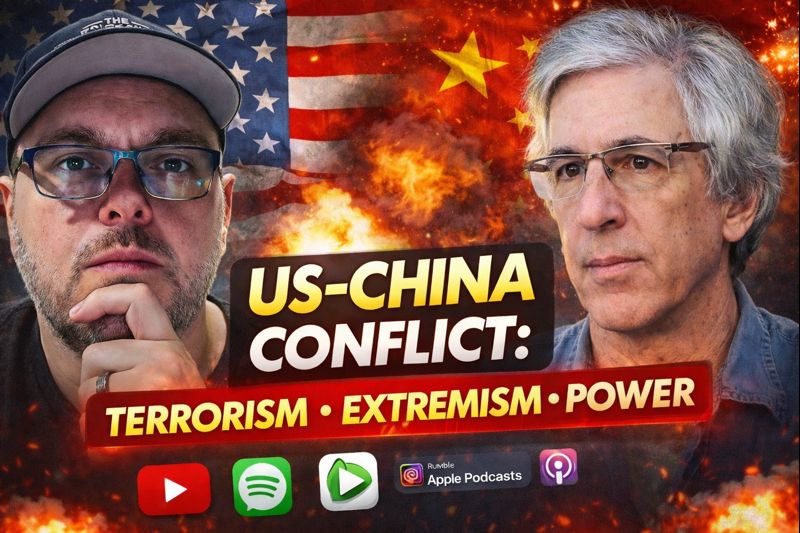
This episode with A. Marc Ross is one of those conversations that forces you to slow down.
China is usually discussed in absolutes. Either it’s the greatest existential threat of our lifetime—or criticism of Beijing gets framed as paranoia, racism, or Cold War nostalgia. What gets lost in that noise is nuance. History. Strategy. And the uncomfortable reality that the U.S. and China are deeply intertwined whether we like it or not.
Marc Ross doesn’t come at this as a cable-news pundit. He approaches China as a system—political, cultural, economic, and strategic. His work challenges the lazy framing that every disagreement with China means war is inevitable, while also pushing back hard on the idea that engagement alone will magically change Beijing’s behavior.
One of the most important themes in this conversation is the distinction between the Chinese people and the Chinese Communist Party. That line gets blurred constantly in public discourse, and when it does, it leads to bad policy and even worse public rhetoric. Ross is clear: understanding China requires separating culture from control, people from power.
We also dig into China’s long-game strategy. Not just militarily, but economically and psychologically. Infrastructure investment, debt leverage, influence campaigns, and narrative control don’t look dramatic in the moment—but over time, they reshape global power without firing a shot. That’s not fear-mongering. It’s how great powers have always operated.
At the same time, this isn’t an episode about chest-thumping nationalism. There’s real criticism here of American overreach, short-term thinking, and the tendency to oscillate between denial and overreaction. If the U.S. wants to compete effectively, it can’t rely on slogans. It needs consistency, realism, and an honest understanding of its own weaknesses.
This is where the middle ground actually matters. You can acknowledge legitimate concerns about China’s government without sliding into hysteria. You can critique American foreign policy failures without pretending authoritarian systems are misunderstood or harmless. That balance is rare—and that’s why this conversation is worth your time.
If you’re tired of hearing China discussed only in extremes, this episode will challenge you in the right way. You don’t have to agree with every conclusion to come away better informed—and that’s the point.
WATCH / LISTEN TO THE FULL EPISODE:
WATCH / LISTEN:
• YouTube: https://tmgm.short.gy/rLJZ59
• Rumble: https://tmgm.short.gy/u7Pkba
• Spotify: https://tmgm.short.gy/GirEzG
• Apple Podcasts: https://tmgm.short.gy/Etvanc
If this kind of conversation matters to you, please consider supporting the show on BuyMeACoffee. Every contribution directly supports more long-form interviews, deeper research, and conversations that don’t fit neatly into outrage cycles.