

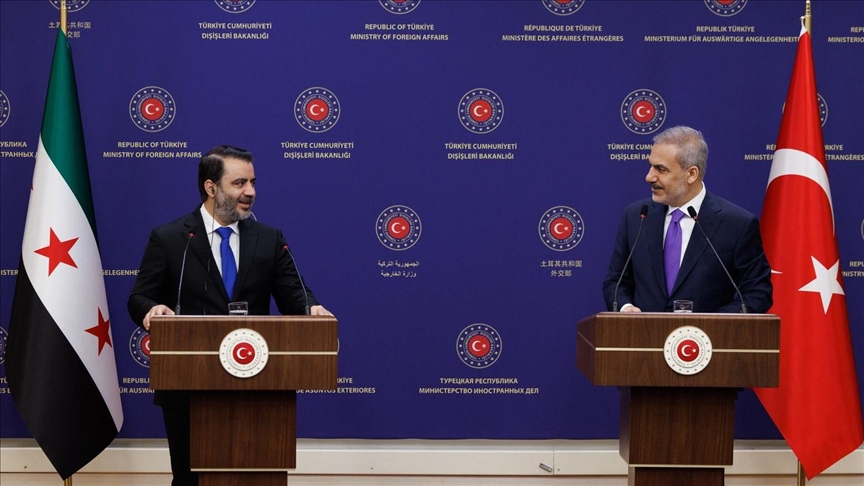
Within the framework of Syria’s territorial integrity and sovereignty, Ankara and Damascus share a common perspective focused on disarming the YPG terrorist organization, which occupies the country’s northeast, and integrating it into the new government.
Following the overthrow of the Assad regime, the newly established Syrian government has begun close cooperation with Turkey—its natural ally—for the reconstruction of the country. At the heart of this cooperation lies security. Both capitals are now aligned in their view that the YPG must be disarmed and brought into the new Syrian state structure.
Diplomatic Traffic Aimed at Security Cooperation
In this context, the recent surge in diplomatic engagement between Turkey and Syria over the past two weeks has centered on forming strategies and taking countermeasures against the YPG’s attempts to buy time and carve out a significant portion of Syrian territory through incremental moves, despite trilateral and quadrilateral integration mechanisms and all good-faith efforts.
The foreign and defense ministers of both countries have met repeatedly to discuss border security, common threats, and military cooperation. Ultimately, Turkish Defense Minister Yaşar Güler and his Syrian counterpart Murhef Abu Kasra signed a memorandum of understanding on military collaboration. This agreement marks a critical juncture, following repeated warnings by Foreign Minister Hakan Fidan regarding the YPG’s delaying tactics. Both Ankara and Damascus now see themselves at a new threshold in confronting the YPG’s “take whatever you can” policy, pursued through certain intermediaries on the Syrian issue and by exploiting Turkey’s “Terror-Free Turkey” process.
Fidan’s recent meeting with his Syrian counterpart, Esad Hasan Shaybani, underscores this point. His blunt description of the YPG’s “tricks” signals that the group’s gradual, separatist stance—contrary to the March 10 agreement—could have military consequences. His warning—“We are calling on you to change your stance. Think about how you will rebuild Syria together”—is a significant indicator of the urgency.
What Strategies Threaten Syria?
The YPG’s refusal to engage in integration with the new Syrian government, while seeking legitimacy from Israel and certain European states, mirrors the recent unrest in Suwayda in southern Syria. In that case, Druze militias loyal to Hikmet al-Hijri, a Druze leader supporting the former Assad regime and involved in the drug trade, rebelled with active Israeli support. The YPG has drawn inspiration from this model, imagining it could adapt it to the north.
While Suwayda is currently relatively calm, the “draw it out, take small steps, seize a large piece, and seek legitimacy” strategy remains visible. After Arabs in Suwayda were forced to flee by Israel-backed Druze militias, the current calm may not last long.
The YPG’s adoption of this Israeli-led approach, and its distancing from the March 10 agreement, poses a comprehensive national security challenge for both Turkey and Syria. The group controls not only energy resources but also water and grain supplies.
This occupation also risks undermining global trade corridor plans stretching from Asia to Syria’s Mediterranean ports. Continued YPG control would, in the medium term, have serious repercussions for Syria’s reconstruction efforts—and the group itself could not escape the fallout. Moreover, without a hinterland, the YPG’s occupied territory cannot survive without reaching an accommodation with Ankara and Damascus.
Turkey’s Demands
Foreign Minister Fidan’s statement—“… we see the group waiting to prolong its lifespan and exploit a potential crisis. Following a policy of ‘I will keep all groups that operate against Turkey here; I cooperated with other countries in the past; now I will call Israel for help’ is not a good policy. We are monitoring closely and hope they understand this”—serves as both a clear warning about the group’s regional positioning and an outline of Turkey’s core demands.
Around 15 illegal leftist organizations that also operate in Turkey are embedded within the YPG, and their affiliates continue to carry out attacks inside Turkey.
Another key issue is the YPG’s mistaken belief that Ankara, due to its “Terror-Free Turkey” initiative, will be unable to act against its maximalist demands. Using this regional security and peace framework to push a separatist agenda is a strategic error. Likewise, the belief that they can work with Israel in northern Syria—an area where NATO member Turkey has jurisdiction under UN law and the Adana Agreement—is part of this miscalculation.
Turkey and Damascus are calling on the YPG to abandon this course without the need for military action, and to help rebuild Syria under an inclusive national identity that guarantees the rights of Syrian Kurds. Instead, the group is training militants and seeking new opportunities. Last week’s conference in Hasakah, whose final declaration called for strengthening the existing autonomous administration, was an open display of this intent.
The Choices Ahead
Ultimately, the YPG must realize that the Israeli strategy it has imported from Suwayda is not applicable to the north. It needs to abandon maximalist demands within the diplomatic and political integration process initiated by the quadrilateral mechanism.
Otherwise, the new administration in Damascus will not compromise its sovereignty, and—just as Foreign Minister Fidan has made clear—Turkey will regard any move toward Syria’s partition as a national security threat and act accordingly. The options are straightforward: the YPG can either choose inclusive unity and consensus within Syria, or face a military operation.