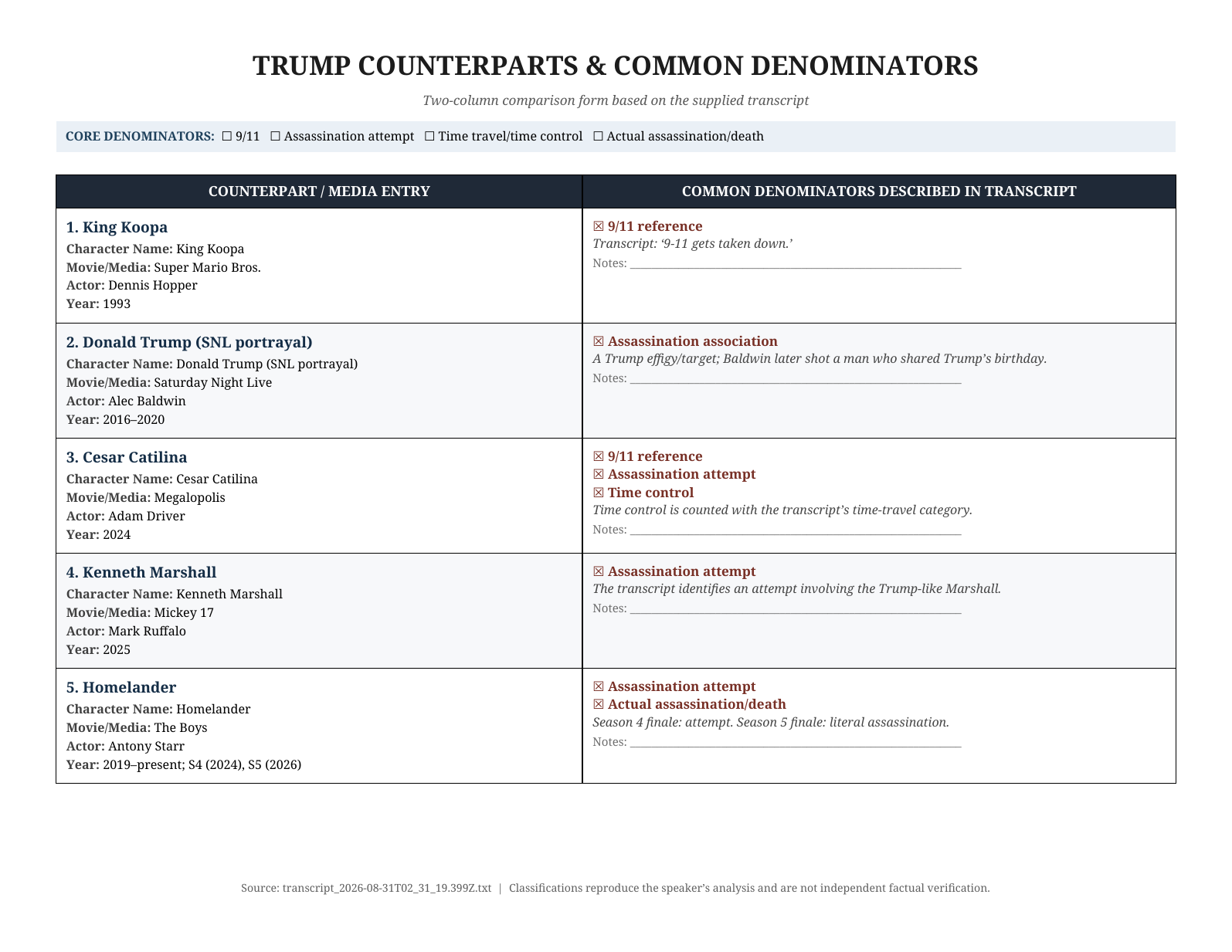
Two-column comparison form based on the supplied transcript
The two-column breakdown compares 15 fictional or satirical characters presented as counterparts to Donald Trump with the recurring story elements connected to them.
The left column identifies each counterpart, the production in which the character appears, the actor, and the year of release. The examples range from Walter Trump in the 1958 television series Trackdown and Biff Tannen in Back to the Future Part II to more recent figures such as Homelander, Kenneth Marshall, Cesar Catilina, Rupert Thorne, and the unnamed president in Civil War.
The right column maps these characters to four principal common denominators:
References or apparent allusions to 9/11
Assassination attempts
Time travel or control over time
Actual assassination or death
CORE DENOMINATORS: ☐ 9/11 ☐ Assassination attempt ☐ Time travel/time control ☐ Actual assassination/death
CLICK TO SEE FORM:
https://docs.google.com/document/d/1ONoPFrdKXJEodDjG4V-3fbSlJQRv-Y8EOpdYwBBXAH4/edit?tab=t.0
COUNTERPART / MEDIA ENTRY
COMMON DENOMINATORS DESCRIBED IN TRANSCRIPT
1. King Koopa
Character Name: King Koopa
Movie/Media: Super Mario Bros.
Actor: Dennis Hopper
Year: 1993
☒ 9/11 reference
Transcript: ‘9-11 gets taken down.’
Notes: ______________________________________________________________
2. Donald Trump (SNL portrayal)
Character Name: Donald Trump (SNL portrayal)
Movie/Media: Saturday Night Live
Actor: Alec Baldwin
Year: 2016–2020
☒ Assassination association
A Trump effigy/target; Baldwin later shot a man who shared Trump’s birthday.
Notes: ______________________________________________________________
3. Cesar Catilina
Character Name: Cesar Catilina
Movie/Media: Megalopolis
Actor: Adam Driver
Year: 2024
☒ 9/11 reference
☒ Assassination attempt
☒ Time control
Time control is counted with the transcript’s time-travel category.
Notes: ______________________________________________________________
4. Kenneth Marshall
Character Name: Kenneth Marshall
Movie/Media: Mickey 17
Actor: Mark Ruffalo
Year: 2025
☒ Assassination attempt
The transcript identifies an attempt involving the Trump-like Marshall.
Notes: ______________________________________________________________
5. Homelander
Character Name: Homelander
Movie/Media: The Boys
Actor: Antony Starr
Year: 2019–present; S4 (2024), S5 (2026)
☒ Assassination attempt
☒ Actual assassination/death
Season 4 finale: attempt. Season 5 finale: literal assassination.
Notes: ______________________________________________________________
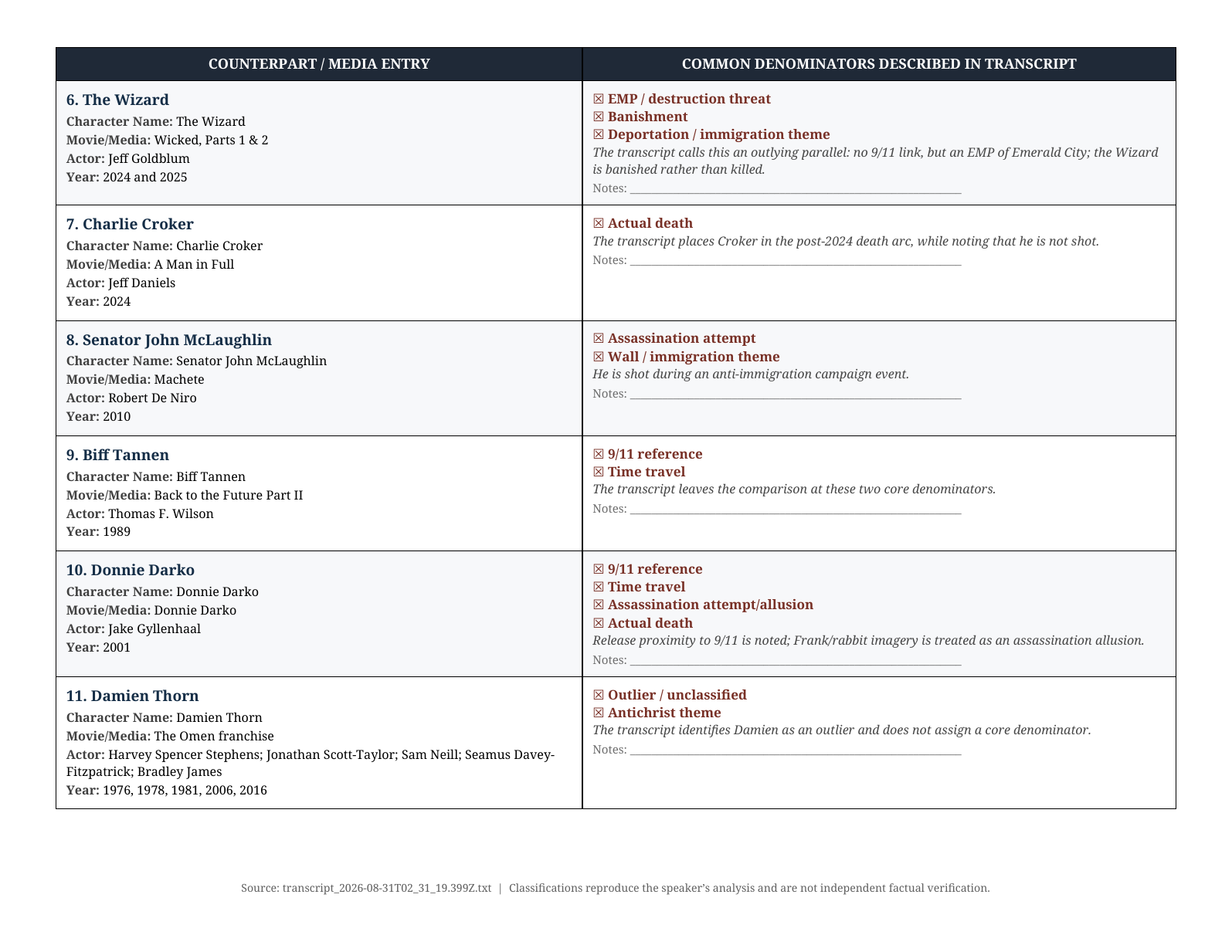
6. The Wizard
Character Name: The Wizard
Movie/Media: Wicked, Parts 1 & 2
Actor: Jeff Goldblum
Year: 2024 and 2025
☒ EMP / destruction threat
☒ Banishment
☒ Deportation / immigration theme
The transcript calls this an outlying parallel: no 9/11 link, but an EMP of Emerald City; the Wizard is banished rather than killed.
Notes: ______________________________________________________________
7. Charlie Croker
Character Name: Charlie Croker
Movie/Media: A Man in Full
Actor: Jeff Daniels
Year: 2024
☒ Actual death
The transcript places Croker in the post-2024 death arc, while noting that he is not shot.
Notes: ______________________________________________________________
8. Senator John McLaughlin
Character Name: Senator John McLaughlin
Movie/Media: Machete
Actor: Robert De Niro
Year: 2010
☒ Assassination attempt
☒ Wall / immigration theme
He is shot during an anti-immigration campaign event.
Notes: ______________________________________________________________
9. Biff Tannen
Character Name: Biff Tannen
Movie/Media: Back to the Future Part II
Actor: Thomas F. Wilson
Year: 1989
☒ 9/11 reference
☒ Time travel
The transcript leaves the comparison at these two core denominators.
Notes: ______________________________________________________________
10. Donnie Darko
Character Name: Donnie Darko
Movie/Media: Donnie Darko
Actor: Jake Gyllenhaal
Year: 2001
☒ 9/11 reference
☒ Time travel
☒ Assassination attempt/allusion
☒ Actual death
Release proximity to 9/11 is noted; Frank/rabbit imagery is treated as an assassination allusion.
Notes: ______________________________________________________________
11. Damien Thorn
Character Name: Damien Thorn
Movie/Media: The Omen franchise
Actor: Harvey Spencer Stephens; Jonathan Scott-Taylor; Sam Neill; Seamus Davey-Fitzpatrick; Bradley James
Year: 1976, 1978, 1981, 2006, 2016
☒ Outlier / unclassified
☒ Antichrist theme
The transcript identifies Damien as an outlier and does not assign a core denominator.
Notes: ______________________________________________________________
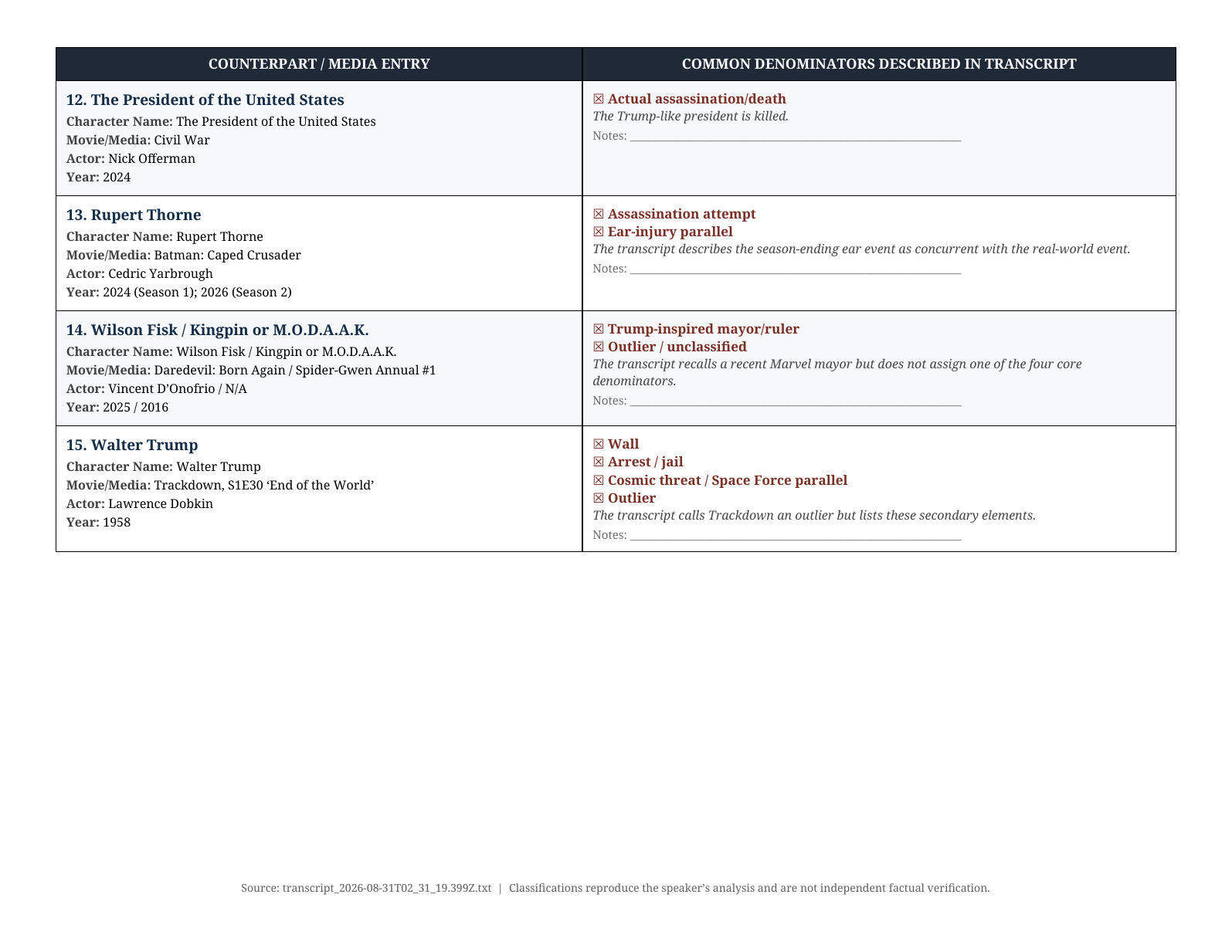
12. The President of the United States
Character Name: The President of the United States
Movie/Media: Civil War
Actor: Nick Offerman
Year: 2024
☒ Actual assassination/death
The Trump-like president is killed.
Notes: ______________________________________________________________
13. Rupert Thorne
Character Name: Rupert Thorne
Movie/Media: Batman: Caped Crusader
Actor: Cedric Yarbrough
Year: 2024 (Season 1); 2026 (Season 2)
☒ Assassination attempt
☒ Ear-injury parallel
The transcript describes the season-ending ear event as concurrent with the real-world event.
Notes: ______________________________________________________________
14. Wilson Fisk / Kingpin or M.O.D.A.A.K.
Character Name: Wilson Fisk / Kingpin or M.O.D.A.A.K.
Movie/Media: Daredevil: Born Again / Spider-Gwen Annual #1
Actor: Vincent D’Onofrio / N/A
Year: 2025 / 2016
☒ Trump-inspired mayor/ruler
☒ Outlier / unclassified
The transcript recalls a recent Marvel mayor but does not assign one of the four core denominators.
Notes: ______________________________________________________________
15. Walter Trump
Character Name: Walter Trump
Movie/Media: Trackdown, S1E30 ‘End of the World’
Actor: Lawrence Dobkin
Year: 1958
☒ Wall
☒ Arrest / jail
☒ Cosmic threat / Space Force parallel
☒ Outlier
The transcript calls Trackdown an outlier but lists these secondary elements.
Notes: ______________________________________________________________
The comparison also records secondary themes, including walls, immigration and deportation, arrest, political banishment, cosmic threats, EMP attacks, ear injuries, and Antichrist symbolism.
Taken as a whole, the breakdown describes what the transcript interprets as an evolving fictional Trump narrative. Earlier counterparts are associated primarily with time travel, disaster symbolism, 9/11 imagery, walls, and threats from space. Beginning around 2010, assassination attempts become more prominent, with Trump-like characters generally surviving. In productions released from 2024 onward, the pattern becomes darker: several counterparts are killed, assassinated, removed from power, or banished.
The central argument is that these portrayals do not function as isolated similarities. They form a developing character arc across decades, with entertainment repeatedly depicting a Trump-like political ruler as a billionaire villain, authoritarian leader, false savior, national threat, assassination target, or doomed president. According to the transcript’s framework, this progression represents predictive and concurrent programming: fictional narratives first establish the character and recurring themes, then evolve alongside corresponding events on the public stage.
The breakdown organizes that argument visually, making it easier to see which denominators recur, when new themes enter the pattern, and how the fictional Trump archetype changes over time.
Production
What was acknowledged
Who acknowledged it
The Boys
Homelander was deliberately developed into a Trump analogue, particularly in the later seasons.
Showrunner Eric Kripke has said the series became explicitly concerned with Trumpism and described Homelander as an increasingly direct Trump analogue. The Hollywood Reporter, Rolling Stone
Back to the Future Part II
The casino-owning alternate-1985 Biff was modeled partly on the public image of Donald Trump.
Co-writer and producer Bob Gale answered, “Yeah. That’s what we were thinking about.” Gale is not the director, although he co-created Biff with director/co-writer Robert Zemeckis. The Guardian, Rolling Stone
Spider-Gwen Annual #1
M.O.D.A.A.K. is an overt Donald Trump caricature: appearance, small hands, political slogans, and the designation “Mental Organism Designed As America’s King.”
Homelander — explicitly acknowledged by showrunner Eric Kripke
Biff Tannen — explicitly acknowledged by co-writer/producer Bob Gale
King Koopa — documented as a Trump-inspired production interpretation by Morton and Jankel
M.O.D.A.A.K. — an overt Trump caricature within the comic itself
Donald Trump on SNL — an explicit impersonation
Captain America: Brave New World — the Trump/assassination correspondence was effectively recognized through alteration of the trailer, although the director denied or avoided a direct character identification
If the record were rigorously documented, it could make a serious case that public reality is being narratively programmed across entertainment, emergency exercises, and news. But different levels of the argument would require different levels of proof.
Three claims being tested
Claim
What a 60-year record could establish
Programmed consensus
Entertainment and news repeatedly teach the public how to interpret political events, threats, enemies, and acceptable responses. This is the easiest claim to support.
Coordinated hyperreality
Entertainment, drills, official messaging, and news coverage repeatedly converge around the same distinctive narratives. This requires evidence that the synchronization exceeds coincidence, genre convention, and normal institutional preparation.
Staged history and a manipulated future
Certain events were planned, rehearsed, and represented as spontaneous reality, after which the resulting accounts became history. This is the strongest claim and requires evidence of causation, foreknowledge, and operational coordination.
A sufficiently detailed record could show something more substantial than scattered “predictive programming.” It could reveal an enduring system in which:
Entertainment introduces a narrative template.
Drills operationalize the same template.
A public event apparently materializes it.
News media assign the event its official meaning.
Institutions incorporate that account into the historical record.
The resulting history conditions public expectations for the next event.
This would describe hyperreality as a feedback system. Entertainment would not merely predict events; it would provide the imagery, characters, emotional responses, and interpretive vocabulary through which those events are subsequently understood. News would then collapse the distinction between representation and reality by authenticating the event’s official narrative.
What would make the case persuasive
The archive would need more than thematic similarities. Each case should document:
Exactly when the entertainment was written, produced, filmed, and released
Exactly when the drill was planned, announced, and conducted
Whether the event matched the drill in location, timing, scenario, personnel, or unusual details
Which details existed before the public event
Whether scripts or exercise materials were later changed
Whether the same institutions, contractors, officials, consultants, or media organizations recur
Whether news coverage used language, images, or story structures already present in the entertainment
Whether officials acknowledged, denied, or concealed the overlap
What ordinary explanations exist for each correspondence
The most important evidence would be high-specificity matches. “A politician is attacked” is common. A match involving the same unusual name, wound location, date symbolism, dialogue, setting, drill scenario, institutional participants, and narrative outcome is much more significant—particularly if those features were documented beforehand.
Evidence of synchronization versus evidence of staging
The archive might strongly demonstrate synchronization while falling short of proving that the events were simulated. That would still be an important finding.
There are several increasingly strong conclusions:
Narrative convergence: institutions repeatedly use the same cultural archetypes.
Agenda coordination: entertainment and news deliberately reinforce compatible political narratives.
Advance narrative preparation: certain productions or exercises anticipate specific planned developments.
Operational coordination: the same network connects entertainment, drills, events, and news coverage.
Event simulation: the publicly reported event itself was a controlled performance.
Manufactured history: the performance was institutionalized as factual history.
Evidence supporting one level does not automatically establish the next. A rigorous presentation should identify exactly where the evidence ends and where inference begins.
The manipulated-future thesis
If the complete chain could be demonstrated, “predictive programming” might be too weak a description. The entertainment would not be predicting an independent future. It would be disclosing, rehearsing, normalizing, or marketing a future already under institutional construction.
In that model, the future is manipulated through narrative preconditioning. Audiences encounter the characters and conflicts in fictional form before confronting their public counterparts. When the event arrives, it feels simultaneously shocking and familiar. People then interpret it through categories supplied in advance.
Once news media authenticate that interpretation, it becomes consensus reality. Once archived, cited, commemorated, and taught, consensus reality becomes history.
So yes: a properly constructed 60-year record could make a substantial case for a long-running hyperreality system. But its credibility would depend less on the number of examples than on chronological documentation, specificity, controls, recurring institutional pathways, and a clear separation between demonstrated correspondence, probable coordination, and alleged simulation.