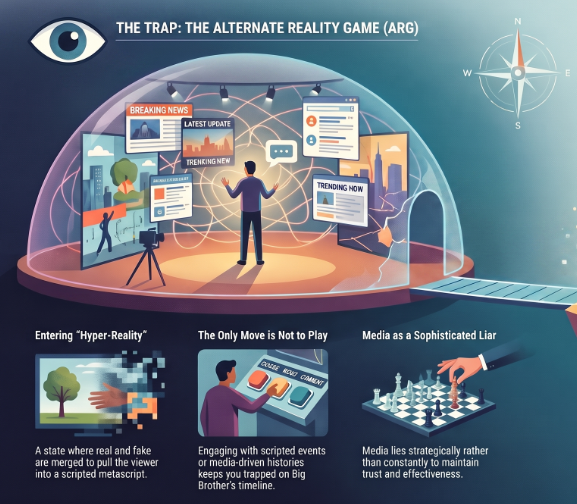
The August 20 episode begins with a practical announcement about distribution. The show is simulcasting on YouTube and Substack, but Ozman no longer wants YouTube to serve as the movement’s “ground zero.” He argues that YouTube is structurally hostile to independent organization because it censors creators, manipulates recommendations, removes monetization, and keeps channels dependent upon rules that can change without explanation. Substack, in his view, offers a more durable center for transcripts, essays, discussion, and community. This platform question is not incidental. It becomes an example of the episode’s larger argument: the institutions that mediate reality also determine what may be said, rewarded, discovered, or erased.
From there, Ozman introduces hyperreality as “real plus fake.” Simulated events, he argues, can be inserted into the historical record and thereafter function as real because institutions, schools, news outlets, entertainment, and public discussion all treat them as settled fact. “The world stage is real plus,” he says. “It is essentially real plus fake. So real plus fake equals world stage, hyperreal world stage” (August 20, 00:06:03–00:06:12). This formulation is the foundation of the broadcast. Hyperreality is not merely a false image placed over an otherwise accessible reality. It is an informational environment in which authentic events, staged events, fictional anticipations, official explanations, public reactions, and institutional memories become inseparable.
The people who perform active roles in this environment are called “world stagers.” Ozman stresses that this does not necessarily mean imaginary computer-generated people. “We’re not talking about people who don’t exist in a literal sense,” he explains. “We’re talking about actors working for the PSYOP entertainment complex, crisis actors with long-term gigs” (August 20, 00:06:40–00:06:54). The emphasis is on role rather than ontology. A public personality may be biologically real while the biography, conflict, death, conversion, scandal, or political function attached to that personality is a managed production.
This leads to the concept of the PSYOP Entertainment Complex: a system joining government, news media, and mainstream entertainment. Ozman argues that major public events increasingly function like spectacles whose significance is determined by narrative logic rather than by ordinary historical causality. He quotes and develops the idea that politics offers “simulated participation in place of actual agency.” Voting, outrage, identification, and online debate may feel participatory while leaving the underlying structure untouched. Politics becomes a pressure-release valve. People choose teams, consume plot developments, and argue about characters, but remain inside the same authored universe.
The closed character of this universe is essential. Ozman compares it to Disneyland, a self-referential world that recognizes only its own licensed characters and stories. The media system likewise refers back to its own archives, experts, precedents, villains, heroes, and predictions. It does not willingly validate a perspective outside the container. “The system does not acknowledge anything outside of itself,” he says. “It’s completely self-referential, like Disneyland” (August 20, 00:30:41–00:30:48). The official present is explained by the official past, while the official future is previewed through forecasts, entertainment, and threat scenarios.
Ozman divides this manufactured temporal structure into history, “the News Testament,” and the Metascript. History is the accumulated archive of accepted stories. The News Testament is the continuously updated scripture of the present. The Metascript is the sequence of future events already being prepared. Together, they create what he calls a fictional reality. “The accumulated fake events distorts history just as much as fake news distorts the daily news,” he argues (August 20, 00:32:33–00:32:45). The result is not a single lie but an altered timeline. Every new event is interpreted within a past that may itself contain decades of simulations.
The alternative is the “off-world stage perspective.” This does not mean physically leaving the world. It means occupying an analytical position outside the narrative frame. The off-world observer sees the media’s model without confusing the model for reality. That person recognizes the continuity of prior fakery and therefore refuses to analyze each new headline as an isolated occurrence. In this sense, deprogramming is historical memory. The audience must remember patterns across news cycles instead of awakening every morning as though the institutional record began that day.
From Belief to Informed Disbelief
The broadcasts repeatedly distinguish informed skepticism from reflexive denial. This is crucial because the IPS Deprogram position could easily be caricatured as “everything is fake.” Ozman rejects that formulation. He argues that both gullibility and indiscriminate disbelief are low-information reactions. Believing a headline because an authority published it is not skepticism, but neither is declaring a robot, animal, technology, or event unreal simply because it looks strange.
The later August 27 livestream uses the debate over humanoid robot competitions to illustrate the point. Some viewers see footage of robots running and immediately conclude that the machines are computer-generated or that the entire competition is staged. Ozman initially found portions of the footage questionable, especially because promotional robot videos have often been polished or manipulated. But after investigating the machines, their cost, control systems, and the presence of people interacting with them, he concluded that the blanket denial lacked evidence. “The question isn’t, are they fakeable?” he says. “Which I agree, yeah, you can fake them in movies…. So it’s not a question of fakeability, but why these?” (August 27 livestream, 00:08:29–00:08:44).
That distinction—between fakeability and evidence of actual fabrication—is one of the strongest methodological points in the episodes. Almost anything presented through a screen is technically fakeable. That fact alone does not establish that a particular image is false. Skepticism requires examining the specific claim, the available evidence, the physical plausibility, and the continuity of the parties involved. Ozman contrasts skepticism with incredulity: “I find that hard to believe, so I don’t believe.” Incredulity is merely disbelief based on unfamiliarity. It is the mirror image of credulity.
The same criticism applies to the “just asking questions” posture. Questions are necessary at the beginning of an investigation, but a person who indefinitely raises insinuations while avoiding evidence is not necessarily seeking truth. “Nobody with a legitimate desire to know the truth is just asking questions,” Ozman says. “The people who want to know are seeking answers” (August 27 livestream, 00:09:26–00:09:38). This is also a criticism of conspiracy media, where questions often function as engagement hooks. The question keeps the audience emotionally suspended while the implied answer is smuggled in without having to be defended.
Informed disbelief therefore demands positive standards. It asks whether claims have identifiable sources, whether the proposed event is physically possible, whether the footage contains demonstrable anomalies, whether the personalities and institutions have recurring roles, and whether the narrative connects with a wider system of entertainment and propaganda. The purpose is not permanent uncertainty. It is clarity. Ozman summarizes his position with the line, “In a land where the default is confusion, I am unconfused” (August 27 livestream, 00:06:44–00:06:51).
Controlled Opposition and the Closed Dialectic
Another recurring theme is that institutional narratives are rarely limited to a single official position. They frequently include their own opposition. The mainstream story and the approved counterstory form a closed dialectic in which both sides reinforce the same underlying assumptions. This is why, in Ozman’s formulation, the “pro” and the “anti” can both be manufactured.
The August 20 episode applies this framework to the cultural divisions that developed after 2020. Ozman argues that one operation frightened the political left while a complementary operation frightened the political right. One side accepted the official emergency, while the other became consumed with apocalyptic claims about the proposed remedy. Although the positions appeared antagonistic, both kept audiences emotionally attached to the same media event. “One PSYOP terrified the left, one terrified the right,” he says (August 20, 00:27:39–00:27:46). The real objective, in his view, was neither simply disease management nor a hidden mass-casualty mechanism. It was behavioral conditioning: “to crate train 8 billion humans” and establish new categories of secular sin, purity, obedience, and exclusion.
This analysis leads to a provocative axiom: “If part of it is fake, all of it is fake” (August 20, 00:25:27–00:25:36). In context, the phrase does not mean that the existence of one dishonest photograph proves the nonexistence of every associated person or condition. It means that when an event contains deliberate theatrical components, planted advocates, managed opponents, predictive programming, coordinated drills, and controlled controversy, analysts should consider the total narrative package as an operation. The apparent opposition may be another department of the same production.
Conspiracy culture is treated as a major example of this controlled opposition. Ozman suggests that alternative media catches people who reject the mainstream but redirects them into frightening subplots: poisoned skies, nanotechnology, secret ethnic cabals, apocalyptic vaccines, alien saviors, demonic technology, and innumerable hidden enemies. These stories preserve the underlying assumption that the news personalities and public crises are real. The dissident may reject the official explanation while remaining totally absorbed in the official cast and timeline.
In the later livestream, Ozman recalls how earlier exposure to InfoWars made the physical world feel increasingly poisonous. Tap water was dangerous because of fluoride. Bottled water was dangerous because of plastic. The sky contained chemicals. Food, medicine, communications technology, and ordinary infrastructure became sources of invisible contamination. “The world was a scarier place back when I was on the red pill,” he reflects (August 27 livestream, 01:12:06–01:12:11). He describes overcoming much of this fear through rational examination rather than by discovering one more hidden toxin.
From this experience he develops the idea of modern superstition. Older societies feared curses, vampires, werewolves, and ominous signs. Contemporary conspiracy audiences fear 5G towers, chemtrails, microscopic machines, poisoned products, and omnipotent billionaires. These may differ in technological vocabulary, but they perform a similar psychological function. “What truthers have been given are superstitions,” Ozman says (August 27 livestream, 01:13:55–01:14:02). He then sharpens the claim: “They are controlling you by making you believe in those things…. Your belief in the scary things is what controls you” (01:15:54–01:16:19).
This is one of the clearest expressions of the show’s deprogramming ethic. The audience is urged to subtract rather than add. Instead of responding to every suspicious event with more villains, technologies, rituals, codes, and secret societies, the method removes unsupported components. Ozman is especially critical of numerical “decoders” whose systems can connect almost any date or name to any other after the fact. He acknowledges that media productions use symbols, timing, recurring motifs, and literary devices, but he warns against drowning meaningful patterns in arbitrary numerology. “They add, we subtract,” he says (August 20, 02:12:30–02:12:35). The ideal is “all signal, no noise.”
The Metascript and Entertainment as Advance History
The Metascript is the most ambitious concept developed across the media-focused episodes. Ozman defines it as “the sequence of fake events planned far into the future,” which ultimately becomes “our history” or “the prefabricated history that everything is going to be attached to in the dominant storyline” (August 27 livestream, 00:59:37–00:59:56). The theory goes beyond conventional predictive programming. Predictive programming usually refers to fictional images that resemble a later real event. The Metascript treats entertainment, political casting, public relations, news production, and government planning as components of a unified narrative system.
If an entertainment production closely anticipates a later event, several explanations are possible. It may be coincidence. It may reflect common cultural anxieties. It may shape how the public interprets an unscripted event. Or it may indicate shared advance knowledge and coordination. Ozman argues that the strongest cases contain numerous specific correspondences, recurring personnel, unusually precise timing, and character arcs that continue after the event. The question is not whether one vague movie scene can be matched retrospectively to a headline. It is whether multiple productions and public narratives share enough uncommon details to suggest a common source.
The episode uses The Tempest and the Charlie Kirk narrative as a primary example. Ozman argues that the widow’s character arc in the show mirrors the public arc assigned to Erika Kirk. The entertainment story does not merely feature a generic assassination. It allegedly supplies the emotional and institutional aftermath: widowhood, suspicion concerning grief, inheritance of a public role, and the continuation of an organization. The host refers to this as the “Erika Kirk conundrum.” In his view, a public figure who continues performing a detailed fictional counterpart in real time offers a stronger case than a one-scene crisis actor who disappears after a headline.
The same method is proposed for figures such as Donald Trump and Elon Musk. Analysts should place each long-term world-stage personality beside his or her fictional counterparts and compare the common denominators. For Trump, Ozman points to a long accumulation of fictional presidents, populist strongmen, media celebrities, assassination attempts, grazed head wounds, public posing, 9/11 associations, and JFK-style scenarios. “We’ve been given the version of it in fiction that will have a real life counterpart later,” he says (August 27 livestream, 00:59:15–00:59:30). The argument is not that any single fictional Trump analogue proves a planned event, but that the accumulated parallels may reveal the allowable storylines assigned to a recurring public character.
The August 20 episode gives another example involving The Diplomat. According to the discussion, the series incorporates a Poseidon nuclear threat after its showrunner consulted people in intelligence and defense. Ozman treats this acknowledged contact as a miniature model of the PSYOP Entertainment Complex: government expertise informs a fictional threat, the threat is delivered as prestigious entertainment, and audiences become psychologically prepared for the same scenario to enter the news. “Propaganda, primetime,” he says. “Presented as entertainment, but it’s there to condition you to accept as inevitable the next fake event” (August 20, 02:08:53–02:09:02).
The broader contention is that entertainment does not merely predict the future; it helps build the interpretive architecture through which the future will be received. Fiction supplies the images, archetypes, phrases, and emotional expectations. News later activates them. The audience recognizes the storyline without recognizing that it has been rehearsed. The event feels shocking yet familiar. This familiarity makes the official meaning easier to absorb.
Ozman nevertheless distinguishes this comparative method from endless symbolic decoding. A legitimate Metascript analysis should identify specific correspondences, establish chronology, record both hits and misses, and show continuity across several sources. Otherwise, hindsight bias and the Texas sharpshooter fallacy can create patterns after the fact. The Great Deconstruction Project proposed in the broadcasts is intended to systematize the work: build “twin timelines,” one for entertainment and one for news; document dates and production histories; place world-stage characters beside their fictional counterparts; and identify repeated motifs without treating every coincidence as intentional.
Westworld Syndrome and the Necessity of Continuity
The need for historical continuity is captured in the phrase “Westworld syndrome.” In Westworld, synthetic hosts repeat loops and can be prevented from recognizing evidence that contradicts their programmed reality. Ozman uses the term for the habit of treating each new news cycle as if it exists in isolation. “When you analyze each event as though it’s in isolation, as though… every day is a blank slate,” he says, “you have to look at the continuity here” (August 27 livestream, 01:19:00–01:19:13).
The episode applies this to a forensic psychiatrist reportedly associated with a succession of notorious defendants and public crime narratives. Ozman interprets the recurring professional connection as an indicator that the latest case belongs to the same narrative system. Whether or not one accepts that conclusion, the methodological principle is clear: institutional overlap matters. Repeated lawyers, psychiatrists, producers, journalists, charities, witnesses, symbols, and narrative structures deserve examination. A single anomaly may be meaningless, but a stable network across supposedly unrelated events may reveal how stories are produced and authenticated.
Westworld syndrome also describes the amnesia encouraged by “breaking news.” The term “breaking” creates urgency and the illusion that audiences are witnessing history arise spontaneously. Ozman rejects this framing: “I don’t think there’s such a thing as breaking news…. Breaking news stories are pretty much just packaged that way, like engagement bait” (August 20, 00:11:43–00:12:00). From the Metascript perspective, major stories are rolled out in stages. The apparent immediacy conceals preparation. The public reacts before it has time to compare the new episode with prior cycles.
The antidote is not frantic research but accumulated memory. One must preserve earlier observations, predictions, media parallels, and corrections. Ozman claims that his group has sometimes anticipated themes in later productions and news events by tracking existing patterns. He treats prediction as a stronger standard than retroactive interpretation because it creates a record before the target event occurs. The goal of a deconstruction archive is therefore not simply to collect curiosities. It is to make the hypothesis testable over time.