
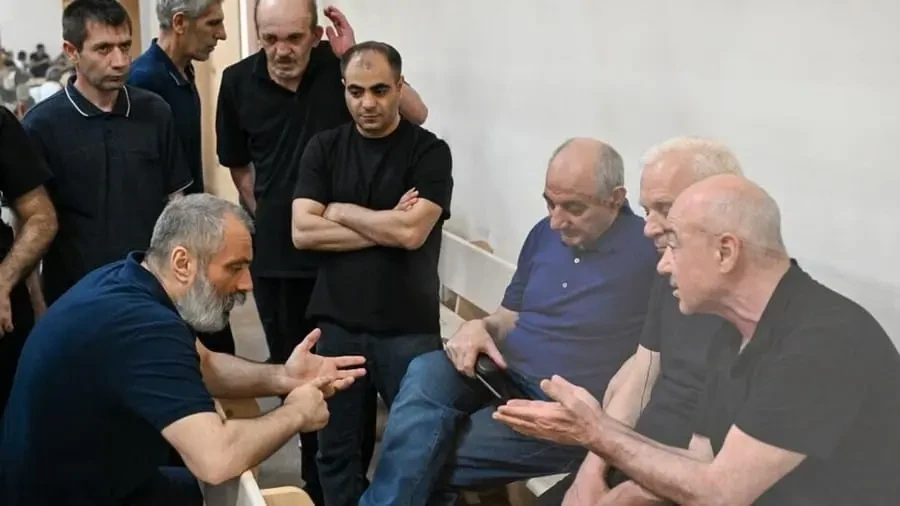
Zhanna Avagyan: Hello, Tigran. In this episode, let’s discuss the Armenian prisoners held in Baku. A few days ago, former Speaker of the Artsakh National Assembly Davit Ishkhanyan issued an appeal, in particular inviting Armenia’s Human Rights Defender to visit Baku, meet with them, and see the conditions in which they are being held. Before that, Ruben Vardanyan’s wife had also made a similar appeal. How would you generally describe and assess the policy pursued by the Armenian authorities, including the Human Rights Defender, on the issue of the prisoners?
Tigran: I think we should first focus on the policy pursued by the Armenian government. As we have seen from recent statements, the main argument is that excessive publicity around this issue could interfere with the process. In other words, the idea is that we should work more quietly and behind closed doors with Azerbaijan in order to achieve results.
If we had heard these arguments two or three years ago, we could have debated how reasonable or effective such an approach might be. But after all these years, particularly following the events of 2023, when we have seen no significant results and have also witnessed some negative consequences of this policy, I think we can now conclude that this approach has failed.
Let me explain why. I am certainly not arguing that we should not work behind closed doors with the Azerbaijani side, try to discuss this issue as part of a broader package, or seek results through negotiations. But the idea that we should not talk about the POWs at all, that we should avoid speaking publicly about the issue is absurd. It has very practical consequences.
In that regard, I would like to mention a few episodes from my interactions with diplomats from different countries that demonstrate how this issue has been pushed into the background.
The first episode took place about a year ago. We had a meeting with a high-level delegation from a European country, at the level of a deputy foreign minister. Naturally, in meetings of this kind, foreign diplomats usually try to understand what Armenia’s main challenges are, what urgent issues it faces, and how their countries can help address them.
As an expert group, we naturally raised the issue of the prisoners, as we always do. What was interesting was that immediately before our meeting, this official had been at the Foreign Ministry, meeting with its leadership and other officials. When we began discussing the POWs, we realized that this person was not even aware that such an issue existed. He actually took out a pen and began taking notes about how many people were being held in Baku, who they were, and what their status was.
This shows that, by and large, there has been no systematic emphasis on this issue.
The second episode happened recently, and it can also be considered a consequence of this policy. We were meeting with a fairly senior diplomat, and naturally the issue of the prisoners came up again. One of our colleagues used the English term hostage, which is not exactly synonymous with “prisoner,” but is closely related in this context.
The diplomat’s reaction was very interesting. This was not some pro-Azerbaijani figure. He/she represented a serious state that cannot simply adopt one-sided positions. Yet he/she said that the term hostage was quite provocative.
But this is an internationally used term and part of the vocabulary of international law. When we tried to understand why he/she perceived the term as provocative, he/she began explaining that, from Azerbaijan’s perspective, the people being held in Baku are criminals. They had allegedly committed crimes, violated Azerbaijan’s constitution and domestic legislation, and so on.
This situation shows that, as with many other issues, only one narrative has remained here: the Azerbaijani narrative. Azerbaijan continuously describes these people as criminals who committed alleged war crimes and violated Azerbaijan’s constitution, while there is no clear public counter-narrative coming from Yerevan, at least not one that effectively challenges this framing.
We can continue conducting negotiations with Azerbaijan in what is described as a constructive atmosphere, whether on TRIPP, unblocking regional communications, or the peace agreement. But pretending that there are no problems whatsoever, that peace has already been established, that there are no outstanding issues in the peace process, and turning that into an end in itself so that it can later be presented to society as an already established peace creates a serious asymmetry.
Azerbaijan has its own positions on these issues and its own framing of them, while there is no corresponding counterweight from the Armenian side. That is why international and foreign diplomats have increasingly begun to view this issue through the Azerbaijani prism.
There is another narrative that Azerbaijan has been promoting in recent years, and this has also become apparent in my conversations with diplomats. Azerbaijan is trying to draw a clear distinction between the people held in Baku: placing the former military-political leadership of Artsakh in one category, and those who were simply captured and did not hold any official position in another.
This framing has also become increasingly accepted by international actors because, once again, Armenia has not articulated a clear position on the issue.
You have presented the general position of the current government. But could we look at some specific examples to show what this attitude looks like and what actions have actually been taken?
Yes. I think there are two problems here.
The first is what we have already discussed: there is no systematic approach, systematic response, or systematic narrative regarding these issues. This allows Azerbaijan to monopolize the discourse and impose its framing of the issue on various foreign actors.
The second problem is that the responses themselves are often quite problematic.
I would recall a statement made several weeks ago by a member of parliament from the Civil Contract party. She essentially argued that there was no contradiction between speaking about an established peace and, at the same time, having prisoners in Baku. She referred to the fate of German, Japanese, or other prisoners belonging to the defeated coalition countries after the Second World War.
Even discussing the issue in those terms is unserious. Comparing the fate of soldiers who fought for the Nazi regime with the fate of Armenian citizens is simply, frankly, a matter of basic historical illiteracy.
More recently, another member of parliament said that, of course, we should talk about the prisoners, but that we should do so in such a way that Azerbaijan does not somehow appear to be violating any norms.
This reflects the basic policy pursued on this issue: do not provoke Azerbaijan. The calculation appears to be that if we avoid provoking Azerbaijan, continue talking to it, and remain quiet, we may eventually achieve some results.
The experience of recent years is also cited in support of this argument. In December 2023, if I remember correctly, 32 Armenian prisoners were returned to Armenia, and the argument is that this was achieved precisely because of this quiet and restrained approach.
But let us remember how that return actually happened.
The prisoners were returned after Armenia agreed not to block Azerbaijan’s hosting of COP29. This was a very important event for Azerbaijan, which had wanted to host it in the country for years. It was also important for Azerbaijan as a way of whitewashing its international image after the ethnic cleansing of Nagorno-Karabakh.
Armenia agreed to the organization of the event and, in return, received 32 prisoners.
The key point is that the reason the process was “quiet” was that a clear transaction took place. Azerbaijan received something it considered important and, in return, agreed to release the prisoners.
The second point is that even under those circumstances, I believe Armenia could have worked more effectively and secured the release of a larger number of prisoners by understanding how important that event was to Azerbaijan and why it was important to Azerbaijan.
Instead, we were satisfied with that number. Afterwards, there was considerable propaganda around the issue, essentially saying: look at the results we achieved through effective, quiet diplomacy.
In short, as I have already said, this approach has completely failed. It has created a situation in which Azerbaijan can promote its narratives and framing of the issue without any meaningful obstacle, and this obviously does not bring us closer to resolving the problem.
To conclude the episode, it is interesting to ask why there does not seem to be greater public demand around this issue. Why is there no stronger pressure on the Armenian authorities?
It is genuinely a paradoxical situation. I do not have a clear answer as to why this issue is not being raised more actively or why it is not one of the primary issues on the public agenda.
Because this is an abnormal situation. You cannot talk day and night about peace while simultaneously having a POW issue unresolved. We have to clearly recognize that the primary responsibility of every state is to protect the interests of its own citizens.
We know of many examples where states have gone to war or carried out special operations to save even a single citizen’s life or secure the release of someone held captive.
It is clear that Armenia does not have such capabilities and, more generally, does not have very serious leverage over Azerbaijan on this issue. But the fact that the issue has been pushed to the margins, that we remember it only when messages emerge from prisons in Baku or when the relatives of the prisoners speak publicly about the problem, shows that we are moving toward a very unhealthy situation.
And this is not only a problem for the government. It is also a problem for society, because, by and large, we have left the relatives of these people alone to deal with these problems.
We also fail to recognize that this is a question of our state’s dignity, its reputation, and, ultimately, the functioning of the state itself. If a state cannot protect the interests of its citizens, or at least does not make sufficient efforts to do so, and does not make those efforts visible to everyone, then there is a serious problem with the state.
Having said this, it is also clear that some of the demands made by the relatives of the prisoners, or by the prisoners themselves, are quite unrealistic.
For example, the demand that Armenia’s Human Rights Defender should visit them in prison in Baku is not, in my view, realistic, because this is not something that depends solely on the Human Rights Defender. Ultimately, it depends on the Azerbaijani authorities.
The same applies to Ruben Vardanyan’s wife asking to be allowed to visit him in Baku, or to Armenian officials being allowed to visit the prisoners. These are not decisions that fall solely within the authority of the Armenian government. First and foremost, Azerbaijan would have to give the green light.
And Azerbaijan is unlikely to do so, because it would primarily entail reputational and international costs for Azerbaijan.
But the central demand from society should be that, on a daily basis, officials from different government agencies are actively working on this issue.
Yes, that includes raising the issue publicly. One does not prevent the other. It is perfectly possible to raise the issue publicly while continuing so-called constructive negotiations with Azerbaijan.
And as long as there is no serious public demand, as long as there is no public outrage over this situation, it is naturally easier for the authorities to push the issue into the background with vague or unclear explanations.
Thank you, Tigran.
Thank you as well.