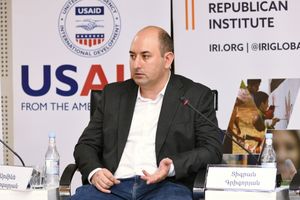

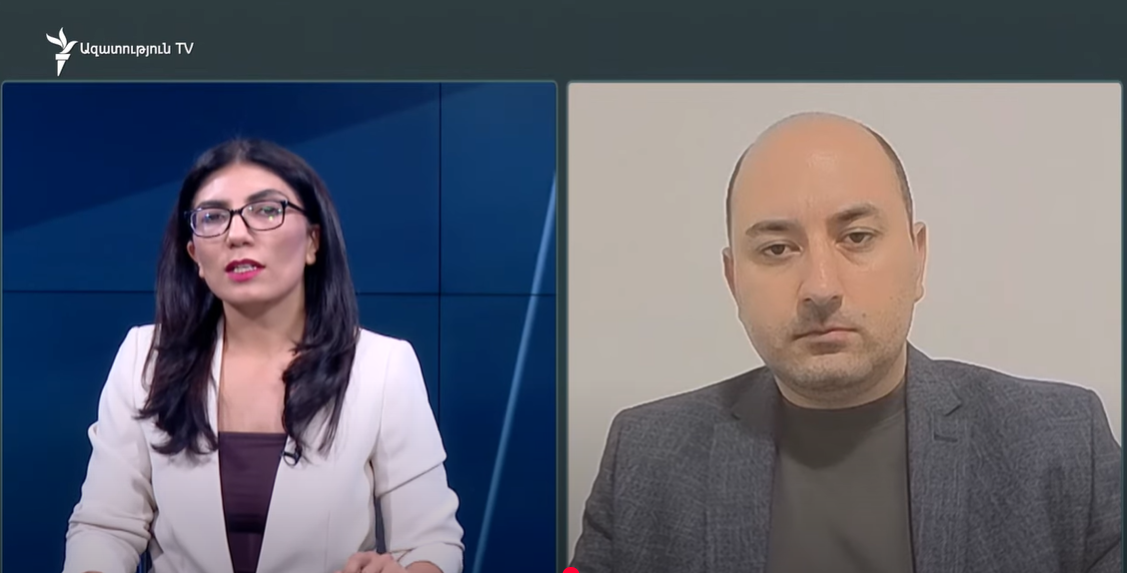
Tatevik Lazaryan (Azatutyun): We will be speaking with Tigran Grigoryan, the President of the Regional Center for Democracy and Security. Thank you, Mr. Grigoryan, for joining us.
— Thank you as well.
So, the Russian Foreign Minister is in Yerevan for the first time in three years. What are the messages of this visit for you, and are there any new signals?
— I think the very fact that the visit has taken place is already an indication that there has been a certain shift in the dynamics of Armenian-Russian relations. Broadly speaking, this shift was already noticeable by the end of last year, when several international developments took place — notably the elections in the United States and the arrival of a new administration, as well as developments in neighboring Georgia. It seemed that Yerevan had begun to introduce some changes in its policies and adopted a more pragmatic approach in its relations with Moscow. The main idea behind this was that, yes, we continue to have problems and disagreements on various issues, but perhaps it’s better to discuss those behind closed doors. The public exchange of criticisms, which had existed at least since September 2022, should be scaled back. The fact that theLavrov’s visit is taking place — and that, as we’ve learned, more high-level visits are expected soon — also points in that direction.
As for the content, I don’t think much has changed in terms of substance. That is, we saw during the press conference today that the main differences that have existed still remain. But it seems the sides have agreed to continue their engagement despite those disagreements.
During the press conference, Ararat Mirzoyan insisted that Yerevan does not plan to reformat its relations, while Lavrov emphasized that non-regional states should not be solving issues here.
Do you think these statements contradict Armenia’s intention to get closer to the European Union?
— I don’t think they contradict it, because broadly speaking, this policy is about diversification. Since at least September 2022, it’s been evident that the change in foreign policy direction is not, as many claimed, about a wholesale pivot. The core of that policy is reducing Armenia’s unilateral dependence on Russia, which is indeed happening to some extent in certain areas.
If we take, for example, the recently adopted law on EU integration — in my opinion, it’s clear to many that this is a process driven by domestic political considerations. I don’t think anyone seriously expects Armenia to leave the Eurasian Economic Union in the near or even medium term, nor to formally apply for EU membership. There’s nothing new in the Russia’s position either — since the 2020 war, the approach of resolving regional issues through regional actors has been in place, and the “3+3” format is one of the clearest manifestations of that thinking. So, to be honest, I don’t see anything new in either Mirzoyan’s or Lavrov’s statements, and I don’t see a contradiction.
At the same time, if we zoom out to a wider picture — Iran’s Defense Minister is also in Yerevan, while Azerbaijan’s Defense Minister is in Israel. Meanwhile, Azerbaijan and Iran are conducting joint military exercises for the first time in the territory of Nagorno-Karabakh. What do these simultaneous meetings and developments mean, in your opinion?
Regarding the military exercise, we should note that these are annual drills. For instance, last year a similar exercise took place under the name “Araz 2024.” I don’t see any new development here. The only newsworthy aspect is that, yes, this time the drills are being conducted in Nagorno-Karabakh. Following the news today, we’ve found out that they are taking place specifically in the Hadrut region.
I believe this is happening at the initiative of the Azerbaijani side—that is, the location was decided by them, and the Iranian side simply didn’t reject the proposal. But yes, as you rightly mentioned, at the same time we are witnessing the visit of Iran’s Defense Minister to Armenia. This is likely a political message to Yerevan, signaling that despite improving relations with Azerbaijan, Iran’s “red lines” remain unchanged—particularly in regard to Armenia’s territorial integrity and especially the inviolability of its southern border. Iran’s position on this has not changed.
Meanwhile, Azerbaijan, by holding such military exercises with Iran, likely also considered it important to send a political signal by dispatching a delegation to Israel. This message is not just intended for Israel, but also for the West more broadly—to show that Azerbaijan continues to pursue a policy of equidistance in its relations with all regional and major global actors.
We can conclude from this that regional players seem to be solidifying their positions. The statements and signals they were previously sending are now being reaffirmed once again.
As I mentioned earlier, there is nothing fundamentally new in today’s announcements or in the military exercise itself. What we’re seeing are the same developments that have been ongoing in recent years.
As for Iran-Azerbaijan relations, there are indeed some noticeable changes. We know that at one point there was a serious crisis in their relationship—especially after the attack on Azerbaijan’s embassy in Tehran. Following that incident, Aliyev demanded that the perpetrator be sentenced to death. Today, that individual was in fact executed in Tehran. This can also be interpreted as a political gesture by Tehran.
Since Pezeshkian's visit to Baku, we’ve also seen a reduction in the level of tension in bilateral relations. On all other fronts, I believe the positions of the parties remain the same. Naturally, Russia is interested in seeing regional issues resolved by regional actors. Iran clearly wants to avoid, under any circumstances, losing its border with Armenia. And Azerbaijan, as I already noted, continues to pursue this policy of equidistance, simply as a means to achieve its strategic objectives.
Thank you very much for the interview. We were speaking with Tigran Grigoryan, President of the Regional Center for Democracy and Security.