
Zhanna Avagyan: Hello, Tigran. The past few days have been quite turbulent in the National Assembly. Let's start with the ratification process of the TRIPP agreement. Once again, the vote highlighted the differences between the positions of the ruling party and the opposition. What were the main statements made? What arguments are opposition representatives putting forward, and how effectively has the government been able to respond to them?
Tigran Grigoryan: The main position of the opposition, and particularly Strong Armenia, is that the TRIPP project should be launched only after the peace agreement has been signed.
This seems to be a relatively new position, because I don't recall such arguments being made previously. In the past, we remember Narek Karapetyan and other opposition MPs saying that they were not opposed to the TRIPP project. They largely did not consider it a corridor, but rather a road passing through Armenian territory, and so on.
In other words, at least publicly, they were not particularly critical of the project. Of course, they had certain proposals, such as the need for guarantees, but we did not see this kind of criticism.
I think this simply reflects a lack of understanding of the issue. Most of these people are only beginning to take an interest in these matters. The argument that the two processes should be linked is itself evidence of this.
A few years ago, when the decision was made to separate the unblocking process from the peace treaty negotiations, it was done because both sides understood that linking the two processes would make progress on both more difficult.
If Armenia now adopts the position that it will not take any steps toward implementing TRIPP, will not ratify the relevant documents, or will not move forward in any way until Azerbaijan signs the peace treaty, this could create a deadlock across all these processes.
At the moment, we already have a deadlock in the peace treaty agenda, taking into account the election results and the fact that the ruling party does not have sufficient parliamentary seats to organize a constitutional referendum. After the elections, it has become fairly clear that the main agenda and the principal mechanism for advancing the peace process is the unblocking of regional communications.
There is active American involvement in this process. We see that, albeit slowly, it is moving forward. If TRIPP is launched and we also manage to activate other communication routes, these could at least connect different parts of Armenia through Nakhchivan and allow Armenia to use Azerbaijani territory to establish connections with Russia and Iran.
This would help keep the peace process active to some extent.
The opposition's current position rules out this scenario. Essentially, the main idea behind its proposal is that if one process is at a standstill, the other should be put on hold as well.
What, then, is the purpose of the opposition putting forward such proposals and formulations?
My primary hypothesis is that there is a lack of knowledge about the process. As I already mentioned, there are no figures in this parliamentary faction who were actively involved in or closely followed these negotiations.
If we look at the issue from a somewhat more conspiratorial perspective, people who accuse Strong Armenia of serving the interests of certain third parties might argue that there is a deliberate attempt to push the process toward a deadlock because it does not correspond to the interests of certain external actors.
On the other hand, if we set aside this particular argument about the peace treaty, there are also some legitimate questions. Nikol Pashinyan addressed some of them as well.
One of these questions concerns the peace treaty agenda: what guarantees do we have that even if Armenia changes its Constitution and fulfills Azerbaijan's precondition, Azerbaijan will actually be prepared to sign the peace treaty?
I would also add that it is rather ironic that the opposition is now advocating so strongly for the signing of the peace treaty. It seems they have not actually read the document, because several of its provisions directly contradict their own political rhetoric and public positions.
When the text was agreed upon, we discussed the fact that it contained several dangerous provisions that could give Azerbaijan an opportunity to scrutinize and potentially interfere in developments inside Armenia. This includes the provision concerning separatism, as well as other clauses relating to Armenia's internal affairs.
From the opposition's perspective, these provisions should also be a problem. Yet we now see that they have become the main advocates of signing the peace treaty.
Nikol Pashinyan made an interesting statement, saying that he would make the opposition an offer they would not be able to refuse. However, when elaborating on this statement, he did not provide any details. What do you think he had in mind?
Yes. As far as I understood, he was referring specifically to the guarantees issue.
The opposition is asking what guarantees exist that, if Armenia amends its Constitution, Azerbaijan will sign the peace treaty without putting additional demands on the table.
Pashinyan appears to be trying to use this argument, including in his contacts and negotiations with Azerbaijan, to demonstrate that these questions are being raised by the main opposition forces.
I listened to his press briefing quite carefully and understood that he intends to use these arguments in negotiations with the Azerbaijani side. During the briefing, he also mentioned that these decisions are not entirely within Armenia's sovereign domain, meaning that they are not decisions Armenia can make unilaterally. I assume he was referring specifically to Azerbaijan.
In short, he will try to use these questions to persuade Azerbaijan to make some kind of public statement, at least, confirming that this is the only obstacle to signing the peace treaty.
Ideally, it might even be possible to sign a document or declaration stating that if Armenia takes this step, the peace treaty will be signed.
As I understood from Pashinyan's briefing, the next step could be to present such a document, or a very clear statement by Azerbaijani officials, to the opposition and the broader public.
Then, if the opposition continues to insist that it will not vote in favor of the new Constitution, the government will develop a narrative that the parliamentary opposition is against peace. An attempt will be made to organize broad public mobilization to force the opposition to accept this agenda, meaning to vote in favor of the new constitutional draft.
In my opinion, there are serious problems with all three steps of this new plan.
First, I do not think Azerbaijan will agree so unequivocally to declare that this is the only obstacle. We have seen that Azerbaijan's position and rhetoric on certain issues have hardened, particularly in recent months.
Hikmet Hajiyev recently insisted that Armenia should apologize to Azerbaijan. We have also heard similar statements in the rhetoric of the Azerbaijani president.
Moreover, Azerbaijan has never adopted such unequivocal positions in the context of the conflict. Strategic ambiguity is a very important component of Azerbaijani policy. We also know that Azerbaijan always maintains several possible scenarios.
At the moment, we can say that the peace scenario is their priority, because certain processes are underway. However, there is no guarantee that Azerbaijan will not pursue alternative scenarios if the external environment changes or if developments take place in Armenia or even in Azerbaijan itself.
If Azerbaijan now unequivocally declares that changing the Constitution and signing the treaty are the only remaining conditions, this could, to some extent, undermine its strategic flexibility.
But let us assume, theoretically, that Azerbaijan does take this step. A senior official, perhaps Hikmet Hajiyev or Aliyev, declares that this is indeed the only precondition and that the peace treaty will be signed once Armenia fulfills it.
I do not think the opposition would agree to vote in favor of the new Constitution even under these circumstances, because doing so would directly contradict its official rhetoric. It could also alienate its own voters, many of whom supported it precisely because they wanted to prevent the adoption of a new Constitution.
This brings us to the third step, which Pashinyan also touched upon during his briefing: putting pressure on the opposition through street mobilization and public demonstrations.
I think the ruling party no longer has this resource either. Its confrontation with the Church was the clearest evidence of this.
Remember a few months ago, when an attempt was made to resolve the issue through public mobilization in Etchmiadzin? If I am not mistaken, they managed to gather a maximum of around 2,000 people, most of whom were party members and government officials.
The ruling party has lost that resource. It is no longer the revolutionary party that carried out all those processes. It has become a conventional post-Soviet party relying on administrative resources. However, administrative resources cannot bring large numbers of people onto the streets.
We should also take into account that this issue will remain controversial in any case. It is not widely accepted by Armenian society, largely because of the perception that it is being imposed by Azerbaijan.
Of course, the government can try to present this concession as the price of peace, but I am not sure that this argument will work either.
Therefore, I think we can conclude that some time will be spent on this newly announced process, but there is a very small likelihood that it will produce results.
Pashinyan will once again return to considering other instruments. Just two weeks ago, for example, he was talking about snap elections.
I also think that politically motivated and selective justice could be actively used to put pressure on individual opposition MPs. However, that does not guarantee the success of the process either.
There is one final point I think is important to emphasize. At the beginning of his statement, Pashinyan said that this was an internal Armenian process and had nothing to do with Azerbaijan. However, with this statement, he essentially acknowledged that the agenda is, in fact, being dictated by Azerbaijan.
If something needs to be negotiated with Azerbaijan on this issue, that means it is no longer exclusively an Armenian domestic matter.
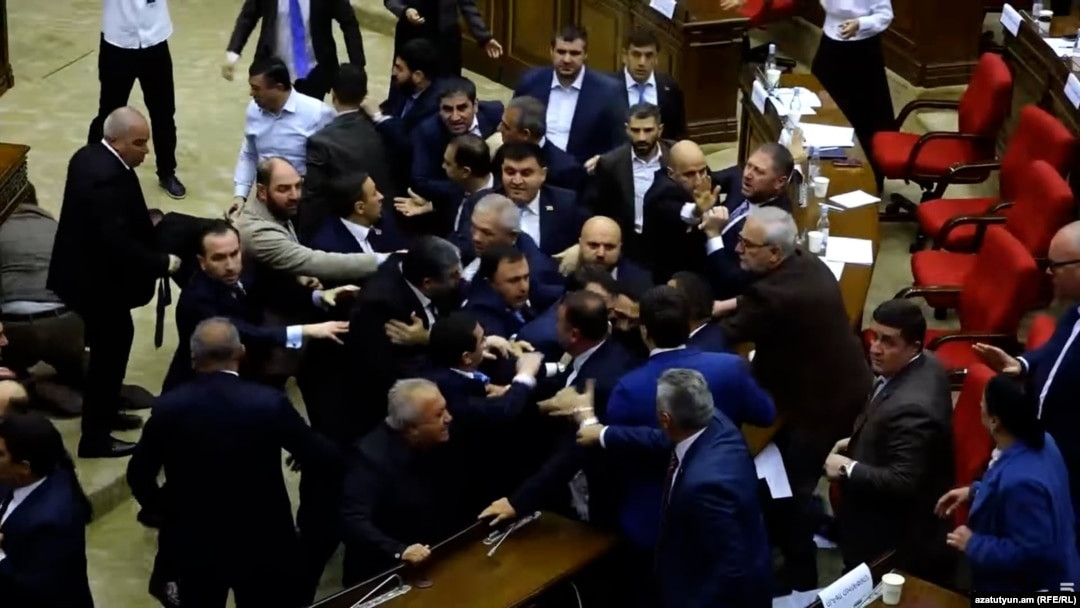
We also cannot ignore yesterday's brawl in the National Assembly, particularly the statements made by members of the ruling party and Nikol Pashinyan himself afterward. What is your assessment? Should legal proceedings be initiated, and do you think they will be?
I do not think legal proceedings will be initiated. However, this situation was predictable.
If you remember when the new parliament was being formed, you may remember Ruben Rubinyan talking about the importance of civility and proper conduct.
I think we said almost immediately, in the following episode, that it was practically unrealistic to expect these rules of conduct to be respected. The first reason was that both political forces have members who are simply not interested in maintaining such standards.
On the ruling party's side, one can mention Taron Chakhoyan. There are also similar figures in Strong Armenia, particularly Edgar Ghazaryan and other MPs who have essentially built their political standing through this kind of provocation and confrontation.
This is the only thing they know how to do.
The incident was predictable, although certainly regrettable. It also demonstrates the degree of polarization in parliament, where polarized rhetoric is now turning into physical violence.
However, I agree that the statements made by the prime minister and Narek Karapetyan following the incident are even more concerning.
Perhaps someone can get involved in this kind of confrontation in the heat of the moment. But when, several hours after the incident, you stand up and declare in all seriousness, particularly if you are the head of government, that everything you did was right and that you should continue acting in the same way, that is deeply problematic.
First, it amounts to justifying violence. Second, it is a statement that has no place in normal political discourse.
There is also an irony here. During those very same days, the ruling party had introduced a bill on preventing domestic violence, authored by Anna Hakobyan.
On the one hand, they say that violence must not be tolerated. On the other hand, the prime minister declares that, yes, we can settle our disputes with a chair, with a chair, or even with our feet.
This sends a serious signal to society that using such methods to resolve disputes, including political disputes, is acceptable.
Today, MPs are hitting one another with chairs. Tomorrow, they could be using firearms.
Political violence is one of the worst things that can happen to a country because it creates vicious cycles that are extremely difficult to break.
If we look at examples from different countries, those that succeed are generally the ones that manage to exclude political violence.
There is extensive academic research on this subject. Erica Chenoweth, a well-known researcher, has studied civil resistance movements dating back to the beginning of the twentieth century.
One of the main conclusions is that only those countries that managed to exclude political violence during these processes were successful in building stable institutions.
In countries where political violence was present, it became a recurring cycle. Power changed hands, and then the new government was removed using the same methods. As a result, more constitutional and civilized norms were never established.
I was genuinely surprised when I saw the publication by Haykakan Zhamanak. It showed photographs of beaten MPs and used circles to indicate which MP had sustained injuries in which part of the body. Of course, perhaps opposition media outlets published similar material too, although I did not notice it. But surely the media should not...
Yes, but this is also an inseparable part of our polarized reality: the polarization of the media.
We have seen the activities of these media outlets in various other processes as well, including how they targeted different vulnerable groups. In other words, they are prepared to cross every red line in pursuit of political interests.
Apart from Haykakan Zhamanak, we can also single out Civic.am, MediaNews and Araratnews. These are all examples of the media instruments that have become conventional features of the political environment.
There are certainly opposition-aligned media outlets that also regularly violate basic standards of civility and other principles.
I think there is another phenomenon at play here. Both sides are trying to prove that they emerged victorious from the confrontation.
This rather juvenile mentality has also been transferred to the developments following the incident.
We saw it in Narek Karapetyan's speech in the National Assembly and in the speeches delivered by Civil Contract MPs. The emphasis was not on the fact that this was an unpleasant incident and that measures should be taken to prevent similar situations in the future.
Instead, much of the discussion focused on who had beaten whom.
This is, of course, a very telling indicator of the level of political discourse in Armenia.
Finally, it is also very concerning that all of this is likely to go unpunished. Some human rights advocates have argued that legal proceedings could be initiated over the statements made by the prime minister and other individuals. But more broadly, why is the absence of consequences dangerous from the perspective of democracy?
I think there is little point in discussing the application of legal mechanisms in this particular case.
Even if those mechanisms are applied, they will be applied selectively.
First of all, this is probably not an incident of sufficient severity to justify stripping someone of parliamentary immunity. That would be unrealistic.
On the other hand, if any measures are taken, they will almost certainly be one-sided. In that respect, perhaps it is even better that there are no legal consequences.
Generally speaking, public condemnation should play some role here.
We should also note that a number of pro-government figures who present themselves as intellectuals or people working in academia are directly or indirectly trying to normalize this incident.
Their argument is essentially: look, similar incidents and brawls happen in other countries too.
Yes, such incidents do happen in other countries. But after a brawl takes place, nobody tries to justify it, either at the level of government officials or among public figures.
That is the main difference between our situation and what happens in other countries.
Here, we have a very active group of people, led by the prime minister himself, who are trying to convince society that this is normal and that it can become an accepted norm in the functioning of our parliament and political system.
Thank you, Tigran.
Thank you as well.