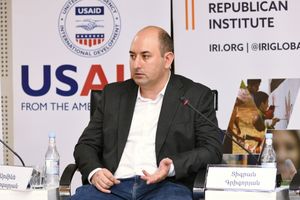

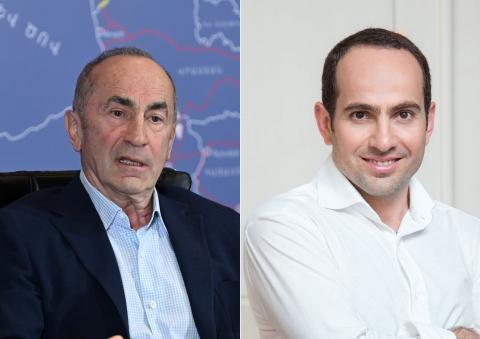
Zhanna Avagyan: Hello, Tigran. As we promised, today we’re going to focus in particular on several provisions of the government’s program. But let’s begin with the arrest of Robert Kocharyan: Today it became clear that Armenia’s second president has been remanded in custody for two months. He is charged with abuse of official powers to obtain a large bribe and with money laundering. It is also worth noting that since 2018, Robert Kocharyan has already been arrested three times. The previous arrests were in connection with charges related to the overthrow of the constitutional order.
How would you characterize these latest actions? How should we interpret them?
Tigran Grigoryan: First, let’s acknowledge that it is obviously not a normal situation when a former president and members of his family become extremely wealthy at such a rapid pace. This would raise questions in virtually any circumstances, and it should raise questions.
The problem here, however, is that it seems we are dealing with something other than a genuine anti-corruption process. If there were an actual anti-corruption logic behind this, there have been numerous opportunities over the past eight or nine years to initiate cases of this kind and bring them to a conclusion.
Let’s remind our viewers that the case concerns the purchase and sale of some property in 2008. In other words, it is a relatively small episode, especially when compared with the scale of the allegations that were being made against the Kocharyan family for years. This looks much more like something that fits into an electoral and post-electoral logic.
We could conditionally call this a stage of political “dekulakization” in Armenia’s newest political history. Nikol Pashinyan explicitly threatened, both during the election campaign and after the elections, that all those prominent figures who had participated in the elections as opposition forces would simply be stripped of their wealth.
And the paradox here is that there is not even an attempt to conceal this process—to say, “Look, I have nothing to do with this; the law-enforcement system is dealing with it.” That is the main problematic aspect.
Of course, in Robert Kocharyan’s case, all of this is much easier politically because of his enormous negative rating. He is probably the politician with the highest unfavorable rating in Armenia, so the authorities taking this step naturally do not expect much negative reaction from the public.
But, as in previous cases—such as the case of Gagik Tsarukyan, or the politically charged criminal cases and selectively applied justice that we have seen before—the problem is not the individual. The problem is not Robert Kocharyan, and it is not Gagik Tsarukyan.
In Kocharyan’s case, given the scale of his wealth and the allegations being made against him, there are legitimate grounds to suspect that he was involved in some illegal processes. But the problem is that, at the instruction of one person, or more broadly at the instruction of a political force, it is possible to launch processes of this kind so quickly.
I am convinced that if there had been no elections, if these forces had not actively participated in the elections, and if there had not been the serious criticism directed at the ruling party, these actions most likely would not have taken place—just as they did not take place during the years preceding the elections.
Nikol Pashinyan and National Assembly Speaker Ruben Rubinyan have made various statements on this issue. The main message was that justice can not be independent of the people's will? How acceptable is this formulation, and what dangers does it pose for perceptions of the justice system?
These statements are textbook examples of how populists approach politics and the political system—of the lens through which they view politics.
For populists, the existence of established institutions is fundamentally unacceptable. They build much of their entire political discourse around a supposed special relationship with “the people”—a mythical people—claiming that they themselves are the representatives of that people’s interests.
The statements that justice cannot be independent of the people are a classic manifestation of precisely this discourse.
If we are talking about modern liberal democracies, liberal democracy has two components. The first is the electoral component, which is where the word “democracy” comes from: the existence of elections and elected leaders and parties. This is where the will of the people is expressed.
But over the course of the development of political thought in recent centuries, people have also reached the conclusion that it is impossible to govern every process solely through popular rule—to reduce the system entirely to the electoral component. There also need to be mechanisms of checks and balances.
The liberal component of liberal democracy reflects precisely that part: checks and balances, as well as the protection of minority rights. The rule of law is part of that liberal component of liberal democracy.
So yes, justice must be independent of the people. Because if questions relating to the justice system are to be decided by the entire population through some kind of referendum, or even through a popular vote, that is no longer justice. That is mob rule.
That is precisely why democratic models evolved from minimalist definitions—definitions built primarily around elections—to the concept of modern liberal democracy, in which justice must remain independent of popular opinion.
So bringing this kind of discourse into the political arena is certainly not unprecedented. Broadly speaking, the ruling party’s discourse is populist and polarizing by nature, and this is not the first time we have heard statements of this kind.
But I want our viewers to understand that these are not normal statements. You cannot justify every process by saying that it is the demand of the people.
Even in this case, for example, you cannot justify a criminal case as being based on “the people’s demand” when you do not even have a particularly strong mandate yourself. You did not even receive 50 percent of the vote. Yet you say, “This is what the people decided.”
And let’s set aside, for a moment, the question of taking minorities and minority opinions into account. The claim itself, as I said, is a textbook populist claim.
It is also another indication that there is not even an attempt to conceal these processes—to show that, broadly speaking, criminal cases are being initiated according to a political logic, and that political considerations are prevailing within the justice system today.
In other words, we are entering a rather turbulent period, where very dangerous processes are being justified through this kind of populist discourse.
And very few people will probably speak about these problems, because from a purely image-related perspective, given Kocharyan’s negative rating and public attitudes toward him—and the same is true in Tsarukyan’s case—talking about these cases is not particularly attractive.
But let me stress once again: this is not about the individuals.
If there were an institutional approach—for example, if we were dealing with injustices or corruption-related crimes committed in previous years, and we could see that the justice system was completely free of political considerations—I would probably be the first to welcome these processes.
I would say: yes, if we have accepted the principle that everyone should be held accountable for what they have done or failed to do, then let’s move forward along this path.
But when criminal cases are initiated from one election to another at someone’s whim, and then later dropped, and when there is clearly a political logic behind the process, then, as I have said before, it means that the justice system simply does not exist.
We will continue following these developments. Now let’s talk about the government’s 5-year action plan. Today we are going to focus specifically on foreign policy and security. What would you single out from the foreign-policy section? And if we compare it with the previous program, what differences do you see?
Some parts of the program are difficult to compare with the previous one because, unfortunately, the subject matter itself no longer exists. I mean Nagorno-Karabakh.
If you remember, the previous program was quite ambitious on this issue. It is true that much of the ruling party's electoral platform was not included in the 2021 government program in its original form, but even in that shortened version, when you read it today, you get the impression that it belonged to a different reality.
And indeed, it was a different reality.
Armenia’s authorities attached importance to the activities of the OSCE Minsk Group. They spoke about resolving the conflict on the basis of the well-known principles. More broadly, it was also stated that the government was the guarantor of the security and rights of the people of Nagorno-Karabakh.
I think this is an important point of reference when, for example, we talk about programs being implemented for people displaced from Nagorno-Karabakh. These are not simply some discretionary programs that the government could choose to implement or not. They are obligations that the government undertook in its 2021 program.
Now, unfortunately, for both objective and subjective reasons, there is very little about Nagorno-Karabakh in the new government program.
And what little there is does not appear in the foreign-policy or security sections, but rather in other sections, particularly those dealing with social programs.
Our center’s expert, Hayk Khanumyan, recently analyzed this issue and pointed out that even there, the housing provision target is inadequate.
The target specified in the government program does not cover even half of the needs of displaced people. In other words, the number of apartments or families for which the government says it will solve the housing problem corresponds to roughly half of the number of people who actually have such a need.
That is the situation concerning Nagorno-Karabakh and the problems facing its displaced population.
But the major difference, of course, is the attitude toward Russia.
If we read the 2021 program, we see that Russia appears almost at the very beginning—I believe it was the second point—where the importance of relations with Russia, the importance of the CSTO, and so on are emphasized. There is also discussion of the importance of the Russian peacekeeping force in Nagorno-Karabakh.
In this program, Russia appears much later, if I am not mistaken, around the ninth or tenth position when the government discusses relations with different countries.
And even within that paragraph on relations with Russia, the term “strategic” does not appear.
This reflects the problems that currently exist in bilateral relations.
Broadly speaking, the entire foreign-policy section is about relations with Russia, about this policy of balancing and counterbalancing, and, in large part, about reducing Armenia’s dependence on Russia.
That idea runs like a red thread even through the paragraph devoted to Russia, where the government speaks about balancing and a balanced foreign policy.
Meanwhile, the importance of other partners is emphasized much more strongly.
I was surprised that India again appears relatively low down the list, if we assume that the order itself is intended to convey some kind of message. Georgia, for example, is listed higher, and Iran is also listed higher, despite the rapidly developing military-technical relations with India in recent years. At the same time, we do not have a strategic partnership document with India, so perhaps that is the main reason for its position.
But overall, there was nothing particularly new in this program. Broadly speaking, it simply contains what the government has been talking about over the past year or two.
It was nevertheless interesting to see these ideas presented in a more systematic way in one document and to understand what the government considers its foreign-policy priorities.
Let’s move on to the security section. Under the subsection on the armed forces, for example, it begins with a formulation saying that the armed forces are a reserve instrument for ensuring external security when an issue cannot be resolved through diplomatic means.
There are also some other somewhat problematic formulations throughout this section.
Tigran Grigoryan: The ideas expressed here are not new. They have been articulated many times on other platforms, including by the prime minister and other senior officials. I think these approaches are heavily influenced by the post-war trauma that we, as a society, and the political elite in particular, have experienced.
The defeat of 2020 and all the security problems that followed have created a situation in which there is, broadly speaking, skepticism about our own capabilities and our own armed forces.
But the phenomenon itself is not new.
For example, similar attitudes were widespread in Europe after the First World War, given the devastating consequences of that war for the continent as a whole and the new technologies that were used in warfare for the first time. The same thing happened after the Second World War.
And the debate over what should form the basis of security—whether it should be very clear military capabilities or, for example, peace—also exists in other contexts.
Idealists and liberals in international relations tend to take peace as their starting point.
Representatives of the more realist schools, including the neorealist and realist traditions, naturally emphasize capabilities, including military capabilities.
For me, the problem here is that peace is fundamentally not a tool; it is the goal.
You cannot take the goal and say that this is our security instrument.
Having capable armed forces, by contrast, creates the conditions that allow you to use additional instruments in pursuit of that goal.
If you do not have military capabilities—if you have not restored your military capabilities, for example—how are you supposed to achieve the desired outcome of peace through diplomacy?
Because, as we have seen in recent years, everything ultimately comes down to the balance—or imbalance—of power.
The fact that Azerbaijan continues to have an advantage over Armenia in terms of the balance of power naturally has a very direct impact on the negotiating process, both in the Armenian-Azerbaijani context and across other aspects of the Armenian-Azerbaijani agenda.
So the claim that the army is some kind of “reserve instrument” is something I understand in terms of why it was written.
First and foremost, it is a message to Azerbaijan and to the outside world: we do not want to start wars, we do not have such an objective, and we are not pursuing revanchism.
But the statement and the approach themselves are problematic, because even if we are not talking about restoring the balance of power, but rather about making the cost of an attack against us very high—about pursuing a deterrence policy toward Azerbaijan so that the situation does not reach the point of war—even then, this formulation is highly problematic.
It can send the wrong signal to Baku. It can create an image of weakness. And weakness can often be provocative. Many wars begin because one side believes that the other side is weak or is not prepared to defend its interests—that it does not have the capabilities necessary to defend itself.
That is the fundamental problem.
There is also another section that can be interpreted in different ways: the claim that the armed forces cannot be used outside the territory of the Republic of Armenia.mIn short, in my view, there are very serious conceptual problems here. These formulations send the wrong signals not only to our adversaries, but also to the international community and to our own armed forces.