
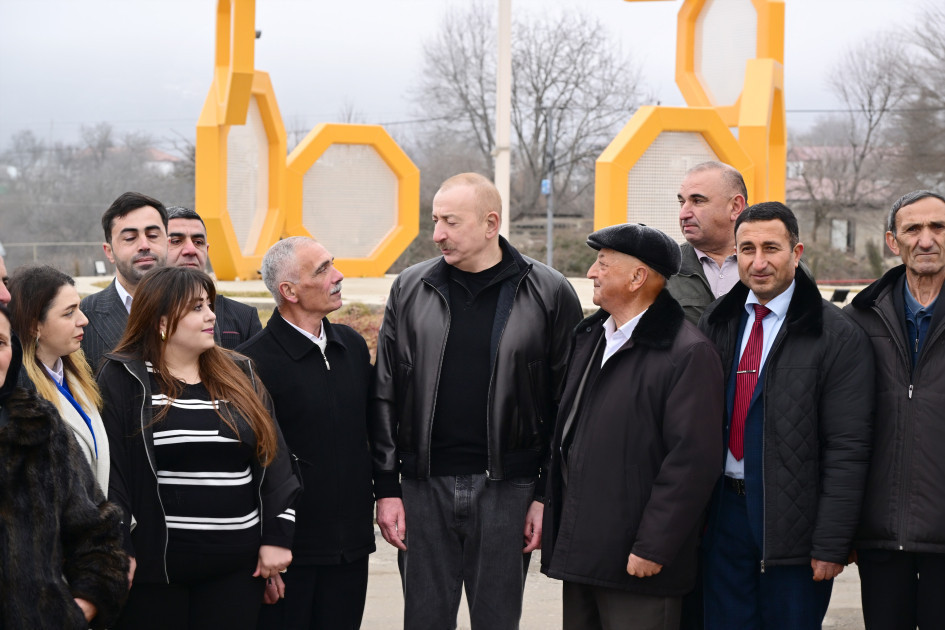
On February 19, Azerbaijani President Ilham Aliyev visited the village of Aygestan (Baluja) in the Askeran region of Nagorno-Karabakh, meeting Azerbaijani settlers who moved there following the ethnic cleansing of the territory. According to official Azerbaijani data, 110 families have settled in the village since Azerbaijan’s takeover. Before the First Karabakh War, Aygestan had a predominantly Armenian population, with only two Azerbaijani families living there in the late 1980s.
Beyond being one of Azerbaijan’s showcases for resettling formerly Armenian-populated areas, Aygestan holds deeply personal significance for me. It is where most of my childhood memories were made. My ancestors founded the village centuries ago, and my great-great-grandfather served as its first mayor, earning our extended family the nickname "the mayor’s kin."
My great-grandfather, Avan Balasyan, built his three-story house near the village church in 1905, as indicated by an inscription on its facade. Before the Second Karabakh War, it was a gathering place for relatives from around the world. According to family legend, the house once hosted prominent Armenian public figures visiting Karabakh.
Avan Balasyan was a trader who imported goods from Persia and sold them in Karabakh. He was a wealthy man by the standards of his time, but like many others, he lost everything when the Bolsheviks took over. He had savings in a British bank in Persia, but when two of his children joined the Komsomol after Soviet rule was established, they burned all documents related to the account to protect themselves. For years, the fate of those savings was a favorite topic at family gatherings. A simple Google search later confirmed what I had suspected—if the account ever existed, it was likely nationalized after the Islamic Revolution in Iran.
 Avan Balasyan is seated in the center, second from the left at the bottom, holding a cup of wine.
The family lost part of its property during the Armenian-Tatar clashes of 1920 when the village was raided and looted. What remained—gold and silver—was sold to Torgsin in the 1930s to stave off starvation (a Soviet state-run organization in the 1930s that allowed citizens to exchange valuables like gold and silver for food and goods during times of economic hardship).
In the 1970s, my great-grandmother Tamara spent her winters in our apartment in Stepanakert. One day, our upstairs neighbor, Gurgen Harutyunyan, a renowned actor, invited our entire family for dinner. Seeing his apartment, which was luxurious by Soviet standards, Tamara was overcome with memories of her former life.
In 1949, Avan, already 79 years old, Tamara, and their unmarried children were exiled to a village in the Biysk district of Altai. A fellow villager, Piruza, had denounced them, falsely claiming they were Dashnaks—despite the fact that they had always been apolitical.
As they were herded onto the train bound for Siberia, Avan turned to Tamara with a wry smile and said, "Tamara, you always complained that we never travel. Well, look at the places I’m taking you now."

After the 20th Congress of the Communist Party in 1956, they were allowed to return. They spent the final years of their lives in Baluja, their homeland. Avan passed away in 1963 at the age of 93, and Tamara in 1982 at 92.
Though my mother was born in Stepanakert, our family’s center of gravity remained in Baluja. In the late 1980s, my grandfather built a house there, intended to be a family dacha. But when the First Karabakh War erupted, and after months spent sheltering in a basement under constant Azerbaijani shelling, my mother, grandmother, and I moved to that "would-be dacha" in Baluja —though, of course, I had no say in the decision. It offered better protection from bombs and a greater chance of finding food.
At the time, only one road connected the village to Stepanakert, through Khnatsakh. My mother, a piano teacher at Stepanakert’s music school, continued working throughout the war. Astonishingly, the school never shut down, and she walked 9 kilometers to Stepanakert and back daily to teach her students Mozart and Bach—sometimes hitching a ride on old Soviet trucks if she was lucky.
My earliest memory of the war is also from Baluja. I was no more than three years old, playing on the street with other children when they suddenly started screaming and running away. Confused, I stood there alone until I saw my mother running toward me. While she was looking for me, an Azerbaijani bomb struck our neighbor’s home, killing him instantly. Shrapnel shattered several of our windows.
After the war, we spent summers in Aygestan/Baluja. That’s where I developed my rudimentary football skills and love for the game. I remember watching England play Brazil in the 2002 World Cup, cheering when Michael Owen scored, only to have my hopes crushed when Ronaldinho lobbed David Seaman from 40 yards out. Supporting England has felt much the same ever since.
My football-playing experience in Baluja was even worse. My notoriously deformed nose—visible to anyone who watches my CivilNet podcast—is the direct result of a game gone wrong. Attempting a brave header, I instead met a young Baluja baller’s foot. Unfortunately, we didn’t have VAR back then. I remember crying for an hour—not from pain, but from the realization that my nose would never be the same again.
I stopped spending summers in Baluja after high school, though I would occasionally return with friends for barbecues or birthday celebrations. But for my mother, the village house was her greatest joy. She visited several times a week to tend to the trees, grow herbs for zhengyalov hats, and have tea on our open balcony with the neighbors, catching up on village news.
During the blockade, when Stepanakert suffered severe food shortages, those same neighbors shared their crops with my mother. Now, they are scattered across Armenia, and the balcony conversations exist only as memories, relived over long phone calls.
Aygestan/Baluja, like many other Armenian towns and villages in Nagorno-Karabakh, has become a battleground for Azerbaijani revisionism and authoritarian conflict management. Through the deliberate erasure of entire neighborhoods and villages, and the settlement of people with no connection to these places, the Aliyev regime seeks not only to seize physical space but also to manipulate the collective memory of the region. This process unfolds with alarming transparency, yet it seems to stir little concern among international observers or political leaders. For many, it is seen as an unfortunate but necessary step toward regional peace. For us, it is not just the loss of territory—it is the erasure of history and identity, a wound that will endure as long as we do.
Tigran Grigoryan