

PRAGUE – Yerevan and Baku have announced that the text of the peace treaty has been finalized. However, as Armenia expressed its readiness to sign, Azerbaijan reiterated its previous additional preconditions, particularly regarding amendments to Armenia's Constitution, which it views as containing territorial claims.
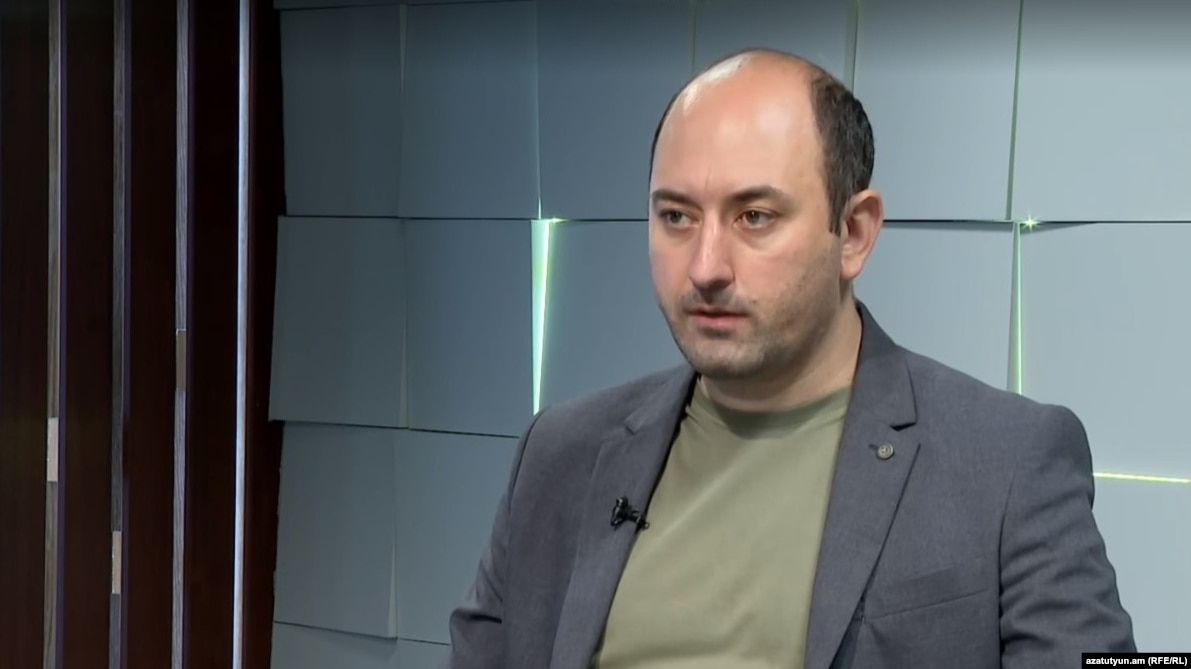
What exactly does this finalized peace treaty entail from a substantive perspective? What compromises were made, what prevented reaching an agreement earlier, and how do global events—sometimes seemingly distant from Baku and Yerevan—factor into the process? These questions are discussed with our guests at the “Non-Round Table” – President of the Regional Center for Democracy and Security, Tigran Grigoryan, and political analyst and political exile Rauf Mirkadyrov.
Vadim Dubnov:
Tigran, the peace treaty has reportedly been agreed upon, with the last two articles—on third-party military representatives at the border and the withdrawal of lawsuits from international courts—being finalized. Were these two provisions truly the main obstacles, or are there deeper, unresolved issues that remain unaddressed to this day?
Tigran Grigoryan:
All of these points can be grouped into several categories.
One category consists of provisions within the peace treaty that were not previously agreed upon. Over recent months, both sides have negotiated these points, and now we see a form of consensus. The second group includes Azerbaijan’s demands, which are not part of the treaty text but are essentially preconditions for signing it. These include the well-known demand to amend Armenia’s Constitution and dissolve the OSCE Minsk Group.
Beyond these, there are other categories—issues related to communications, border disputes, etc. In general, the peace treaty does not resolve all existing problems. It’s theoretically possible, though unlikely, that the treaty will be signed while certain issues remain unresolved, such as the opening of transport links or future border delimitation processes.
Vadim Dubnov:
Rauf, what Tigran just mentioned is probably the key question—how much is this peace treaty actually a treaty for peace? The fact that all these articles have been agreed upon and that there are supposedly no further textual disagreements—does this genuinely contribute to conflict resolution?
Rauf Mirkadyrov:
First, I want to point out that amending the Armenian Constitution is directly related to the peace treaty. A fundamental principle of any peace agreement between states is the unconditional recognition of territorial integrity. Armenia’s Declaration of Independence explicitly claims part of Azerbaijan’s territory.
As for whether this peace treaty is truly a treaty for peace... In reality, it could have been signed a year and a half ago, since most peace agreements contain well-known provisions, except for specific elements unique to a particular conflict. From Azerbaijan’s perspective, these include opening communication routes, addressing refugee issues, withdrawing lawsuits from international courts, and so on.
Vadim Dubnov:
Tigran, what exactly have the parties been negotiating? If it was just the treaty text, then Rauf’s question makes sense—after all, a general statement that peace is preferable to war could have been signed back in 2020. Or was this document conditioned on a set of preconditions that were truly significant and couldn’t be agreed upon until now? And did the broader global context play a role in finally reaching an agreement?
Tigran Grigoryan:
I’ll start with the Constitution. When I mentioned different categories, I was referring to technical issues. Constitutional amendments are not included in the peace treaty text. Of course, one can debate the legitimacy of Azerbaijan’s demands to amend Armenia’s Constitution and whether this complicates the treaty signing process. Realistically, however, this makes signing nearly impossible in the short term.
Vadim Dubnov:
Is that the intention?
Tigran Grigoryan:
That’s the question. Is Baku genuinely concerned about this issue, or is it being used as a means to prevent signing the treaty? Because if we look at the Constitution, it contains legal references upon references, and Armenia’s Constitutional Court has already stated that these do not impact the peace treaty. The treaty itself includes a provision stating that it takes precedence over domestic legal documents.
To answer your question directly, over the past year, both sides have deliberately separated key issues from the peace treaty. About six months ago, they announced that the issue of transport links would be handled outside the treaty, and border delimitation and demarcation would be discussed within a separate bilateral commission. So, in reality, this is a framework agreement—a document outlining principles for relations rather than resolving specific disputes. And that is the fundamental problem with this document.
This explains the intense reactions from various international actors. Yet, most of the key issues remain unresolved. If we look at Baku’s reaction after the peace treaty was finalized—statements demanding further concessions, heightened rhetoric, and accusations that Armenia is violating the ceasefire—it becomes clear that the two sides are still far from achieving lasting peace.
Vadim Dubnov:
Rauf, are both sides truly interested in such a framework agreement? And does signing such a document make sense if it leaves major issues unresolved?
Rauf Mirkadyrov:
A peace treaty is always, by definition, a framework agreement. It establishes certain principles. Border delimitation and demarcation cannot be resolved within the peace treaty itself, but it can specify which maps will be used—at best.
Vadim Dubnov:
But agreeing on the maps would be significant in itself.
Rauf Mirkadyrov:
Yes. The same applies to transport links. These aren’t matters that can be settled with a simple agreement stating that a particular road will open tomorrow. Instead, the treaty could affirm that both sides agree to resolve these issues through specific agreements. Even the establishment of diplomatic relations would only be mentioned in principle, with additional agreements needed later.
So, aside from recognizing borders and territorial integrity, this is a framework agreement. Incidentally, any Constitutional Court can interpret a constitution, so Armenia’s court ruling on this matter is legally questionable.
Vadim Dubnov:
Tigran, unlike in Azerbaijan, in Armenia the peace treaty has immediately become a subject of intense domestic political debate. And as far as I know, you don’t fully share the government’s position. What exactly is being criticized in Nikol Pashinyan’s approach, and why? Also, why does Armenia need this treaty if it does not resolve fundamental issues?
Tigran Grigoryan:
Before answering that, I want to stress that the peace treaty does not include specific implementation mechanisms for issues like transport links or border delimitation. It only sets out principles. If we’re talking about transport routes, the principles are well known—sovereignty, reciprocity, and jurisdiction. But six months ago, both sides decided that even these principles wouldn’t be included in the treaty text.
Regarding the criticism—there are two types. The political criticism sees the treaty as a capitulation. Then there’s the expert criticism, which is where I stand. I believe that before resolving key issues—such as transport routes and border delimitation—it would be extremely risky for Armenia to withdraw the EU monitoring mission.
For example, when Azerbaijan accuses Armenia of ceasefire violations, this mission verifies that there are no unusual troop movements. While its role shouldn’t be overestimated, without it, Baku would have a blank check to escalate tensions.
Vadim Dubnov:
Would rejecting Azerbaijan’s demands enhance Armenia’s security?
Tigran Grigoryan:
This isn’t about rejecting demands outright; it’s about negotiations. If one side fully accepts the other’s negotiating position, that’s not a negotiation at all.
However, as you noted, the global situation is volatile. Events, particularly in the United States, have made Armenia’s government rethink the extent of possible U.S. engagement in the South Caucasus. Previously, the U.S. played an active role in containing Azerbaijan’s aggressive policies. Against the backdrop of a potential decline in U.S. involvement, the Armenian government's latest concession appears to be an effort to mitigate risks in an increasingly unpredictable international landscape.
Vadim Dubnov: Let me clarify. What risks are associated with changes in the domestic political situation in the United States? And is this connected, to put it mildly, with the suspension of Armenia’s declared movement toward Europe and, consequently, some temporary or demonstrative warming of relations with Moscow? Or am I mistaken?
Tigran Grigoryan: As I already mentioned, over the past 2–3 years, the United States has played a fairly positive role in the region, more or less restraining Azerbaijan’s aggressive policies. While diplomatic and political pressure did not resolve all issues, it at least mitigated Baku’s approach.
As for broader foreign policy issues concerning Armenia, I never took seriously the rhetoric about Armenia moving toward European integration. That law on Eurointegration, by the way, has not yet been adopted. The first reading took place, but—coincidentally—the second has yet to happen. This law is more about domestic politics than defining any foreign policy direction.
Naturally, when the new U.S. administration itself seeks contact with Moscow, the message everywhere—including in Yerevan—is: resolve your own issues with your neighbors and with Russia. I believe that, yes, these developments have influenced the Armenian government’s behavior. Now, we are likely to see a more calculated approach toward relations with Moscow.
Vadim Dubnov: Rauf, can we say that the international context has in some way influenced the negotiation of the peace agreement?
Rauf Mirkadyrov: I think that many processes are happening in the world, but the world doesn’t change simply because Trump came and said something. That said, Ilham Aliyev recently stated that the U.S. dominates global affairs. This was the first time in a while that he explicitly said that everything is decided in Washington. Hearing that from Aliyev, who in recent years seemed to believe Azerbaijan was becoming a center of power itself, was quite surprising.
At the same time, we are witnessing the emergence of a new international structure outside the U.S.—something we didn’t anticipate just a few months ago. The coalition supporting Ukraine, which is forming in the UK with Canada, Australia, and others, is not just about Ukraine; it reflects broader U.S. policies. This is a new center of influence, still in its infancy.
Turkey’s role is also changing—not just in the region, but in the Armenia-Azerbaijan conflict. Before all Azerbaijani territories, including Khankendi, were taken back, Turkey unequivocally supported restoring Azerbaijan’s territorial integrity, even by military means. Today, Turkey is playing a somewhat peacekeeping role. It continuously states that peace should be achieved and all issues resolved peacefully. When tensions flared on the border recently, Erdogan even called for an end to clashes.
Additionally, for the first time since 2008, negotiations with Armenia have resumed—negotiations that are not directly linked to Azerbaijan. Previously, Turkey would say: “Do this first, and then we will start negotiations with you.” Now, that condition is absent. This is a separate trend.
Turkey also understands that the U.S. under Trump is not the most reliable ally. New geopolitical games are beginning, and Turkey’s role is shifting—not only in European security but also in the region.
Vadim Dubnov: So, for Turkey, restoring relations with Europe is now much more important than before?
Rauf Mirkadyrov: Yes, including military-political relations—but not without considering the U.S. The U.S. remains a major factor. Erdogan recently announced that he plans to meet with President Trump in April. But there is also a separate European trend. Turkey needs this for many reasons, and it is particularly interested in reopening regional trade routes.
When I talk about corridors, I don’t mean just the Middle Corridor—Turkey wants Armenia to be involved as well because Turkey sees an economic opportunity in this.
Meanwhile, the Russian factor—despite Putin currently engaging more with the Americans—has weakened in Turkish foreign policy for many reasons. The interest is simply not there anymore. A glance at Turkey’s trade balance makes it clear what is driving its priorities.
Vadim Dubnov: Tigran, the attempt to separate the "Turkish" negotiation track from the "Azerbaijani" one has been a long-standing tradition in Armenian diplomacy regarding conflict resolution. Am I correct in understanding that Yerevan also senses the changes Rauf mentioned, and that this process is progressing better than before, even though the prospect of opening the border with Turkey remains uncertain?
Tigran Grigoryan: Unfortunately, even after the end of the Second Karabakh War—when Ankara’s preconditions for negotiations seemed irrelevant—Turkey continued to introduce new ones. The latest precondition is signing a peace treaty. In some interpretations, this also includes opening the so-called “Zangezur Corridor.”
The Armenian government is now trying to demonstrate that progress is possible on the Armenia-Turkey track. As you may recall, a few years ago, there were minimal agreements on opening the border to third-country nationals and diplomatic passport holders. However, even that has not been implemented.
Now, the Pashinyan government will likely try to “sell” the finalization of the peace treaty text with Azerbaijan as real progress on the Armenia-Azerbaijan track—and attempt at least to implement the previously agreed-upon steps.
Vadim Dubnov: What comes first here? Is normalizing relations with Turkey the goal, with the peace treaty being used as leverage? Or is Turkey’s involvement needed to put pressure on Azerbaijan?
Tigran Grigoryan: I think that for the Armenian government, signing a potential peace treaty with Azerbaijan is important. But looking at Armenia’s post-war foreign policy as a whole, normalizing relations with Turkey has been a priority. The government is doing everything possible to make that happen, but Armenia-Azerbaijan issues remain a major obstacle.
Unfortunately, as I mentioned earlier, Ankara continues to condition this process on Armenia-Azerbaijan relations. I don’t think that agreeing on the peace treaty’s text will lead to a breakthrough. However, Armenian diplomacy seems to be playing this card: “Look, at least there is some progress here—so let’s move forward with implementing the smaller steps agreed upon a few years ago.”
Vadim Dubnov: Rauf, to what extent will Azerbaijan align itself with Turkey’s needs as it seeks to restore relations with Europe and the U.S.? And how likely is Azerbaijan itself to improve ties with Europe, given how poor relations have been over the past two years?
Rauf Mirkadyrov: We need to separate issues here. Azerbaijan will not become a democratic country in the near future. That fundamental obstacle in its relations with Europe will remain.
However, we are already seeing certain changes. Azerbaijan’s ambassador to the U.S. recently stated that Azerbaijan should be a strategic ally of the U.S.—something we haven’t heard in at least a decade. For the past ten years, we’ve only heard about Azerbaijan distancing itself from the West.
Moreover, the European trend has been “optimized.” Serious negotiations have taken place in the UK, for example. Azerbaijan will certainly be watching how things unfold globally, especially if the “nightmare” of current tensions somehow ends. I think the same process is happening in Yerevan.
Another key point to consider: despite Europe and the U.S. being generally pro-Armenian, they reacted relatively calmly to Azerbaijan’s military actions to reclaim its territories. That’s because diplomatic ties and channels of communication with Azerbaijan were never fully severed.
For Azerbaijan, Turkey remains critically important. But Turkey cannot abandon Azerbaijan either—it’s a domestic political issue for Erdogan, as he relies on nationalist support, which is strongly pro-Azerbaijan.
At the same time, Azerbaijan cannot ignore Turkey’s position. Turkey is Azerbaijan’s only relatively reliable ally. Baku cannot afford to reject peace with Armenia outright, nor can it maintain openly hostile relations, as Turkey’s withdrawal of support would leave Azerbaijan highly vulnerable to Russian pressure.
Ultimately, Turkey has broader regional ambitions that, in principle, align with Armenia’s interests as well. I believe Turkey could become a security guarantor for the region, and that is something that matters to Azerbaijan too.
The interview was originally published in Russian on ekhokavkaza.com.