
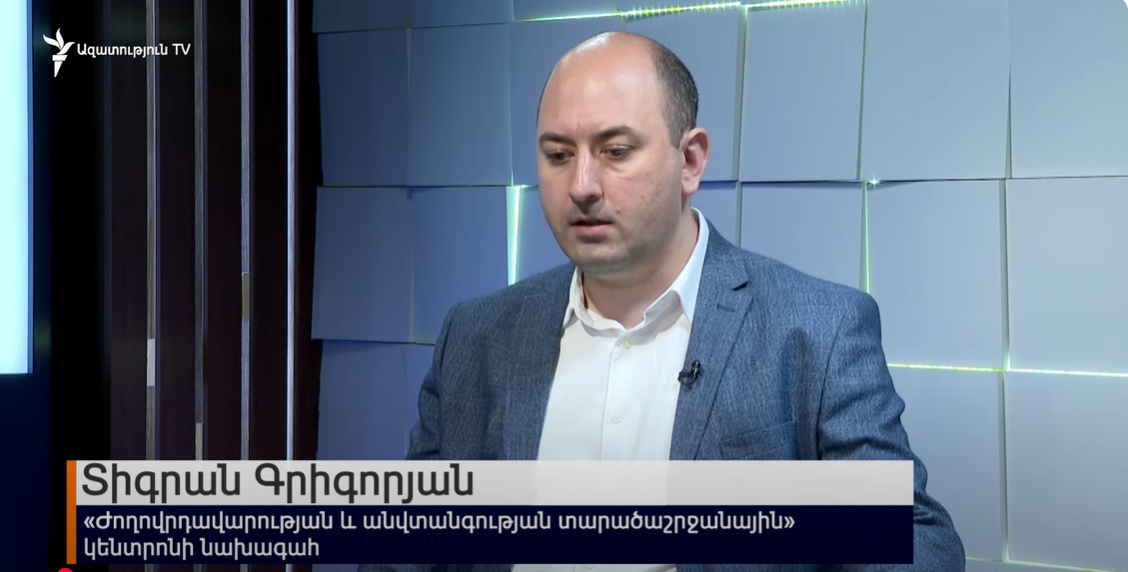
Astghik Bedevyan (Azatutyun): We have invited political scientist Tigran Grigoryan for a conversation. Welcome, Mr. Grigoryan, and thank you for accepting our invitation.
Mr. Grigoryan, the Armenian government emphasizes the importance of concluding the negotiations. The text asserts that there is no humiliating settlement for Armenia. The opposition, however, holds the exact opposite view, arguing that concessions and coercion will continue. I would like to hear your perspective—when Baku announces the conclusion of negotiations but simultaneously sets a demand for constitutional amendments as a prerequisite for signing, do you believe an agreement is near?
I don’t think the signing is imminent. We have seen that an agreement on the text has been reached. From the beginning, we have known that there are two separate packages: a set of unresolved issues included in the peace treaty text and the Azerbaijani preconditions, such as constitutional amendments and issues related to the OSCE Minsk Group, which have existed in parallel. In this sense, there is nothing new, and it was expected that Azerbaijan would continue to insist on constitutional changes.
Regarding the recent agreement reached in this phase, it is evident that Armenia was forced to accept Azerbaijan’s position. We all remember that the Armenian Prime Minister and the government insisted that the withdrawal of third-party forces from the border could be implemented only in demarcated sections.
Yes, and we know this refers to the European Union monitoring mission. But in reality, we see that Armenia has retreated from this position, and now the withdrawal from the border areas will take place along the entire border in the event of the treaty’s signing and ratification.
Why are you skeptical? Is it because there are deadlines for fulfilling demands, and you don’t see them being met quickly, particularly regarding constitutional amendments? Or do you anticipate new demands? What is the basis of your skepticism?
There are at least two issues here. The first is a matter of timing. We know that constitutional amendments cannot be made easily; a new constitution needs to be drafted. The ruling party has been working on this in recent months under the broader discourse about the "Real Armenia" concept. Justice Minister Srbuhi Galyan has also stated that the draft of the new constitution will be ready in time for the 2026 parliamentary elections. If a referendum is required, the people's opinion must also be taken into account.
Yes, and that could be the second major obstacle—ensuring public participation. We know that constitutional referendums have specific participation requirements. Furthermore, no matter how much the authorities try to present this as a domestic agenda and part of the "Real Armenia" concept, the public perception will likely be that these changes are being imposed by Azerbaijan. The government will likely frame this as the price of peace, but considering that many unresolved issues remain, this argument may not be convincing.
How far are we from signing the treaty, in your opinion?
I think this process will take another one or two years, and there are no guarantees that, for instance, in the case of a constitutional referendum, the Armenian public will give a positive response. There are also considerations regarding the timing of other issues, such as the EU monitoring mission’s mandate, which was approved for two years. The approach seems to be that by the time the treaty is signed and ratified, the mandate will expire, eliminating the need for an extension.
Mr. Grigoryan, there are broad understandings of the treaty's provisions, but the reality remains one where the threat of war is constant, demands keep increasing, and Artsakh is depopulated while Armenian prisoners remain in Azerbaijani jails. If the treaty is signed, ratified, and enters into force, do you think it will remain just a piece of paper, or will it bring real change?
Look, this document itself is quite weak. Over the past few years, we have seen how all the key issues have been removed from the peace treaty text. The authorities now try to present this as an achievement, arguing that, for example, the issue of transport unblocking is not included in the document. However, even after the treaty’s signing, many unresolved issues will remain—first and foremost, the issue of unblocking transport routes, which I believe is quite dangerous.
Additionally, the decision regarding international observers—that they can withdraw after the treaty’s signing and ratification—creates serious risks. If we still have unresolved issues, especially along the borders, not having a third party present on the ground would be unwise. Observers can document and refute Azerbaijan’s various accusations, such as claims that Armenia is preparing for war.
Prime Minister Pashinyan mentioned that the agreement includes a provision that prohibits actions contradicting the logic of peace. But in Baku, can't this always be interpreted according to their own interests? Isn’t this a risk, Mr. Grigoryan?
Yes, absolutely. This likely refers to so-called "revanchism," but it is difficult to determine what Baku would consider revanchism. This, too, leaves ample room for interpretation by the Azerbaijani authorities. In this sense, we must acknowledge that simply signing a document does not guarantee that escalations will not occur in the future.
Even without having seen the full text, we can already identify provisions that could be interpreted in different ways by each side. This alone highlights the risks involved.
If the treaty is signed, do you see any chance that it could lead to lasting peace?
This treaty is a framework agreement—it only sets out general principles and does not resolve any specific issues. If it is signed, it might create a more favorable atmosphere for progress in various processes. However, let’s say the treaty is signed, but disagreements persist regarding transport unblocking. Over the past year, we have seen numerous creative solutions proposed, such as third-party oversight or limited cargo transportation, but Azerbaijan continues to insist on a special regime. If this issue remains unresolved despite a peace treaty, can we truly speak of peace? The same applies to other issues.
It is also paradoxical that at least the humanitarian issues are not addressed in this document. How can we talk about peace while Armenian prisoners are still held in Baku?
Mr. Grigoryan, you spoke about unblocking, and we know that this issue is separate from the peace treaty, with separate negotiations currently taking place between the parties. Today, Foreign Minister Mirzoyan also stated that there is no provision regarding the so-called "Zangezur Corridor" in the negotiated draft, correct? Instead, there is a provision on territorial integrity and the non-use of force. In your opinion, does this neutralize the threat of forcibly taking the so-called "Zangezur Corridor," considering that such statements have been made from Baku?
Look, first, let’s note that in the past two days, the authorities have been trying to present the fact that the topic of unblocking or the so-called "Zangezur Corridor" is not included in the final text as a major achievement. However, we all know that these issues were separated months ago. Elchin Amirbayov, the representative of the President of Azerbaijan, was the first to mention this months ago, there is nothing new here, and it is unclear why so much emphasis is being placed on it.
The processes have been separated, and I assume that there will be some reference to principles regarding unblocking or perhaps more general principles. However, these principles have already been recorded multiple times in various documents. The delimitation process has also been recorded, and we recall that statements have been made regarding unblocking, where principles such as reciprocity, sovereignty, and jurisdiction were also mentioned. However, Azerbaijan’s behavior in this regard has not changed, meaning that these statements have had little impact on Baku’s stance.
What is more important here is not necessarily the principles included in the document but rather the overall changes in the international context. It can also be noted that Azerbaijan's position on this issue has, in some ways, even hardened. For example, after Trump's election in the United States, whereas before they were broadly telling Armenia that if you do not provide us with that road or passage, we will not carry out any unblocking at all, Aliyev stated in early January that this road, this communication, or "corridor," as they call it, must be opened and will be opened.
So, you do not see the risk as eliminated?
Absolutely not, and I believe this remains one of the main issues that could serve as a source of escalation. In this regard, I reiterate that abandoning the European Union’s monitoring mission, even in the future, even two years from now, while such unresolved issues remain, carries serious risks.
Thank you for accepting our invitation. I remind our viewers that I was in conversation with political analyst Tigran Grigoryan.