

I’ve lost count of how many times I’ve heard health influencers proclaim that “sugar makes your blood sticky!” Usually, this is accompanied by someone making jazz hands whilst looking dramatically into the camera, as if they’ve just revealed the secrets of the universe. And look, I’m not saying they’re wrong—but what does “sticky” actually mean when we’re talking about blood? Is it like honey? Treacle? Are we meant to imagine our red blood cells getting stuck together like poorly separated pieces of fudge?
And then there’s the other favourite: “Sugar in the blood is damaging!” Right, but how exactly? Does glucose turn into tiny ninjas that attack your vessel walls? Does it form sharp crystals that scratch things up inside?
Today, we’re going to dig into what these claims actually mean from a physiological standpoint. We’ll explore blood rheology (fancy word for how blood flows), the physics of turbulence in your vessels, and why the combination of elevated glucose and high blood pressure might genuinely be creating chaos in your circulatory system. And yes, we’ll even tackle that rather impressive claim that if blood pressure doubles, turbulence increases sixteen-fold.
Buckle up. We’re about to get properly nerdy.
The “Sticky Blood” Question: What Does It Actually Mean?
Let’s start with the obvious: glucose molecules floating around in your plasma aren’t literally sticky like jam on your fingers. You can’t pour blood out and have it stick to things because of the glucose content. So what are people actually talking about?
The answer lies in something called blood rheology—the study of how blood flows through vessels. And it turns out that chronically elevated glucose profoundly affects how blood behaves, just not in the way you might imagine.
The Four Ways Glucose Affects Blood Flow
1. Increased Plasma Viscosity
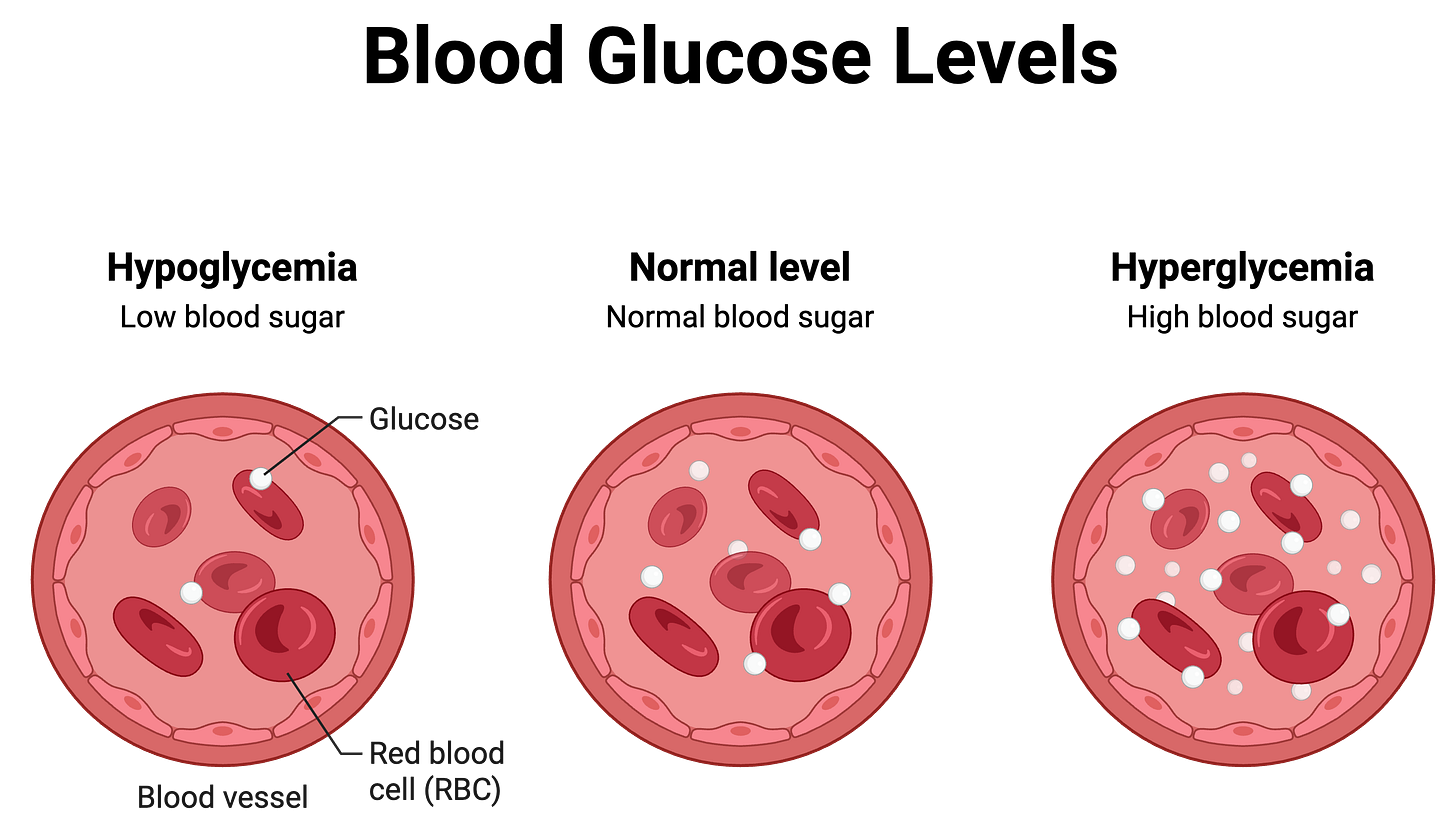
Elevated glucose does contribute to higher plasma viscosity—basically, blood becomes thicker and flows less easily. Think of it like adding sugar to water: pure water flows freely, but a sugar solution becomes progressively more viscous as you add more sugar. Research shows that blood viscosity can increase approximately threefold under certain pathological conditions. Not quite treacle, but definitely not ideal.
2. Red Blood Cell Deformability (This One’s Crucial)
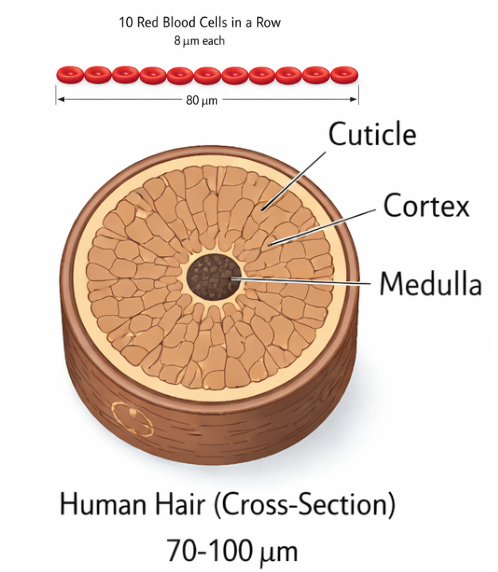
Your red blood cells need to be remarkably flexible. They’re about 8 micrometres in diameter, but they need to squeeze through capillaries that are only 3-4 micrometres wide. To do this, they have to fold and deform like a gymnast squeezing through a tight space.
Chronically elevated glucose impairs this ability. The cells become more rigid, less able to change shape, and consequently, blood flow becomes less efficient. It’s like trying to push a tennis ball through a drinking straw versus a deflated balloon—one of these is going to flow much more easily.
Created in https://BioRender.com
3. Glycation (The Long-Term Problem)
Glucose binds to proteins in a process called glycation—this is exactly what HbA1c measures (although the calculation method makes it unreliable). When glucose binds to haemoglobin and other proteins in red blood cell membranes, it alters their properties permanently. The cells become less flexible, their membranes become stiffer, and their lifespan is often reduced.
This is cumulative damage. Every time glucose bumps into a protein and decides to stick around, it’s making permanent modifications that affect function. It’s why the fructosamine assay is such a useful marker—it’s literally measuring how much of your haemoglobin has been “sugar-coated” over the past three weeks.
4. Platelet Activation
Hyperglycaemia increases platelet aggregation—meaning your platelets are more likely to clump together and form clots. This isn’t just about making blood “stickier,” it’s about making it more prone to forming thrombi (clots) in places you definitely don’t want them.
Created in https://BioRender.com
So, Is Blood “Sticky”?
In colloquial terms, yes—elevated glucose makes blood flow less efficiently, increases viscosity, reduces red blood cell flexibility, and promotes clotting. “Sticky” is a reasonable layman’s term for a complex set of rheological changes that all point in the same direction: worse blood flow.
Stephen Thomas BSc (Hons) Substack is a reader-supported publication. To receive new posts and support my work, consider becoming a free or paid subscriber.
The “Damaging Sugar” Claim: What’s Actually Happening?
Right, so sugar affects how blood flows. But what about the claim that it’s “damaging”? This is where we need to think about mechanisms.
Direct Damage Mechanisms
Glycation (Again)
We’ve already mentioned glycation, but it’s worth emphasising that this happens to all proteins, not just haemoglobin. Glucose can glycate proteins in vessel walls, enzymes, structural proteins—you name it. These glycated proteins (called Advanced Glycation End Products or AGEs) can trigger inflammatory responses, generate free radicals, and impair normal cellular function.
Think of it like this: imagine you’re a protein trying to do your job, and someone keeps supergluing random objects to you. Eventually, you’re not going to function very well, are you?
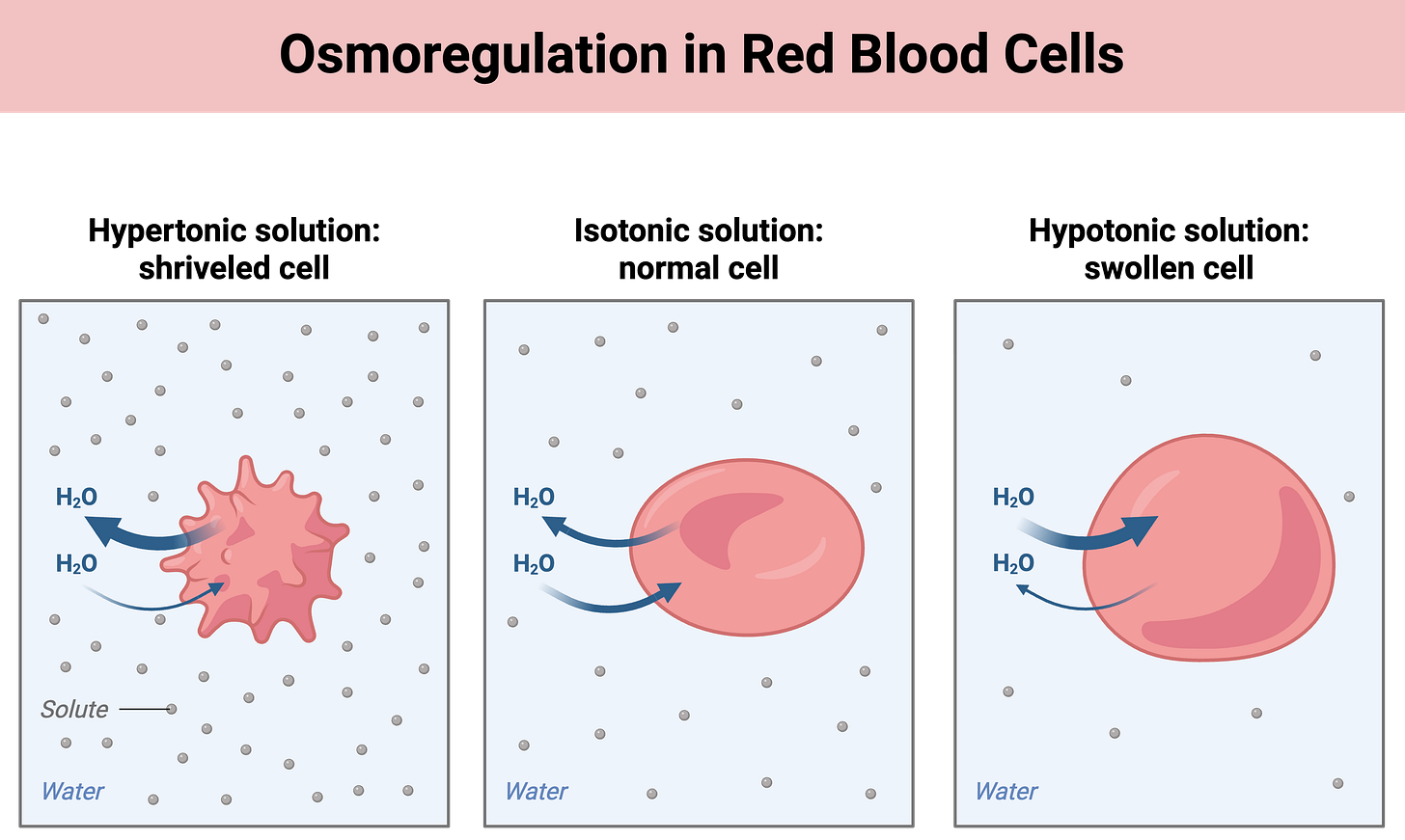
Osmotic Stress
High glucose levels create osmotic stress on cells. Water follows glucose (osmosis), which can cause cells to swell or shrink inappropriately. In the endothelial cells lining your blood vessels, this can disrupt tight junctions and barrier function.
Indirect Damage: The Mechanical Component
Here’s where it gets really interesting, especially considering your work with the thrombotic theory and Subbotin’s research on the vasa vasorum.
The combination of impaired blood rheology (from glucose) and altered flow dynamics (from blood pressure) creates mechanical stress on vessel walls. And this is where the physics of turbulence becomes critical.
Created in https://BioRender.com
Blood Pressure, Turbulence, and the Sixteen-Fold Mystery
Someone recently mentioned to me that if blood pressure doubles, turbulence increases sixteen-fold. My immediate reaction was: “That’s oddly specific. Is that actually true?” So let’s dig into the physics.
Reynolds Number: The Gatekeeper of Chaos
There’s a dimensionless number in fluid dynamics called the Reynolds number (Re) that predicts when flow transitions from laminar (smooth, orderly) to turbulent (chaotic, swirling) .
Laminar flow is like cars driving in neat lanes on a motorway—everyone stays in their lane, flowing smoothly in the same direction.
Turbulent flow is like a car park during the Boxing Day sales—chaotic movement in all directions, with unpredictable swirls and eddies.
In healthy blood vessels, flow is typically laminar because Reynolds numbers are relatively low. But at narrowings (stenoses), branch points (bifurcations), or with elevated blood pressure and flow velocity, turbulence can occur .
The Velocity-Turbulence Relationship
Here’s where the maths gets interesting:
Reynolds number is proportional to flow velocity. So if flow velocity doubles, Reynolds number doubles. Simple enough.
But turbulent kinetic energy doesn’t scale linearly with velocity. Oh no, that would be far too straightforward. Instead, turbulent kinetic energy scales approximately with velocity squared (v²) .
And for certain turbulent parameters—like turbulent shear stress or turbulent dissipation—the relationship can be even steeper, scaling with v³ or even v⁴ depending on the flow regime.
The Sixteen-Fold Claim
If we assume that doubling blood pressure roughly doubles flow velocity (this is a simplification, but bear with me), and if turbulent shear stress scales with v⁴, then:
2⁴ = 16
So a doubling of flow velocity could theoretically lead to a sixteen-fold increase in certain turbulent parameters. This is particularly relevant for turbulent shear stress on vessel walls—the mechanical force that can damage endothelial cells.
Now, I should note that most blood flow in healthy vessels remains laminar even at elevated pressures . But at vulnerable sites—branch points, areas of previous damage, stenoses—the potential for turbulence and the associated mechanical stress increases dramatically with elevated blood pressure.
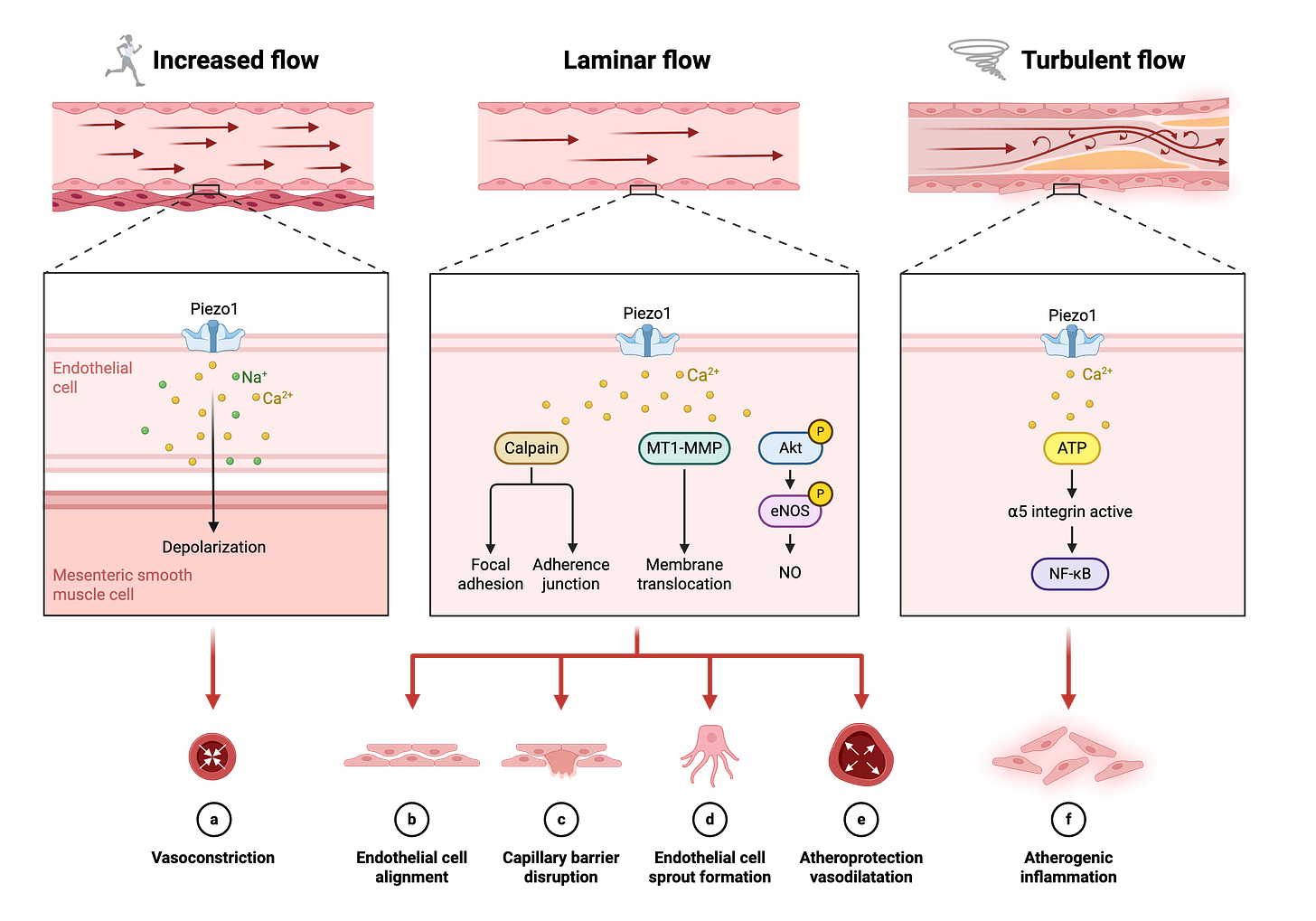
Created in https://BioRender.com
Piezo1 is a mechanosensitive ion channel found on endothelial cells, acting as a biological “sensor” for changes in blood flow.
When blood flow increases, Piezo1 detects the mechanical force and triggers a calcium influx, which in turn helps regulate vascular tone, blood pressure, and endothelial responses.
It plays a crucial role in flow-mediated vasodilation, ATP release, and overall vascular health, connecting blood flow dynamics to cellular behaviours in the vessel wall
Why This Matters: The Mechanical Damage Theory
Turbulent flow creates several problems:
Higher and more chaotic shear stress on vessel walls
Endothelial cell dysfunction from random directional forces
Potential damage to the vasa vasorum (the tiny blood vessels that supply the vessel wall itself) from mechanical stress
Increased likelihood of thrombus formation in areas of flow separation
From the perspective of the thrombotic theory—and particularly Subbotin’s work on the vasa vasorum—this mechanical component is crucial. If turbulent flow damages the vasa vasorum, it compromises the blood supply to the vessel wall itself, potentially triggering the healing response that leads to plaque formation.
The Perfect Storm: Glucose + Blood Pressure
Now imagine combining these factors:
You have elevated glucose, which:
Increases blood viscosity
Reduces red blood cell flexibility
Promotes platelet aggregation
Directly damages proteins through glycation
And you have elevated blood pressure, which:
Increases flow velocity
Dramatically increases turbulent potential (possibly sixteen-fold for certain parameters)
Creates mechanical stress on vessel walls
Potentially damages the vasa vasorum
It’s like trying to push treacle through a kinked garden hose at high pressure. Something’s going to give, and it’s usually the hose—or in our case, the vessel wall and its supporting blood supply.
A Practical Example: The Type 2 Diabetes Patient
Let me give you a real-world scenario that ties this all together.
Meet John (fictional, but representative):
Type 2 diabetes, poorly controlled
Fasting glucose: 9.5 mmol/L (171 mg/dL)
HbA1c: 8.2% (66 mmol/mol)
Blood pressure: 155/95 mmHg
Taking metformin, but diet is high-carbohydrate
What’s happening in John’s circulation?
His chronically elevated glucose is:
Increasing his blood viscosity by perhaps 50-100%
Reducing his red blood cell flexibility, making them struggle to squeeze through capillaries
Glycating proteins throughout his body, including vessel walls
Promoting platelet aggregation
His elevated blood pressure is:
Increasing flow velocity in his arteries
Creating turbulent flow at vulnerable sites (coronary arteries, carotid bifurcations, renal arteries)
Generating mechanical stress on endothelial cells that could be 8-16 times higher than normal
Potentially damaging the vasa vasorum
The combination creates a cascade of endothelial dysfunction, inflammatory responses, and mechanical damage that sets the stage for atherosclerosis through the thrombotic mechanism.
Now, John switches to a low-carb or carnivore approach:
Within weeks:
His fasting glucose drops to 5.2 mmol/L (94 mg/dL)
His HbA1c trends downward (though this takes 3 months to fully reflect changes)
His blood pressure improves to 130/90 mmHg
His blood viscosity normalises
His red blood cells regain flexibility
His platelets are less “sticky”
The turbulent stress on his vessel walls drops dramatically
This is the mechanical explanation for cardiovascular benefit that goes well beyond lipid profiles. We’re literally changing the fluid dynamics and rheological properties of the blood itself.
Interpreting This in the Context of Low-Carb and Carnivore
(Important caveat: Interpreting bloods in the context of a carnivore or ketogenic way of eating is crucial.)
When you see someone’s glucose normalise, their HbA1c drop, and their blood pressure improve on a low-carb approach, you’re not just seeing numbers change—you’re witnessing a fundamental shift in blood rheology and flow dynamics.
The reduced glucose load means:
Better blood flow properties
Less glycation damage
Reduced platelet activation
Less potential for turbulent-induced endothelial damage
This aligns perfectly with the thrombotic theory and provides a mechanical explanation for why so many of my clients see dramatic cardiovascular improvements that their doctors can’t quite explain by looking at lipid panels alone.
I’ve worked with over a thousand people now who’ve adopted ketogenic or carnivore approaches, and the reversal of Type 2 diabetes is genuinely remarkable. But it’s not magic—it’s physics and physiology working in your favour.
Final Thoughts: From Sticky Blood to Smooth Sailing
So yes, glucose does make blood “sticky”—or more accurately, it impairs blood rheology in multiple ways that reduce flow efficiency and promote clotting. And yes, sugar in the blood is damaging—through both direct mechanisms (glycation, osmotic stress) and indirect mechanical effects (when combined with elevated blood pressure to create turbulent chaos).
The influencers making jazz hands weren’t entirely wrong. They just weren’t showing you the full picture.
Understanding these mechanisms matters because it shows us exactly why reducing glucose makes such a profound difference. It’s not just about preventing glycation damage—it’s about optimising the fundamental fluid dynamics of your circulatory system. You’re quite literally making your blood flow better.
And if the thrombotic theory is correct (which I’m increasingly convinced it is), then protecting the vasa vasorum from mechanical stress might be one of the most important things we can do for cardiovascular health. Normalising glucose and blood pressure through dietary intervention achieves exactly this.

Thank You
I find it genuinely humbling that approximately 2,500 of you read these articles daily. When I started writing, I thought maybe a handful of colleagues might occasionally glance at them. The reality has been beyond my wildest expectations.
What makes this even more rewarding is that it’s become a conversation rather than a monologue. The replies, the comments, and especially the brilliant people in my Common Sense Carnivore group keep coming up with topics that make me think, research, and write. This article came directly from questions raised in the group, and honestly, some of the best ideas come from all of you.
So thank you. Thank you for reading, for engaging, for questioning, and for being part of this growing community of people who believe in common sense, joined-up thinking, and actually understanding the mechanisms behind health claims.
If you’d like to join the conversation, you’ll find us at the Common Sense Carnivore group. And if you’re looking for one-to-one support, you can book consultations through my website.
Keep questioning. Keep learning. And remember: your blood doesn’t have to be sticky—it just needs the right fuel.
Stephen
P.S. — If anyone can find the actual source for the sixteen-fold turbulence claim, please send it my way. I love a good physics rabbit hole, and I’m convinced there’s a fluid dynamics paper somewhere that explains it perfectly. Until then, I’m satisfied that the maths checks out even if I can’t cite the original source! I have done my best below…
1. Reduced Red Blood Cell Deformability and Elevated Blood Viscosity in Diabetes
Erythrocytes in patients with type 2 diabetes show reduced ability to deform and increased viscosity, which impairs blood flow and supports the “sticky blood” concept.
Read: Modeling of Biomechanics and Biorheology of Red Blood Cells in Diabetes (Chang et al., 2017)
2. The Effect of Hyperglycaemia on Blood Rheology
Diabetes alters both plasma and red cell rheology, leading to higher blood viscosity and impaired microcirculation. Read: The Effect of Diabetes on Blood Flow Properties (McMillan et al., 1983)
3. Empirical Study on Blood Viscosity in Type 2 Diabetes Mellitus
Blood viscosity, haematocrit, and red cell deformability interplay in type 2 diabetes, confirming that hyperglycaemia promotes “thicker” blood. Read: Blood Viscosity in Subjects With Type 2 Diabetes Mellitus (Sun et al., 2022)
4. Computational and Patient-Specific Modelling of Blood Rheology in T2DM
Advanced modelling demonstrates altered blood flow properties and viscosity in diabetic patients. Read: In silico modeling of patient-specific blood rheology in type 2 diabetes mellitus (Han et al., 2023)
5. Endothelial Dysfunction and Advanced Glycation End Products
AGEs from chronic hyperglycaemia directly mediate endothelial dysfunction, a key factor in vascular disease. Read: Endothelial Dysfunction and Advanced Glycation End Products (CORDIOPREV Study)
6. Impact of AGEs on Vascular Dysfunction
AGEs induce vascular dysfunction via nitric oxide resistance and suppression of endothelial NO synthase. Read: Impact of Advanced Glycation End Products in Cardiovascular Disease
7. Hyperglycaemia-Induced Platelet Activation
Acute hyperglycaemia triggers enhanced platelet activation, increasing the risk of clot formation. Read: Hyperglycemia-Induced Platelet Activation in Type 2 Diabetes
8. Shear Stress and its Role in Atherosclerosis
Disturbed (turbulent) flow and abnormal shear stress are site-specific triggers for atherosclerosis development. Read: Flow Shear Stress and Atherosclerosis: A Matter of Site Specificity
9. Turbulent Flow Patterns in Physiologic Blood Flow
Turbulent flow can exist in physiological and pathological states and increases greatly with velocity—underpinning the point about pressure and turbulence. Read: Physiologic blood flow is turbulent (Nature, 2020)
10. Critical Reynolds Number and Turbulence in Blood Vessels
When Reynolds number exceeds critical levels, laminar flow transitions to turbulence, requiring significantly more energy and stressing vessel walls. Read: Turbulent Flow - Cardiovascular Physiology Concepts