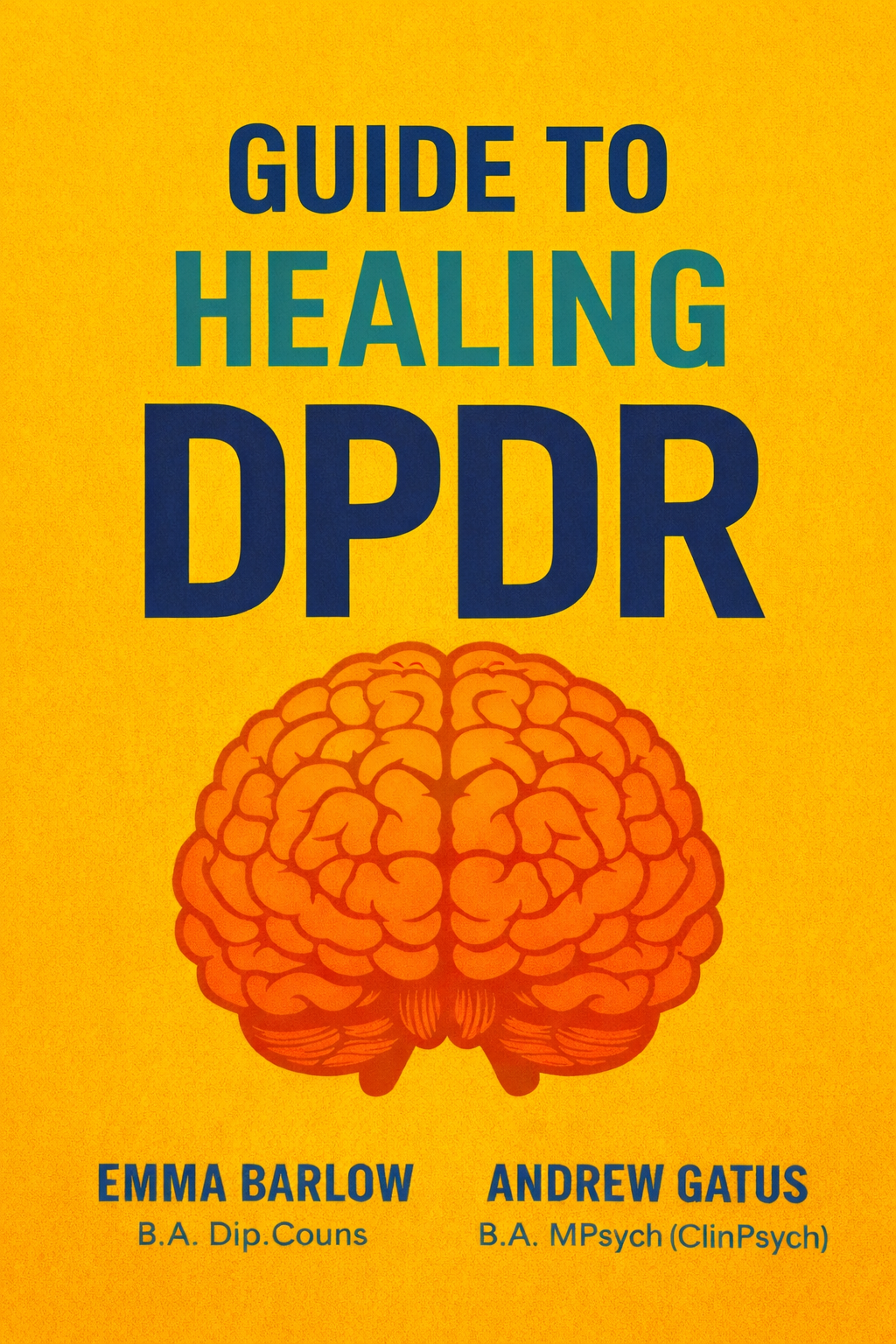

Struggling With DPDR? Here’s What You’ll Learn in our Guide To Healing DPDR book!
Grab it here: https://buymeacoffee.com/therapy_em/e/546246 (for immediate download).
If you’ve been living with depersonalisation-derealisation disorder (DPDR), you’ve probably spent hours searching for answers.
You might have read countless recovery stories, watched videos, tried different techniques and searched online for reassurance that what you’re experiencing is normal. Perhaps you understand some of the theory behind DPDR, but you’re still left wondering: How do I actually get better?
What if, instead of piecing together information from countless different sources, you had a guide to help you understand what’s happening, recognise the patterns that may be keeping you stuck, and learn practical ways to approach your recovery?
That’s exactly why we’re wrote The Psychologist’s Guide to Healing DPDR.
Written by clinical psychologist Andrew and clinical counsellor Emma (me) of The Life Clinic, this book is designed to help you move beyond simply understanding DPDR symptoms and towards understanding the recovery process itself.
Whether you’re newly experiencing DPDR or have been struggling with it for years, our aim is to give you a clearer framework for making sense of your experience, practical strategies to explore, and a more hopeful perspective on what moving forward can look like.
Because you deserve more than spending another evening searching the internet, wondering whether you’ll ever feel like yourself again.
1. Finally understand what’s happening to you - and why
One of the most distressing aspects of DPDR is not knowing how to interpret what you're experiencing.
Feeling disconnected from your body, emotions, thoughts or surroundings can be incredibly unsettling. The world might look dreamlike, your reflection might feel unfamiliar, or you might struggle to connect with people you love in the way you once did.
When you don't understand these experiences, it's easy to become frightened by them. You might start questioning your sanity, analysing every sensation or worrying that something has permanently changed.
Our book aims to help you make sense of these experiences rather than continue navigating them in fear.
You'll be guided towards a clearer understanding of DPDR, the role anxiety and stress can play, and why symptoms can become so distressing when you don't know how to interpret them.
Understanding what's happening doesn't automatically make every symptom disappear, but it can give you a much stronger starting point for approaching recovery.
Instead of feeling as though you're constantly fighting an experience you don't understand, you can begin working with a clearer picture of what you're dealing with.
2. Discover the patterns that might be keeping you stuck
Have you ever noticed yourself checking whether you feel real, testing your emotions, analysing your surroundings or repeatedly asking yourself whether your symptoms have improved?
Perhaps you wake up and immediately assess how disconnected you feel. You might spend the day monitoring your thoughts and sensations, only to become more anxious when you notice that things still feel strange.
These behaviours often develop because you're desperately trying to feel better. Unfortunately, repeatedly monitoring symptoms, seeking reassurance and treating every unfamiliar sensation as a problem can sometimes reinforce the cycle of fear and attention surrounding DPDR.
Recognising these patterns can be a turning point in how you approach recovery.
In The Psychologist’s Guide to Healing DPDR, we aim to help you understand the processes that may be contributing to your ongoing distress and explore ways to respond differently.
This is an important distinction: learning about DPDR is one thing, but learning to recognise your own patterns and change how you respond to them is where that understanding can begin to become useful in everyday life.
If you've been stuck in a cycle of analysing, checking and searching for reassurance, this is exactly the kind of understanding that can help you start approaching things differently.
3. Learn practical ways to approach your recovery
Knowing that DPDR is associated with anxiety or stress doesn't necessarily tell you what to do when you're experiencing symptoms at 2 am, struggling to concentrate at work or feeling disconnected while spending time with your family.
You need to know how to apply what you've learned to your actual life.
That's why we want this book to go beyond explaining DPDR. We want to help readers understand how psychological concepts translate into practical steps they can explore throughout their recovery journey.
This includes developing a better understanding of your responses to symptoms, recognising unhelpful thought and behavioural patterns, and learning how to gradually redirect your attention towards everyday life rather than allowing DPDR to dominate it.
Rather than relying on a single technique or expecting one exercise to fix everything, the goal is to develop a more comprehensive understanding of recovery and the different factors that may influence it.
If you've ever thought, "I understand what DPDR is, but I still don't know how to get out of it," this book is being written with that very question in mind.
Yes I need to get the book now: https://buymeacoffee.com/therapy_em/e/546246
4. Understand why recovery involves more than changing your thoughts
One aspect of recovery I'm particularly passionate about is the connection between our psychological experiences and our physical wellbeing.
In my own experience recovering from DPDR, practices such as yoga, meditation and breathwork were valuable tools that I used as part of my broader recovery journey.
I believe it's important to consider how we support ourselves physically as well as psychologically, particularly when stress and anxiety are part of the picture.
Research has explored mind-body approaches for a range of stress-related difficulties, and these practices may complement psychological strategies for some people. They aren't a guaranteed cure for DPDR, but they can be worthwhile tools to understand and explore.
Our approach recognises that recovery isn't necessarily about thinking your way out of every uncomfortable experience. It can also involve learning how to relate differently to your body, respond to stress and build supportive daily habits.
The aim is to help you consider the bigger picture, rather than feeling that you're failing because one breathing exercise, meditation or positive thought hasn't made your symptoms disappear.
5. Stop feeling as though you're supposed to solve DPDR overnight
When you're desperate to feel normal again, it's understandable to want immediate results.
You might try a new strategy, spend the next few hours checking whether it has worked, and feel discouraged when you're still experiencing symptoms.
You might move from one recovery method to another, wondering whether you've finally found the missing piece.
This constant search for certainty can become exhausting in its own right.
Recovery deserves a more sustainable approach than repeatedly searching for the next thing that might make your symptoms disappear.
Our book aims to help you develop a clearer understanding of the recovery process, including the importance of patience, consistency and learning to respond differently to difficult experiences.
This doesn't mean forcing yourself to tolerate everything or following a rigid routine regardless of your needs. It means developing a more informed approach that allows you to practise new skills without expecting every attempt to produce an immediate change.
When you understand the broader process, you can begin to spend less energy chasing instant reassurance and more energy applying what you've learned.
6. Start reclaiming the parts of life DPDR has taken up space in
Perhaps you've stopped doing things you once enjoyed because you feel too disconnected.
Maybe you struggle to be present with your partner, find it difficult to concentrate at work, avoid social situations or feel as though you're simply watching your life pass by.
When DPDR has been present for a long time, it can be easy to make everything dependent on feeling normal again.
You might tell yourself you'll start enjoying life when your emotions return, when your surroundings feel real or when you finally wake up without symptoms.
But this can leave you feeling as though your life is on hold.
Part of recovery can involve gradually re-engaging with meaningful activities, relationships and experiences, even while you're still working through uncomfortable symptoms.
In our book, we want to help readers understand how they can begin moving towards a life that isn't organised entirely around DPDR.
Because the goal isn't simply to spend your days checking whether you feel normal. It's to have more freedom to focus on the people, activities and experiences that make life meaningful to you.
7. Find a more informed and hopeful way forward
If you've had DPDR for months or years, you might have started to wonder whether your situation is different from everyone else's.
Perhaps you've read stories about people recovering quickly and felt discouraged because your experience hasn't followed the same path.
Maybe you've tried different approaches without finding the answers you were hoping for.
We want you to know that struggling for a long time doesn't mean you are beyond help. DPDR can be complex, and recovery varies from person to person, but there are meaningful ways to understand your experience and seek appropriate support.
The Psychologist’s Guide to Healing DPDR is being developed to bring together psychological understanding, practical guidance and a broader perspective on the recovery process in one place.
Rather than promising a quick fix, we want to help you understand what you're experiencing, identify areas you can work on and feel better equipped to take your next steps.
If you're tired of feeling confused, overwhelmed or unsure what to do next, our hope is that this book will give you a more structured and useful place to begin.
Is this book right for you?
This book may be particularly helpful if you're someone who:
Has been experiencing DPDR and wants to understand it beyond the symptoms.
Feels caught in a cycle of checking, analysing or seeking reassurance.
Understands some of the theory but struggles to apply it to everyday life.
Wants to explore practical psychological approaches to recovery.
Is interested in the relationship between anxiety, stress and the mind-body connection.
Has tried different strategies and wants a more coherent framework for understanding the recovery process.
Wants to stop allowing DPDR to dictate so much of their attention, decisions and daily activities.
You don't need to have all the answers before you start. In fact, the book is being developed for people who are looking for a clearer understanding of where to begin and how to move forward.
It is intended as an educational resource to complement appropriate professional support.
Your life doesn't have to revolve around DPDR forever
When you've been experiencing DPDR, it's understandable that recovery becomes the thing you think about most.
You want to feel connected again. You want to stop questioning your experiences. You want to enjoy the people you love without constantly monitoring how you feel.
And you want to know that the effort you're putting into recovery is actually taking you somewhere.
That's why we're writing The Psychologist’s Guide to Healing DPDR.
We want to help you move beyond simply collecting information about your symptoms and towards developing a clearer understanding of the patterns, skills and approaches that may support your recovery.
You may have spent a long time searching for answers, and we can't promise that a book will solve everything. But the right information can help you make sense of your experience, approach recovery more constructively and take more informed steps towards change.
If you're ready to understand DPDR more deeply and learn how to approach your recovery with greater clarity, this book was written with you in mind.
You deserve to understand what you're experiencing. You deserve access to practical, thoughtful guidance. And you deserve the opportunity to build a life that feels bigger than DPDR.
We hope The Psychologist’s Guide to Healing DPDR can be part of that journey.
Learn more about The Psychologist’s Guide to Healing DPDR and stay connected with The Life Clinic for updates on ways we can support you.
Emma, Clinical Counsellor, and Andrew Gatus, Clinical Psychologist
The Life Clinic
Get your copy RIGHT NOW here: https://buymeacoffee.com/therapy_em/e/546246