
A Practical Evolution of August Bradley’s PPV Framework
Most productivity systems stop at the level of goals or projects.
August Bradley’s PPV System changed that by introducing a layered, interconnected structure that aligns your daily actions with your highest aspirations.
But for many creators, consultants, and digital entrepreneurs, one layer is still missing:
Tasks.
The atomic units of progress.
The real drivers of execution.
That’s why I expanded the PPV chain into a fully operational model:
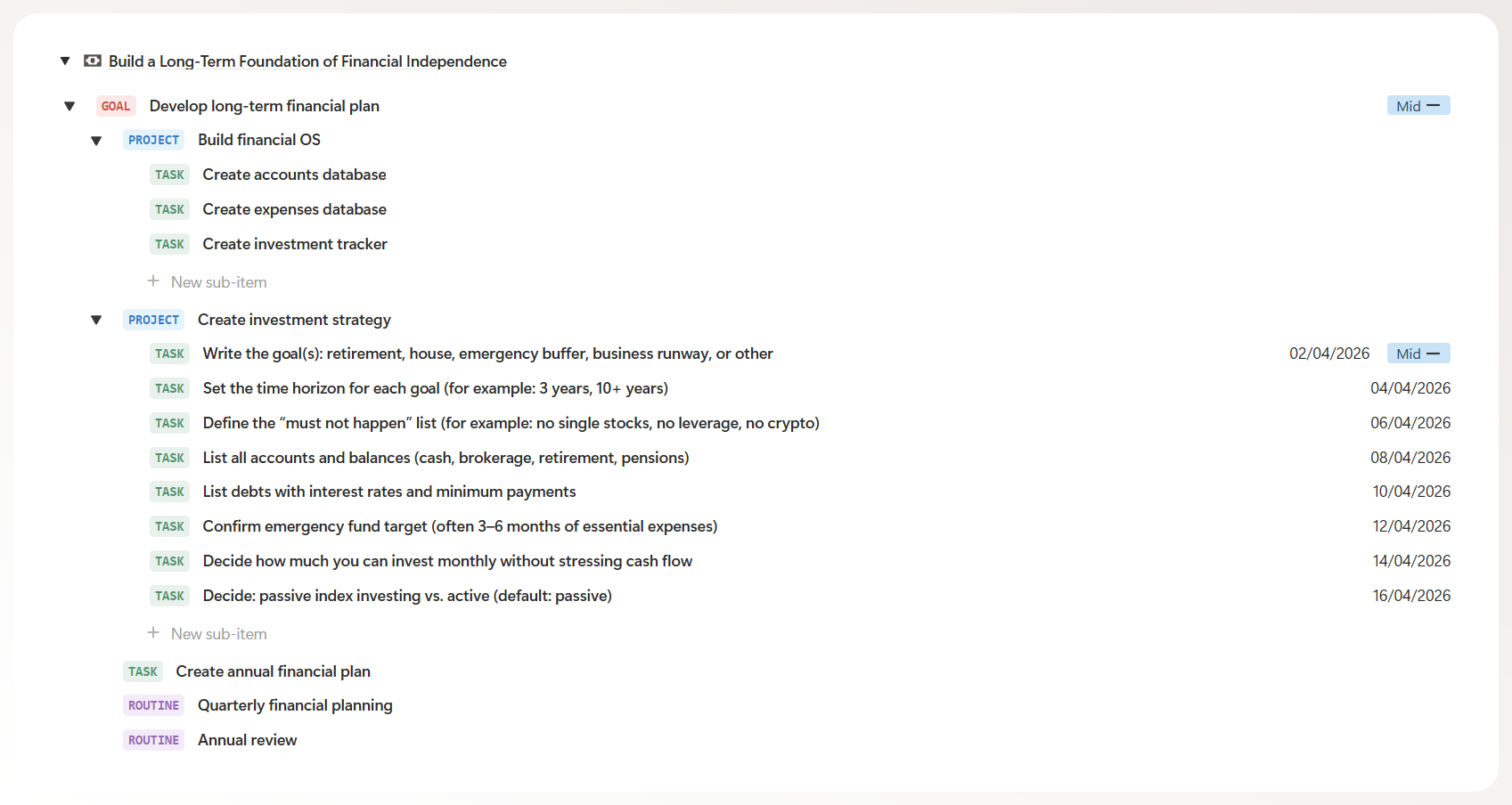
Life Aspirations → Goals → Projects → Routines → Tasks
A complete execution hierarchy designed for clarity, momentum, and long‑term alignment.
🎯 1. Goals: The 1–3 Year Outcomes
Goals define the direction of your life and business.
They are ambitious, measurable, and identity‑driven.
Examples from my system:
Become a leading architect of digital clarity
Build a sustainable Notion‑based business
Create a body of work that educates and elevates
Live a location‑flexible, autonomy‑driven lifestyle
Master multilingual communication as a strategic advantage
Maintain a high‑clarity, high‑energy mindset
Build a long‑term foundation of financial independence
Goals give meaning to everything that follows.
🧩 2. Projects: The Time‑Bound Initiatives
Projects are the vehicles that move goals forward.
They have a clear start, end, and outcome.
Examples:
Build a flagship Notion template
Create a multilingual terminology library
Produce a 10‑video tutorial series
Build a consulting onboarding system
Create a personal operating system in Notion
Build a financial OS
Projects turn goals into tangible progress.
🔁 3. Routines: The Identity‑Shaping Behaviors
Routines (your version of habits) are ongoing systems that maintain momentum and consistency.
Examples:
Weekly content production
Morning clarity routine
Weekly revenue tracking
Monthly brand consistency review
Translation QA routine
Weekly deep work block
Routines ensure that progress is not episodic — it becomes part of who you are.
✔ 4. Tasks: The Atomic Units of Execution
This is where the system becomes truly actionable.
Tasks are the smallest, clearest, most concrete steps you can take.
Every Project and every Routine contains Tasks such as:
Project Tasks
Outline the template architecture
Build database relations
Write the script for tutorial #1
Create multilingual landing page
Build CRM stages
Design icon set
Routine Tasks
Review weekly goals
Update revenue dashboard
Translate new terminology
Publish weekly tutorial
Run template QA checklist
Perform weekly declutter
Tasks are the bridge between intention and action.
They are the reason this system works.
🧠 Why This System Works So Well
Because it creates vertical alignment:
Every Task supports a Routine or Project
Every Routine or Project supports a Goal
Every Goal supports a Life Aspiration
Nothing is random.
Nothing is wasted.
Everything flows upward.
This is the missing piece in most productivity systems — a clear, traceable path from your daily actions to your long‑term identity.
🏛 The Database Structure (G/P/R/T All‑In‑One)
Your Notion system now contains:
Life Aspirations (identity‑level direction)
Goals (1–3 year outcomes)
Projects (time‑bound initiatives)
Routines (ongoing behaviors)
Tasks (actionable steps)
All connected.
All relational.
All flowing through your Pipelines and Pillars.
This is a premium, enterprise‑grade execution system — built for creators, consultants, and digital entrepreneurs who want clarity, structure, and long‑term alignment.
🚀 Conclusion
Inspired by August Bradley’s PPV System, this expanded G/P/R/T model brings execution to the forefront.
It transforms your aspirations into daily action — without losing the depth, intentionality, or structure that PPV is known for.
This is the system I use to run my business, create content, build templates, and design a location‑flexible lifestyle.
And it works.