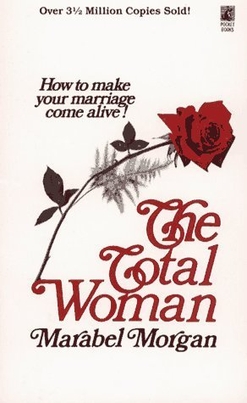

Recently I went to a thrift store that sold paperback books for 50¢ each. I found a 1973 piece of anti-feminist propaganda called The Total Woman: How to Make Your Marriage Come Alive by Marabel Morgan. I knew it was going to be incredibly toxic when I bought it, and so you may be wondering why I bought this book and read it. The simple answer is: I think this particular type of anti-feminist propaganda is incredibly fascinating.
The late 1960s and the early 1970s was a time of a lot of developments and wins for feminists. In 1964 Title VII of the Civil Rights Act passed, which prohibited employers from discriminating based on race, color, religion, national origin, or sex. In 1968, the executive order 11246 was passed, which prohibited sex discrimination by government contractors and requires affirmative action plans for hiring women. In 1969, California adopted the nation’s first “no fault” divorce law. In 1972 Title IX of the Education Amendments was passed, prohibiting sex discrimination in all aspects of education programs that receive federal support. In 1973, Roe v. Wade was passed, which legalized abortion and created a basis for medical privacy concerning topics like abortion. For the first time in American history, women were getting federally protected economic and sexual power, which opened up a lot of new options for us.
As women were able to safely leave their abusive husbands because they now had money, bank accounts, and the legal right to divorce, many conservative organizations and individuals felt that this was a direct attack on the "traditional" family structure. "Traditional family structures," in their view, consisted of a stereotypical masculine man leading the house, while a stereotypical feminine wife stayed home and did all the household chores. The best woman in this mindset was one who never complained, who always had everything together, and who didn't mind being a subordinate to men. In these fascist and conservative viewpoints, women holding any ability to support herself actively hurt men and "good Christian values." So, enter Marabel Morgan, a woman who was a bubbly personality and submissive housewife and the perfect "foil" to the "mean" feminists.
Morgan's whole philosophy outlined in the Total Woman book and education program was that a wife should ignore her husband's faults and only focus on his positives, like how attractive her husband is. A woman should never "nag" her husband, and, in fact, should drop everything she is doing whenever her husband asks her to do anything. Women, according to Morgan, were not able to adequately lead a household and were fundamentally different than men (a main difference being women were predestined by God to follow men). Men were the leaders of the household, and women were only good at "feminine" things, like being emotional. Men were the ones who made money, women stayed home and cared for the home.
The irony of this is, of course, that by this book and program, Morgan made her family money. Writing and presenting her philosophy was her job. Charlie Morgan, Marabel's husband, is not well known enough to have a Wikipedia page, and Marabel is. But so it goes with these sorts of things. The trad wife grifter will insist that all women should stay home and give up their power to men, and by doing so gains economic power herself.
What surprised me most about the book is how very obvious it is that this exaggerated gendered submission is not so much a Godly ordained commandment, but rather a sexual kink. The Total Woman is most known, and mocked, in popular culture because of Morgan's suggestion that the wife dress up in costumes to greet her husband. She specifically suggests a "cowgirl" or a "showgirl" and says that her own costumes have gotten progressively "less and less conservative over the years." In addition, despite the fact that so much of what Morgan says is extremely regressive, she makes a point to emphasize that women should be orgasming during sex. On this point, I agree with Morgan. Women should be just as likely as men to orgasm during sex, but the fact that she emphasized this in the middle of her book about how men shouldn't be critiqued at all, just further reinforces my theory that all of her book is more an exploration of a sexual fantasy/kink than an actual self help.
While this book is extremely outrageous at parts and therefore easy to mock, there are some genuinely disturbing things that we need to talk about. The most notable one is how spanking children is seen as the "loving" thing to do. She references James Dobson's Dare To Discipline, which details a very similar style of abuse that Morgan speaks so lovingly about. Another thing I found disturbing was the fact that she... how do I put this... actively encouraged women include children in the sexual foreplay. Did she call it "sexual foreplay?" No. But I don't know how else you could describe dressing up in sexual costumes for your husband. At one point she says that her teenage son said "wow, you've been looking nice lately, I hope I find a woman like you to marry." The same abusive nonsense is found in today's "boy mom" TikTok culture. When you look at the way that Dare To Discipline talks about spanking, it is very difficult to not see it as sexual. The parent pulls down the pants, spanks the bare bottom of the child, and forces the child to hug them afterwards. Spanking in this manner is not just a form of physical abuse, it is a form of sexual abuse. The way the book encourages children to be seen as props instead of, ya know, human beings, is a terrifying aspect of this book that cannot be understated.
This sort of anti-feminist propaganda tends to pop up when we see advancements in gender equality. The notorious book Men Are from Mars, Women Are from Venus by John Gray (1992) speaks to much of the same patriarchal thinking, and it just happened to pop up around the same time as the 1986 Supreme Court case which ruled that a hostile or abusive work environment can prove discrimination based on sex, or the 1993 Supreme Court case, Harris v. Forklift System, which ruled that a victim of sexual assault did not need to show that she suffered physical or serious psychological injury as a result of sexual harassment.
Another example of this sort of propaganda is the 2009 book by Steve Harvey, Act Like a Lady, Think Like a Man: What Men Really Think About Love, Relationships, Intimacy, and Commitment. In it, Harvey details a very gendered philosophy that reinforces the false narrative that men and women's difference in personality, emotional intelligence, sex drive, and varying degrees in interests in things like love and romance are all a biological differences, rather than a social ones. This propaganda, again, came out during a time when there was a lot of developments in the feminist space. For instance, in 2003 Nevada Department of Human Resources v. Hibbs ruled that states could be sued in federal court for not upholding the Family Leave Act, and the 2010 introduction of the Affordable Healthcare Act.
Over and over again we have seen this type of propaganda pop up, especially when women are winning major battles in the fight for gender equality. And over and over again this type of propaganda does very well commercially. The Total Woman was a major best seller, Men are From Mars, Women are From Venus was a major best seller and referenced in basically every part of pop culture in the 90s, Act Like a Lady, Think Like a Man actually got a movie made based off of it. Part of the appeal of this sort of propaganda is that it actually talks to something women tend to care a lot about: love and romance and having a fulfilling romantic relationship.
A misguided stereotype of feminists is that they do not want or care about romance. This isn't the case, as bell hooks talks about in her trilogy on love. Communion: The Female Search for Love, the third installment of this trilogy, talks about how often these very regressive books can be commercial hits because they actually speak to an issue that many people, but women, specifically because of our socialization, care deeply about. bell hooks goes on to explain in Communion that feminist thinkers in the 60s and 70s often focused on economic power rather than relationship power, because economic power could be regulated. Unfortunately, many women are very progressive in the workforce, but when they got home, they went right back to that patriarchal norms, especially in the bedroom. Clearly there was a desire to talk about relationship power dynamics and how to have a successful relationship, but overwhelmingly the focus in feminist circles was not on love but rather on economic freedom (which, to be fair, creates the environment that a loving relationship can flourish).
Caring about love and romance is not embarrassing, as All About Love by bell hooks reinforces, but how we interact with this deep desire for love and acceptance can make or break us. If we think that love is as simple as not getting a divorce, we would all be stuck in loveless and abusive marriages. If we think that love is removed the second that women get any sort of power in the relationship, we weren't in love at all. Instead we were imprisoned.
We have a lot of anti-feminist propaganda being pushed on young people today. It is both the same and different from past anti-feminist propaganda. It is the same because it rehashes the same talking points as the past propaganda did. It is the same because, like the past propaganda, it is often secretly or not so secretly a kink and a fetishization of womanhood and femininity (how many of these "trad wife influencers" frame their shot to give them the most sexualized angle?). It is the same because the people behind it are the same people behind the past propaganda (evangelical white Christian churches, primarily, though there are obviously others too).
The biggest reason why today's propaganda is different is due to the way it is being pushed. Yes, there are still books on this topic, but today the vast majority of the conservative and fascist anti-feminist talking points are being heard online on social media. Unlike a book, which requires effort to read and requires the reader to actively go and seek it out at a bookstore or library, social media's algorithm deliver the information right to you, with very little effort on your part. You get to turn off your brain and just allow the propaganda to take over. And unlike a book, which will eventually end, social media is an endless scroll. You will never find the bottom of the anti-feminist propaganda, because millions of posts are able to be pumped out a day. This is especially true in the age of AI.
So while the increases in anti-feminist propaganda is obviously concerning, and the way that this anti-feminist propaganda is being spread is also concerning, I don't think we should assume that the young people are "doomed" because of it. In fact, I think this anti-feminist propaganda is so commonplace because it means we will get a great revival of feminist thinking. I think the fascists are terrified of people realizing that their talking points are actually quite harmful and disliked, which is why they have to push so much propaganda. I think we will not make the mistakes of the past and assume that we can work within the system, and instead we will burn it all down and build a better world for everyone. I genuinely think I will see a better and more just world in my lifetime.
Am I delusional in my thinking? Maybe. But I also I have reasons for my delusions. Every other time we've seen a lot of anti-feminist propaganda, it was because feminists were winning. We are on the verge of a new world. As Dr. Martin Luther King Jr. once asked, Chaos or Community: Where Do We Go From Here? We have the opportunity to choose community, and, despite everything, I think we just might do that.