

Getting my head back in the game after my recent "Sabbatacle" is harder than expected, so I'm doing everything I can to get back on track for business, and Molly Keyser's Vision Board idea seems to be helping. I even made a video to show you how to make one, too:
Even though I did put thought into a real 'vision' for my board, creating it already feels like a positive exercise. When you create a Vision Board, it's like having a visual strategic document, a reminder at a glance, to stay aligned with your business goals throughout the year. I like that. It seems like a kind of shorthand for your Mission, Vision, and Values statement.
Shaping Your Vision Board
You can go about the structure and design of your board in several ways. But remember that alignment between you, your business, and defined, concrete goals is imperative.
For simplicity and clarity, pick only three things: one business goal, one lifestyle goal, and one feeling you want more of in your work. Be sure to give your Vision Board a timeline and a purpose. I created my new Vision Board with a story outline to clearly explain it. When you know what each image means, it’s much easier to take actions that actually match the vision and goals you’re working towards.
Here's a look at my Vision Board, 2026:
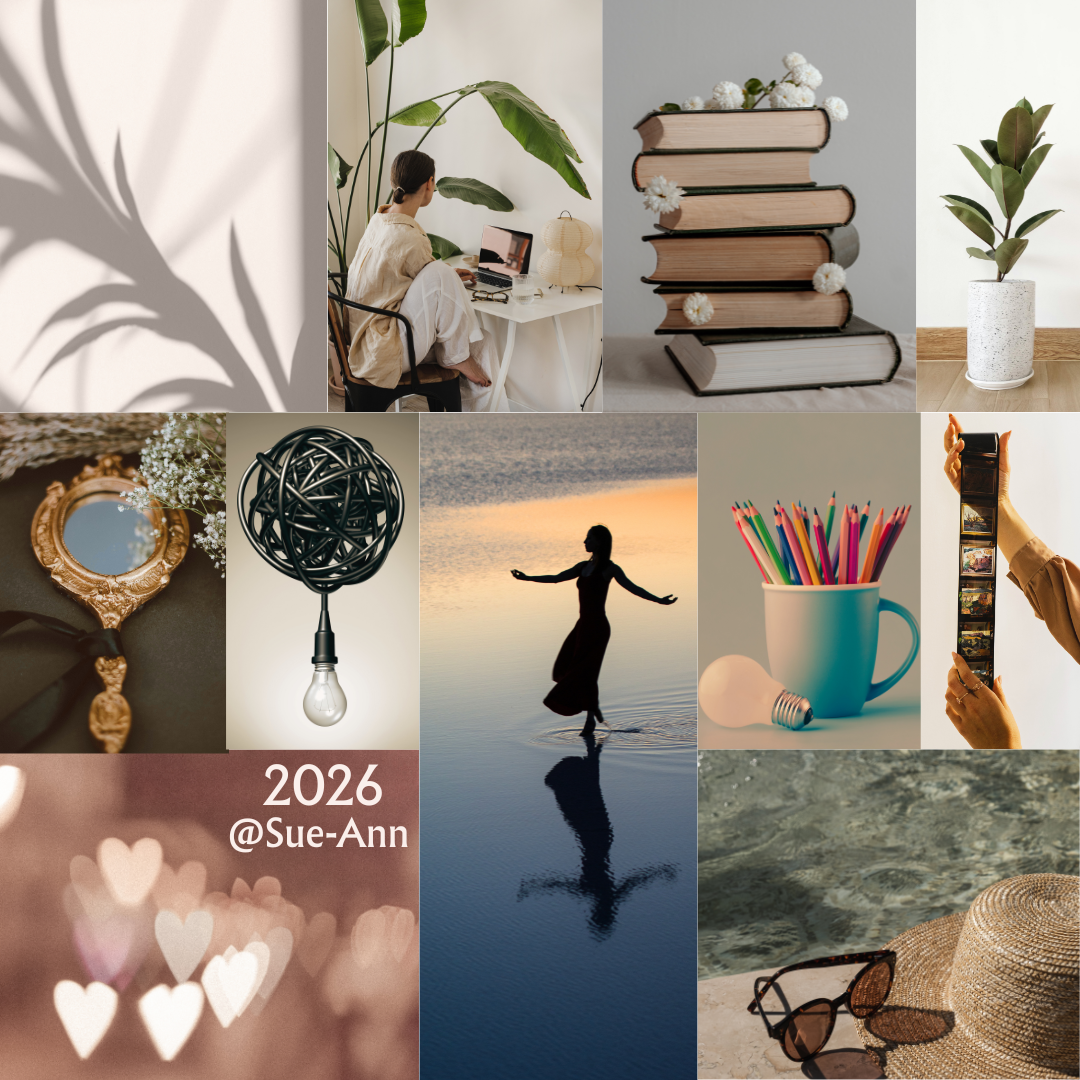 This is the simple outline to explain my board:
From top left...
I'd like to...
- come out from the shadows
- to do my thing (happy desk)
- learning (books) and
- growing (plant)
But also...
- to have the insight (mirror) to reflect, appreciate, and evolve
- as a conduit (corded light) for learning via my channel and digital business work
- I just want to feel free and breathe... (happy place water)
And, of course, it will include...
- expanding my superpowers—(writing and creativity) into
- a highly successful YouTube channel (filmstrip)
But, don't forget...
- peace, love, and respect for all people (dreamy hearts)
- and finally, eliminating panic of the future (chilling hat and shades)
Where Did the Idea of 'Vision Boards' Come From?
Well, for me, as I mentioned above, Molly Keyser was my inspiration to create a Vision Board and think about my goals for the coming year. (I can't believe I even made a video about it! lol) However, I was still curious, so I asked Perplexity for some background.
This is an outline of the History of Vision Boards by Perplexity** starting with a definition and roots:
Vision boards (collages of images/words representing desired goals or identities) are a modern, craft-friendly expression of older practices: mental imagery in healing/psychotherapy and “creative visualization” traditions that later blended with self-help and the “law of attraction.”
Deep roots: imagery practices
Imagery has a long history in psychotherapy, including early hypnosis-related approaches and later clinical methods (e.g., trauma-related imagery work and 20th‑century therapeutic techniques). In parallel, forms of guided imagery have been linked to longstanding healing/religious traditions and later modern therapeutic approaches (including psychodrama-related developments).
19th-century metaphysical backdrop
A major philosophical ancestor often associated with modern vision-board culture is the “law of attraction” idea emerging from the 19th‑century New Thought movement and its writers. These traditions emphasized mind-over-matter themes and practices resembling affirmation plus visualization (i.e., repeatedly imagining a desired state).
Late 1970s–1980s: “treasure maps” (proto–vision boards)
Collage-style goal imagery was popularized in self-help circles as “treasure mapping,” commonly attributed to author Shakti Gawain and her Creative Visualization era (described by readers as late 1970s exposure). In this framing, a “treasure map” is a physical picture/blueprint of a desired reality meant to focus attention and intention—very close to what many people now call a vision board.
1970s–1990s: visualization becomes “mainstream” in performance and health
Visualization also gained credibility in sports settings as “mental rehearsal,” with sport-psychology resources describing evidence and theories for how imagery practice can improve performance. In health and wellness publishing, guided-imagery approaches were further popularized for stress/illness contexts (for example via widely read late-1970s mind-body books).
2006–2007: mass-pop culture explosion
Vision boards (and closely related practices) reached a much larger mainstream audience with The Secret (book/film) and its promotion of the law-of-attraction message. Media amplification—such as Oprah’s involvement discussed in coverage of The Secret—helped normalize cutting/pasting goals into boards as a widely shared annual ritual.
2010s–2020s: digital tools and therapeutic reframing
In the 2010s–2020s, vision boards increasingly moved from poster board to digital canvases (e.g., online “vision board” tools and templates). In counseling and expressive-arts contexts, they’ve also been reframed less as “magic manifestation” and more as a motivational/reflective tool that can support meaning-making and behavior change.
Vision Boarding, Anyone?
Marketing Millie is also excited about Vision Boards! My excitement for her is about the latest progress with Millie, from AI lessons, and continuing to learn and experiment with AI. That's why Millie's getting new clothes, changing voices, and new movement, and scenery, etc. It's so fun, and I hope it also gets better as I learn more.
What do you think about having a Vision Board to guide and lighten you? Think about you and where you are right now. Think about your business and what you want it to be over the year, and think of the future and what’s most important to you. Giving your Vision Board a timeline and a purpose makes it more of a ‘visual strategy doc.’
Of course, making shorter-term lists and goals to achieve your vision and purpose comes into play later, but for now, we’re going a little broader. Still focused. Still meaningful. And still seeking clarity to guide your path forward.